
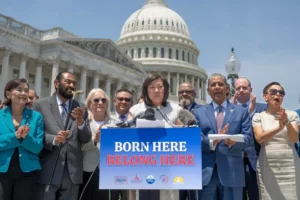
The Supreme Court delivered one of the most consequential constitutional rulings of the year this week, striking down President Trump’s attempt to end automatic birthright citizenship for children born to undocumented or temporary immigrants. The 6-3 decision, authored by Chief Justice John Roberts, reaffirmed a more than century-old understanding of the Fourteenth Amendment. The ruling marks the third major legal defeat for Trump at the nation’s highest court this year.
Story Highlights
- The Supreme Court ruled 6-3 in Trump v. Barbara that the president’s executive order ending birthright citizenship is unlawful
- Chief Justice Roberts wrote the majority opinion, joined by Justices Sotomayor, Kagan, Barrett, Kavanaugh, and Jackson
- Justices Thomas, Alito, and Gorsuch dissented, arguing the Fourteenth Amendment applied only to freed slaves and their descendants
- Trump urged Congress to pass legislation on the issue, though legal experts say such a law would likely fail under this ruling
What Happened
The Supreme Court ruled on June 30 in Trump v. Barbara that President Donald Trump’s executive order seeking to end birthright citizenship for children born in the United States to undocumented or temporarily present parents is unlawful. The 6-3 decision struck down Executive Order 14160, which Trump signed on his first day back in office in January 2025 as part of his broader immigration crackdown. The order sought to limit automatic citizenship to children with at least one parent who is a U.S. citizen or lawful permanent resident.
Chief Justice John Roberts authored the majority opinion, grounding his reasoning in the text and history of the Fourteenth Amendment’s Citizenship Clause. Roberts was joined by Justices Sonia Sotomayor, Elena Kagan, Amy Coney Barrett and Ketanji Brown Jackson in finding the order unconstitutional, while Justice Brett Kavanaugh concurred in the result on narrower statutory grounds, writing that the order violated federal immigration law rather than the Constitution itself. “Citizenship, then and now, was the right to have rights, to freely participate in our political community,” Roberts wrote, invoking the Fourteenth Amendment’s Reconstruction-era history and the Supreme Court’s 1898 decision in United States v. Wong Kim Ark, which affirmed birthright citizenship for a man born in San Francisco to Chinese immigrant parents.
Justice Clarence Thomas authored a lengthy dissent, joined by Justice Neil Gorsuch, arguing that the historical record does not support the majority’s broad reading of the amendment and suggesting it was intended primarily to secure rights for freed slaves and their descendants. Justice Samuel Alito wrote separately in dissent. Justice Ketanji Brown Jackson responded directly to Thomas’s historical argument in a concurring opinion, noting the tension between his stated commitment to a colorblind reading of the Constitution and his characterization of the citizenship clause as a race-specific remedy.
The case reached the justices after the Supreme Court’s earlier ruling limiting the power of lower courts to issue nationwide injunctions, which had initially blocked Trump’s order from taking effect anywhere in the country. Following that decision, a New Hampshire federal judge issued a narrower class-action injunction covering children affected by the policy, setting up the case that ultimately reached the high court. Trump attended the April oral arguments in person, a rare move that underscored how central the issue was to his second-term agenda. Following the ruling, Trump wrote on Truth Social that the outcome was “too bad for our Country” but claimed, incorrectly according to legal analysts, that Congress could achieve the same result through ordinary legislation.
Why It Matters
The ruling represents one of the most significant reaffirmations of constitutional text in recent memory, resolving a question that had lingered as a persistent flashpoint in American immigration politics for years. For Americans concerned with constitutional fidelity, the decision demonstrates that even a Supreme Court with a six-justice conservative majority, including three Trump appointees, will not permit executive action to override clear constitutional text when the historical and textual evidence points decisively against the government’s position.
The practical significance for American families is substantial. Had the order taken effect, it would have created a new class of children born on U.S. soil without automatic citizenship, a status that legal scholars warned could have produced generations of stateless or precariously documented individuals. The ruling preserves the long-standing principle, unbroken since the 1898 Wong Kim Ark decision, that citizenship is conferred by birthplace rather than parental status, a rule that has underpinned American nationality law for well over a century.
The decision also illustrates the limits of executive power more broadly. This marks the third major defeat for Trump’s signature second-term initiatives at the Supreme Court, following the February ruling striking down his global tariffs and a separate ruling barring him from immediately removing a sitting Federal Reserve governor. Taken together, these rulings suggest a Supreme Court willing to constrain executive overreach even while ruling favorably for the administration in other significant cases this term, including decisions on transgender athletes and temporary protected status.
Economic and Global Context
Although primarily a constitutional and immigration case, the ruling carries downstream implications for federal and state administrative systems that rely on stable citizenship rules, including Social Security enrollment, passport issuance and eligibility determinations for federal benefits programs. Had the executive order taken effect, state and federal agencies would have faced the enormous administrative burden of tracking parental immigration status at the time of every American birth, a system with no existing infrastructure and substantial projected costs.
The ruling also arrives amid broader international attention to how democracies define citizenship and manage immigration. Birthright citizenship, sometimes referred to by the Latin term jus soli, is practiced in the United States, Canada and most of the Western Hemisphere, in contrast to many European and Asian nations that confer citizenship primarily through parentage. The Supreme Court’s decision to reaffirm the American approach keeps the United States aligned with its hemispheric neighbors, even as European nations continue to debate their own citizenship frameworks amid ongoing migration pressures.
Domestically, the ruling removes a significant source of legal uncertainty for hospitals, state vital records offices and federal agencies that had been bracing for potentially contradictory citizenship determination requirements depending on where the executive order was being enforced amid the patchwork of lower court rulings that preceded the Supreme Court’s decision.
Implications
With the constitutional question now settled by the nation’s highest court, Trump’s stated hope that Congress could legislate around the ruling faces steep legal obstacles. Legal analysts, including reporting from the National Constitution Center, note that any statute attempting to narrow birthright citizenship would need to overcome the same constitutional interpretation the majority just applied, an outcome most court watchers view as unlikely to succeed given the current composition of the majority.
For immigrant families and civil liberties organizations, including the American Civil Liberties Union, which argued the case, the ruling provides durable legal certainty after more than a year of uncertainty for families who feared their children’s citizenship status could be revoked. Advocacy groups have signaled they will continue monitoring for any legislative or administrative efforts to circumvent the ruling’s core holding.
For the Trump administration, the defeat is likely to shape strategy on remaining immigration priorities, with officials expected to redirect focus toward enforcement measures and legislative priorities, including the pending SAVE America Act, that do not directly conflict with the newly reaffirmed constitutional baseline established by the Court.
Sources
“Supreme Court upholds birthright citizenship on constitutional grounds”
