
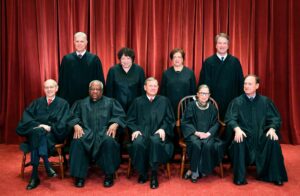
The Supreme Court of the United States heard arguments this week in a high-stakes case examining the limits of executive authority in implementing major federal regulations. At issue is whether the executive branch exceeded statutory boundaries in advancing a sweeping policy initiative without explicit congressional authorization. The case carries implications far beyond the specific regulation in dispute, potentially redefining the scope of administrative power across multiple sectors. Supporters aligned with Donald Trump argue that constitutional separation of powers demands clear legislative backing for transformative policies. Strategically, the Court’s review signals an ongoing recalibration of the balance between Congress and the executive branch in modern governance.
Story Snapshot
- Supreme Court heard arguments on executive authority limits
- Case centers on statutory interpretation and agency discretion
- Justices questioned scope of delegated power
- Ruling could affect regulatory frameworks nationwide
- Decision expected later this term
Revisiting Separation of Powers
During oral arguments, several justices probed whether Congress had clearly delegated the contested authority. The debate centered on statutory language and whether agencies can interpret broadly worded mandates to enact expansive regulatory programs.
Conservative members of the Court signaled concern about unchecked administrative expansion. They referenced constitutional principles requiring Congress—not executive agencies—to make major policy decisions.
Legal analysts noted parallels with prior rulings that reinforced the “major questions” doctrine, which limits agency authority absent explicit legislative direction. The doctrine has increasingly shaped administrative law debates in recent years.
From a constitutional standpoint, the case underscores Article I’s vesting of legislative power in Congress and the judiciary’s role in enforcing that boundary.
Implications for Federal Agencies
If the Court narrows executive authority, federal agencies may face tighter constraints when implementing complex regulations. Agencies could be required to seek more detailed statutory authorization before pursuing transformative initiatives.
Industry groups supporting the challenge argue that regulatory predictability depends on clear legislative mandates. They contend that shifting administrative interpretations create economic uncertainty.
Opponents warn that limiting agency discretion could hamper responsiveness to emerging challenges. They argue that Congress often legislates broadly to allow flexible implementation.
Strategically, the ruling may reshape how administrations of both parties approach regulatory policymaking.
Congressional Responsibility and Political Dynamics
The case places renewed attention on the United States Congress. If the Court restricts agency authority, lawmakers may need to draft more detailed statutes to accomplish policy objectives.
Members of the United States House of Representatives and United States Senate are already debating legislative clarity in areas ranging from environmental standards to financial regulation.
Republican lawmakers have welcomed the Court’s willingness to scrutinize executive overreach, arguing that democratic accountability requires elected officials to make major decisions directly.
Democratic members caution that legislative gridlock can impede timely responses, emphasizing the need for administrative flexibility.
Election-Year Significance
Executive authority and regulatory scope remain central issues in the national political landscape. The Court’s eventual decision may influence campaign narratives surrounding governance, economic policy, and constitutional limits.
Trump and allied policymakers have consistently advocated reducing bureaucratic expansion and restoring legislative primacy. A ruling limiting executive reach would reinforce that policy framework.
Regardless of outcome, the case highlights a structural tension in modern governance: balancing efficiency with constitutional fidelity.
Looking Ahead
The Supreme Court is expected to issue its decision later this term. The ruling could clarify boundaries that affect regulatory initiatives across sectors including energy, finance, and labor.
If the Court imposes tighter standards, Congress may face pressure to legislate with greater precision. Alternatively, if the executive authority is upheld, agencies could retain broad interpretive flexibility.
The strategic importance of the case lies not only in its immediate regulatory consequences but in its broader constitutional message. At a time of expansive federal policymaking, the judiciary’s interpretation of executive limits will shape the trajectory of administrative governance for years to come.
Sources
- “Supreme Court Hears Arguments on Executive Authority Case”
- “Justices Question Scope of Agency Power in Major Case”
- “High Court Weighs Limits on Federal Regulatory Authority”
- “Legal Experts Analyze Potential Impact of Supreme Court Case”
- “Republicans Say Court Review Reinforces Constitutional Boundaries”
