


Story Highlights
- Trump signed an executive order on his first day in office seeking to deny citizenship to children born in the U.S. to parents who are undocumented or on temporary visas
- Every lower court to consider the order, including multiple circuit courts, has ruled it unconstitutional under the Fourteenth Amendment’s citizenship clause
- Trump became the first sitting president to attend Supreme Court oral arguments in person when the case, Trump v. Barbara, was heard on April 1
What Happened
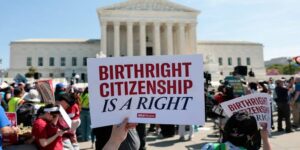
On the first day of his second term, President Trump signed an executive order barring automatic citizenship for children born on U.S. soil if their parents entered the country illegally or are living and working in the United States on temporary visas. The order directly challenges the plain text of the Fourteenth Amendment, ratified after the Civil War, which states that “all persons born or naturalized in the United States, and subject to the jurisdiction thereof, are citizens of the United States.” For more than a century, that clause has been understood, including in the Supreme Court’s own 1898 ruling in United States v. Wong Kim Ark, to confer citizenship on nearly all children born within U.S. borders regardless of their parents’ immigration status.
The order never took effect. Every federal judge who reviewed it, across multiple jurisdictions, concluded that it was unconstitutional, with one judge describing it in unusually blunt terms as “blatantly unconstitutional.” The case, now styled Trump v. Barbara, made its way to the Supreme Court, where oral arguments were held on April 1. Trump made history that day by becoming the first sitting president to attend oral arguments at the Court in person, sitting in to hear his solicitor general, D. John Sauer, defend the order’s constitutionality before the justices.
According to court observers, the argument did not go well for the administration. Legal analysts following the proceedings suggested that at least five, and potentially as many as seven, justices appeared skeptical of the order’s constitutionality based on their questioning. Trump himself appeared to anticipate an unfavorable outcome in subsequent public remarks, acknowledging that the Court would “probably rule against me because they seem to like doing that.” Even so, in a social media post, he framed the stakes in stark terms, writing that “a negative ruling on Birthright Citizenship, on top of the recent Supreme Court tariff catastrophe, is not Economically sustainable for the United States of America,” a reference to the Court’s earlier February ruling striking down his use of emergency powers to impose tariffs.
The case is one of several still pending as the Court’s term winds toward its close. The justices indicated they would issue additional opinions on Monday, June 29, though that date may not mark the term’s final day, as the Court has in recent years pushed major rulings into early July. Other pending matters include Trump’s effort to remove Federal Reserve Governor Lisa Cook and disputes over independent agency leadership, mail-in ballot deadlines, and transgender athletes in school sports, several of which similarly implicate questions about the limits of presidential and federal authority.
Why It Matters
Few provisions of the Constitution carry the kind of settled, foundational status that birthright citizenship has held for over 150 years. A ruling upholding Trump’s order, even in part, would mark a fundamental reinterpretation of the Fourteenth Amendment’s citizenship clause and could affect the legal status of potentially hundreds of thousands of children born in the United States each year to parents without permanent legal status. The practical consequences would extend far beyond the immigration debate, touching questions of who qualifies for federal benefits, who can vote upon reaching adulthood, and how states administer everything from school enrollment to driver’s licenses.
For originalists and textualists across the ideological spectrum, the case poses an unusually difficult test, since the constitutional text itself is widely regarded as clear, and the Court’s own 1898 precedent in Wong Kim Ark has stood essentially unchallenged for well over a century. A ruling for the administration would require the Court to either distinguish that precedent in a novel way or directly revisit it, either of which would represent a significant judicial intervention into settled constitutional understanding.
For Congress, an adverse ruling against birthright citizenship, should one occur, would likely trigger immediate legislative responses from both parties, given how central the issue is to broader immigration policy debates, though any such response would itself face significant procedural and political hurdles in a closely divided Congress.
For everyday Americans, the ruling will resolve more than a year of legal uncertainty for families directly affected by the policy, who have spent that period unsure whether children born during this period will ultimately be recognized as citizens, a level of legal limbo with significant consequences for healthcare, education, and family planning decisions.
Economic and Global Context
The economic stakes of birthright citizenship policy extend well beyond the immediate immigration debate. Demographic researchers have long noted that birthright citizenship plays a meaningful role in long-term population and labor force growth projections, particularly as the United States, like most developed nations, faces a slowing of native-born population growth and an aging workforce. Changes to citizenship eligibility could have multi-decade effects on these underlying demographic trends, which themselves bear on the long-term sustainability of programs like Social Security and Medicare.
Internationally, the United States is among a relatively small group of nations, including Canada and most countries in the Americas, that maintain unconditional jus soli, or birthright citizenship. Most European and Asian nations instead tie citizenship primarily to parentage. A ruling narrowing the American approach would represent a significant shift toward the citizenship models used by countries with notably different historical relationships to immigration, and could influence ongoing political debates abroad about citizenship and national identity.
The case also lands amid a broader pattern this term of the Court ruling on the outer boundaries of executive power, including its February decision striking down Trump’s use of emergency tariff authority and its more recent rulings expanding the administration’s latitude on asylum and temporary protected status. How the Court approaches birthright citizenship, an issue resting on express constitutional text rather than statutory interpretation, may reveal whether the justices apply a meaningfully different standard when constitutional text, rather than congressional delegation, is at stake.
Implications
The most immediate development to watch is Monday’s opinion day, though there is no guarantee the birthright citizenship ruling will be among those released, given that the Court does not announce in advance which decisions are coming when, and several other major cases remain pending as well. If the ruling does not arrive Monday, observers expect it before the term’s likely close in early July.
For immigrant families and advocacy organizations, the period between now and the ruling remains one of significant anxiety, with legal aid organizations across the country preparing guidance for affected families under multiple possible outcomes. For state governments, particularly those administering vital records and benefits programs, an adverse ruling would require rapid operational adjustments to determine how affected children’s legal status should be documented and processed going forward.
For the broader judiciary, the ruling will offer important signals about how the current Supreme Court approaches direct constitutional text versus statutory authority claims, a distinction relevant to numerous other pending and future cases involving the scope of executive power.
For Trump and his administration, the case represents one of the highest-profile tests yet of his broader effort to reshape immigration law through executive action rather than legislation, and the outcome will significantly shape the administration’s strategic calculus on whether to pursue similarly aggressive unilateral actions in its remaining time in office.
Sources
“The Supreme Court is in its final stretch this term. Here are the major cases left”
