


Story Highlights
- The Supreme Court ruled 6-3 that Trump’s executive order ending birthright citizenship for children born on U.S. soil violates the 14th Amendment
- Chief Justice John Roberts wrote the majority opinion, joined by Trump appointees Brett Kavanaugh and Amy Coney Barrett
- Justices Clarence Thomas, Neil Gorsuch, and Samuel Alito dissented; Trump says he will now pursue the policy through Congress
What Happened
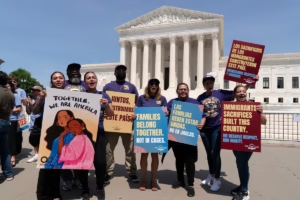
The Supreme Court issued its ruling in Trump v. Barbara on June 30, 2026, striking down an executive order President Donald Trump signed on the first day of his second term that sought to deny automatic citizenship to children born in the United States to parents who are undocumented immigrants or hold only temporary legal status. The case had moved through the federal court system for more than a year after the American Civil Liberties Union and a coalition of civil rights organizations filed a nationwide class action lawsuit immediately following an earlier related ruling, known as the CASA decision, which had initially narrowed the scope of injunctions against the order.
Chief Justice John Roberts authored the majority opinion, holding that the order ran directly contrary to the Fourteenth Amendment’s citizenship clause, which has been interpreted for more than 150 years to grant citizenship to nearly all individuals born on American soil. “Citizenship, then and now, was the right to have rights — to freely participate in our political community,” Roberts wrote, adding that the framers of the amendment “extended that promise to every free-born person in this land.” Notably, two of Trump’s own appointees, Justices Brett Kavanaugh and Amy Coney Barrett, joined the majority, with Kavanaugh writing separately to note his view that the order also violated federal statutory law independent of the constitutional question. Justices Clarence Thomas, Neil Gorsuch, and Samuel Alito dissented.
The case was argued before the Court on April 1, 2026, with ACLU National Legal Director Cecillia Wang representing the plaintiffs and U.S. Solicitor General John Sauer arguing on behalf of the administration. Trump himself attended the oral arguments in person, an unusual step that underscored how much personal and political significance he attached to the case. A broad coalition of members of Congress, civil rights organizations, and constitutional law scholars filed briefs in the case, reflecting its status as one of the most closely watched constitutional disputes in decades.
Following the ruling, Trump responded on social media, acknowledging the defeat while signaling his intent to continue pursuing the policy through different means. “The Supreme Court upheld Birthright Citizenship, which is too bad for our Country, but we can easily make it up in Congress through Legislation,” Trump wrote, suggesting that legislative action, rather than further executive unilateralism, would now be his preferred path forward, though any such legislation would face its own constitutional vulnerabilities given the Court’s clear reading of the Fourteenth Amendment’s text.
Immigration policy analysts noted a complicating dynamic in the ruling’s aftermath. Mark Krikorian, executive director of the Center for Immigration Studies, characterized the loss as something of a mixed outcome for the administration, suggesting the ruling could still be leveraged to justify more aggressive deportation efforts and stricter visa policies, including the possibility of new restrictions targeting pregnant visa applicants, ahead of any future legislative push.
Why It Matters
The ruling stands as one of the most significant defenses of constitutional text against executive overreach in modern history. The Fourteenth Amendment’s citizenship clause has anchored American constitutional identity since Reconstruction, and a ruling in Trump’s favor would have opened the door to redefining citizenship status for potentially millions of American-born children based on their parents’ immigration status, a change with profound implications for the rule of law and the stability of citizenship as a legal status.
For American liberty advocates across the political spectrum, the case illustrates the enduring strength of judicial review as a check on executive power, even when exercised against a sitting president by a Court with a conservative supermajority. The fact that two Trump-appointed justices joined the majority signals that constitutional text, rather than partisan loyalty, ultimately governed the outcome, a reassuring signal for those concerned about the politicization of the judiciary.
At the same time, the ruling does not end the underlying policy fight. Trump’s stated intention to pursue legislation raises the prospect of a renewed constitutional confrontation, since any statute attempting to redefine birthright citizenship would face the same Fourteenth Amendment text that doomed the executive order, unless Congress and the states pursued the far higher bar of a constitutional amendment. This sets up a potential years-long legislative and judicial battle over an issue the Court has now spoken on unambiguously.
For families directly affected, the ruling provides critical certainty. The nationwide class action had already provisionally protected citizenship status for babies born while litigation proceeded, and Tuesday’s ruling now permanently forecloses the executive branch’s ability to strip that status unilaterally, protecting the citizenship rights of children born to immigrant parents nationwide.
Economic and Global Context
The ruling arrived alongside several other major decisions issued as part of the Supreme Court’s final rulings of its 2025-2026 term, providing a broader picture of how the judiciary is shaping the boundaries of executive authority under Trump. Taken together, the term’s rulings delivered the administration a mix of wins and losses, including an earlier decision that the president lacked authority to impose sweeping tariffs under emergency powers law, a ruling that similarly narrowed unilateral executive economic authority in ways relevant to the birthright citizenship dispute’s broader themes of separation of powers.
Internationally, the ruling reinforces the United States’ historical position, dating to the 1898 case United States v. Wong Kim Ark, that citizenship by birthright applies broadly regardless of parental immigration status, a principle that distinguishes the U.S. from many nations that apply jus sanguinis, or citizenship by descent, rather than jus soli, citizenship by birthplace. The ruling’s international resonance is significant given ongoing global debates about migration, national identity, and the legal status of children born to migrant populations in host countries worldwide.
Domestically, immigration analysts note the ruling could accelerate other enforcement priorities the administration has signaled interest in pursuing, including expanded scrutiny of visa applications and pregnancy-related travel restrictions, representing a broader recalibration of immigration strategy in the wake of the citizenship defeat.
Implications
For Congress, the ruling sets the stage for a legislative fight over immigration and citizenship policy that will likely dominate portions of the upcoming legislative session, though any bill attempting to override the Fourteenth Amendment through ordinary statute faces near-certain further litigation and probable defeat under the same constitutional reasoning the Court just applied.
For immigrant families and legal advocates, the decision represents a durable, though not necessarily final, victory, given the administration’s stated intent to continue pursuing the underlying policy goal through alternative means. Continued vigilance from civil rights organizations is likely as any new legislative proposals emerge.
For the broader constitutional order, the ruling reinforces the judiciary’s role as an independent check on presidential power, a precedent likely to be cited in future disputes over the scope of executive authority, regardless of which party controls the White House going forward.
Sources
Supreme Court Rules to Protect Birthright Citizenship in Landmark Case
