
Story Highlights
- The feud between President Donald Trump and Tucker Carlson has exposed deep divisions inside the MAGA movement over the Iran conflict.
- Carlson has accused Trump of abandoning the America First promise to avoid new foreign wars.
- Trump has dismissed Carlson’s criticism, while defending his Iran strategy as necessary to stop Tehran’s nuclear ambitions.
What Happened
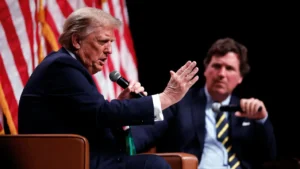
The public feud between President Donald Trump and Tucker Carlson has become one of the clearest signs of a widening split inside the America First movement over foreign policy, military intervention, and the war with Iran.
Carlson, once one of Trump’s most influential media allies, has sharply criticized the administration’s handling of Iran. He has argued that the conflict violates the anti-interventionist message that helped Trump build support among populist conservatives, libertarian-leaning Republicans, and younger right-wing voters.
- Carlson has repeatedly attacked the Iran war as a betrayal of America First principles.
- Trump has rejected the criticism and defended the conflict as limited and necessary.
- The feud has turned a foreign policy dispute into a broader fight over the future of MAGA.
The break intensified after U.S. and Israeli strikes on Iranian targets earlier this year. Carlson accused the administration of prioritizing foreign interests and warned that another Middle East conflict would damage Trump’s political coalition.
Trump responded by mocking Carlson and other anti-war voices on the right, suggesting they misunderstand the stakes of the Iran conflict. In recent remarks, Trump rejected the argument that the war contradicts his “no new wars” message, saying the action was necessary to prevent Iran from obtaining nuclear weapons.
The dispute has continued across podcasts, newsletters, interviews, and social media, with Carlson presenting himself as a defender of the original America First promise and Trump allies portraying him as out of step with the president’s national security priorities.
Why It Matters
The feud matters because Carlson is not a traditional Trump critic. He helped shape the populist media environment that powered Trump’s comeback and gave intellectual language to parts of the America First movement.
That makes his break with Trump more damaging than criticism from Democrats or establishment Republicans. Carlson is attacking Trump from inside the political world that once treated him as the central figure of the movement.
- The fight exposes a real divide between anti-interventionist conservatives and national security hawks.
- It raises questions about whether Trump can keep his populist base unified during the Iran conflict.
- It gives anti-war Republicans a high-profile media figure willing to challenge the president directly.
For years, Trump’s appeal to many voters rested partly on the promise that he would avoid the foreign policy mistakes of previous administrations. Carlson’s argument is that the Iran conflict breaks that promise.
Trump’s counterargument is that stopping Iran from obtaining nuclear weapons is not optional and that limited military action can serve American interests without becoming an endless war.
Political and Public Context
The MAGA split over Iran comes at a dangerous political moment for Republicans. The 2026 midterms are approaching, Trump’s approval has weakened, and some GOP lawmakers have already begun pushing back on the administration over war powers, surveillance, spending, and foreign policy.
Inside the conservative movement, the debate is no longer just about Trump personally. It is about what America First means in practice.
- One side defines America First as avoiding foreign wars and focusing on domestic problems.
- Another side argues that America First can include military action when U.S. security is at stake.
- The Iran conflict has forced that disagreement into the open.
Carlson’s criticism may resonate with voters who supported Trump because they wanted fewer U.S. military commitments abroad. Those voters may not defect to Democrats, but reduced enthusiasm could matter in close races.
For Trump, the risk is that the feud keeps attention on one of his most politically vulnerable issues. The longer Carlson attacks the war from the right, the harder it becomes for the White House to frame opposition as purely partisan.
Economic and Global Context
The Iran conflict has also created economic pressure that makes the political feud more consequential. Fighting near the Gulf and Strait of Hormuz has raised concerns about energy prices, shipping costs, defense spending, and inflation.
Those pressures give Carlson’s argument more force with voters who already feel squeezed by higher costs. If the war is linked in voters’ minds to gasoline prices, inflation, or new spending, the anti-war faction inside MAGA could grow louder.
- Energy markets remain sensitive to escalation involving Iran.
- Defense spending tied to the conflict has become part of the broader budget debate.
- Republican candidates must now navigate both Trump loyalty and voter fatigue over foreign conflicts.
Globally, allies and adversaries are watching the feud as a sign of how durable U.S. political support for the Iran conflict may be. If Trump’s own base is divided, foreign governments may question whether the administration can sustain pressure over time.
The feud also affects conservative media. Carlson’s audience gives him a powerful platform to challenge Trump from within the right, creating a counterweight to pro-Trump media voices defending the administration’s war policy.
What Happens Next
The feud is unlikely to disappear quickly. Carlson has built his criticism around a core ideological claim: that Trump has abandoned the anti-war side of America First. Trump, meanwhile, is unlikely to concede that his Iran strategy violates his campaign message.
The next major test will be whether the Iran ceasefire holds, whether peace talks produce a real agreement, and whether U.S. involvement continues to generate costs for voters at home.
- If the conflict de-escalates, Trump may be able to claim his approach worked.
- If the war expands or drags on, Carlson’s critique could gain influence.
- The dispute may shape Republican turnout and messaging before the midterms.
For the broader MAGA movement, the fight has opened a question that will outlast this single feud: is America First primarily an anti-interventionist doctrine, or can it support military action abroad when Trump defines the mission as vital to U.S. security?
That debate is now fully public. The Trump-Carlson break is not just a media fight — it is a warning that the coalition Trump built is under stress from one of the oldest forces in American politics: war.
