Story Highlights
- Carlson told his audience in June 2026 that he and Charlie Kirk privately warned Trump “to his face” in June 2025 that entering the Iran war would betray the America First platform he ran on
- In April 2026, Carlson publicly apologized on his podcast for having “misled” supporters into voting for Trump, calling the moment a cause of “personal torment”
- As of June 2026, Carlson has praised Democratic California Governor Gavin Newsom and speculated he could be the 2028 Democratic presidential nominee
What Happened
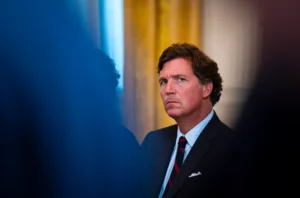
Tucker Carlson, the former Fox News anchor and host of The Tucker Carlson Show, has completed one of the most dramatic political reversals in contemporary conservative media. Once a central pillar of the coalition that elected President Donald Trump in 2024 — Carlson gave Trump an exclusive interview during the campaign and appeared with him on the trail — Carlson is now one of the president’s most pointed and public critics, and the schism between them shows no sign of resolution.
The origins of the feud trace to June 2025, when the United States was considering entering the Israel-Iran conflict. Carlson said publicly, and later confirmed on his podcast, that he and fellow conservative commentator Charlie Kirk privately warned Trump “to his face” that the people pushing him toward war with Iran were attempting to involve the United States in a regime-change conflict — exactly the type of foreign intervention Trump had campaigned against. Carlson named specific individuals he believed were driving the pressure, including Israeli Prime Minister Benjamin Netanyahu, media figures, and conservative commentators aligned with the interventionist wing of the right.
The administration’s initial response to Carlson’s public warnings was relatively muted. Trump at one point told reporters that Carlson had called to “apologize” for his strong language, suggesting the rift was manageable. But when joint U.S.-Israeli strikes were launched against Iran in February 2026, the feud entered a new and more severe phase. Carlson denounced the president in terms that went well beyond policy disagreement, characterizing the war as a betrayal of the movement Trump himself had built.
In April 2026, Carlson made the most striking statement of the entire episode: on his podcast, he apologized to his audience for having, in his telling, misled them into supporting and voting for Trump. He described the experience as a source of personal torment. The apology was remarkable not only for its content but for what it implied — that Carlson had concluded his own judgment about Trump had been wrong, and that his audience deserved to know it.
By June 2026, the rupture had expanded into territory that few observers had anticipated. Carlson praised California Democratic Governor Gavin Newsom on a recent episode of his show, calling him “fantastic” and suggesting he appeared to “care about the people.” He also speculated that Newsom could be the 2028 Democratic presidential nominee. Trump, for his part, responded to Carlson’s continued criticism with an AI-generated mockery post on Truth Social targeting Carlson and other right-wing Trump critics.
Why It Matters
The Carlson-Trump feud is not simply a personality conflict between two prominent figures. It is a proxy war over the soul of the populist right — over whether “America First” means non-interventionism and restraint, as Carlson has long argued, or whether it means projecting American military dominance globally, as the Trump administration’s Iran policy has demonstrated in practice.
That ideological fault line predates Trump. The libertarian and non-interventionist strain of conservatism — associated historically with figures from Robert Taft to Ron Paul — has always existed in tension with the hawkish neoconservative tradition that dominated Republican foreign policy from Reagan through George W. Bush. Trump’s 2016 and 2024 campaigns drew heavily on non-interventionist rhetoric to distinguish themselves from the Republican establishment. The Iran war has forced a reckoning with whether that rhetoric reflected genuine conviction or campaign strategy.
For Liberty Tribunal readers who care about constitutional governance, Carlson’s central argument — that the Iran war was launched without meaningful congressional authorization and in defiance of the war-making restraint Trump promised — deserves serious engagement regardless of one’s overall view of Carlson. The constitutional allocation of war powers between the executive and legislative branches is one of the most important and most frequently contested questions in American governance. The Iran conflict has been no exception.
The feud also raises questions about the long-term stability of the coalition Trump has assembled. If prominent movement figures like Carlson are publicly questioning whether Trump has betrayed the agenda he ran on, that creates permission for ordinary voters to ask the same question — and potentially to express that doubt through reduced turnout or political disengagement, which broader polling already suggests is occurring.
Economic and Global Context
The Carlson-Trump schism exists within a broader context of popular anxiety about the economic and military costs of the Iran war. The near-total closure of the Strait of Hormuz since February 2026 has contributed to elevated energy prices, increased shipping costs, and global supply chain strain. These are not abstract concerns for the American households that form the core of Trump’s political coalition.
Carlson’s audience — disproportionately working-class and middle-income Americans, concentrated in the interior of the country, often economically anxious — are also the Americans most likely to feel the indirect effects of a prolonged Middle Eastern conflict through gas prices and imported goods costs. The $70 billion in immigration enforcement funding signed into law last week, while popular with the base on its merits, does not address the economic discomfort many Trump voters feel when they fill their gas tanks or buy groceries.
Beyond economics, the geopolitical implications of a fracture in the America First coalition are significant. The non-interventionist right was one of the distinguishing features of Trump’s foreign policy brand, and it has attracted supporters — including some former Democrats and independents — who were specifically drawn by opposition to what they characterized as endless foreign wars. If that brand is now associated with a major Middle Eastern military conflict, the political proposition changes for those voters.
The situation also creates an opening — or at least a perception of one — for Newsom and other Democrats who are positioning themselves for 2028. Carlson’s praise of Newsom, however idiosyncratic, is a data point for strategists on both sides who are watching whether populist crossover voters remain in the Republican column or become genuinely available.
Implications
The most immediate implication of the Carlson-Trump feud is for conservative media and the information ecosystem that shapes Republican primary politics. Carlson’s show commands a substantial audience that overlaps significantly with Trump’s own base. When Carlson tells that audience that he misled them and that the president betrayed the movement, some portion of that audience will take it seriously — not all, but enough to matter at the margins in a midterm environment where Republican turnout is already showing signs of fragility.
For the Trump White House, the feud represents a communications problem that cannot easily be solved through the normal tools of political management. Carlson is not a political opponent who can be dismissed as a partisan enemy — he is an ideological fellow traveler who has turned, and who carries credibility with exactly the voters the administration most needs to maintain. The AI-generated mockery on Truth Social signals the White House is treating the feud as a culture war skirmish, but that approach may underestimate its electoral significance.
For conservative movement organizations and donors, the Carlson-Trump break forces a choice about which vision of conservatism they are investing in. The interventionist, hawkish wing of the Republican Party — which supported the Iran strikes and has remained closely aligned with the White House — and the non-interventionist wing that Carlson now represents are operating on fundamentally different premises about what the movement stands for.
For the American public, the most significant implication may be the simplest: the coalition that produced Trump’s 2024 victory is not monolithic, and the stresses now visible within it — over foreign policy, economic pain, and broken promises — are real, documented, and growing. Whether they are large enough to reshape November’s outcome remains to be seen.
