
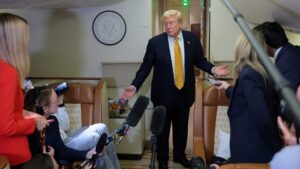
The Trump administration has issued subpoenas to multiple New York Times journalists following the newspaper’s reporting on security concerns involving the president’s new Qatari-donated Air Force One aircraft, a move press freedom advocates and members of Congress have condemned as an escalating effort to intimidate journalists. The action represents the latest in a lengthening pattern of legal and financial pressure the administration has applied to news organizations covering the White House critically.
Story Highlights
- The Justice Department subpoenaed New York Times reporters after the paper reported that Trump’s new Air Force One lacks certain advanced security features present on the older aircraft
- An FBI official had reportedly contacted the Times before publication, asking that the article be held over unspecified national security concerns
- The subpoenas follow a broader pattern including a $10 billion lawsuit against the Wall Street Journal, subpoenas over Pentagon access, and over $86 million in settlements Trump has collected from media companies
What Happened
The Trump administration issued subpoenas to several New York Times journalists in July after the newspaper published reporting on security shortcomings in President Trump’s newly delivered Air Force One, a Boeing 747-8 that had been donated by the government of Qatar. The Times reported that the new aircraft lacked some of the advanced security features present in the older presidential aircraft it is replacing, including certain antimissile capabilities, an article that cited multiple anonymous sources familiar with the aircraft’s specifications.
According to Times reporting on the episode, a senior FBI official contacted a reporter and a senior editor before the story’s publication, asking that the article be held, citing what the official described as a national security issue without providing further explanation. The Times proceeded with publication after its own editorial review, and the subpoenas followed shortly after, targeting reporters involved in the coverage in what press freedom organizations characterized as a direct attempt to identify confidential sources and deter future reporting on similarly sensitive topics.
The subpoenas represent an escalation in an already tense relationship between the Times and the administration. In 2025, Trump sued the newspaper directly, alleging defamation and claiming the paper sought to undermine his 2024 campaign. Separately, the Times sued the Defense Department in December 2025 after it imposed new restrictions limiting reporters’ physical access to the Pentagon, restrictions the paper argued unlawfully curtailed its ability to cover military affairs central to its journalistic mission.
Press freedom advocates and congressional lawmakers swiftly condemned the subpoenas as part of a broader pattern of intimidation. Legal experts and media analysts note that the Justice Department and Pentagon are separately exploring prosecuting government officials who leak information to journalists, a parallel track that, combined with subpoenas targeting reporters directly, raises the practical cost of investigative journalism covering the administration.
The Air Force One subpoenas fit within a much larger pattern of legal and financial pressure the administration has applied to media organizations broadly. A 2025 financial disclosure filing revealed that Trump personally earned 86.5 million dollars from legal settlements with media and technology companies he sued, an unprecedented sum for a sitting president. Separately, Trump has filed a 10 billion dollar defamation lawsuit against the Wall Street Journal over its reporting on a 2003 letter he allegedly sent Epstein, and a federal judge dismissed a separate 3.8 billion dollar defamation suit Trump brought against the Washington Post, finding insufficient evidence of actual malice required under established defamation law.
Why It Matters
The subpoenas raise serious First Amendment concerns central to the constitutional protections afforded the press specifically to prevent government intimidation of journalists reporting on matters of public interest, including national security and presidential conduct. Legal experts note that subpoenas targeting reporters directly, rather than pursuing leak investigations through other means, carry a chilling effect on confidential sourcing relationships essential to accountability journalism.
The pattern of settlements totaling tens of millions of dollars from major media companies, including Paramount’s 16 million dollar settlement and ABC’s 15 million dollar settlement, illustrates how corporate ownership structures can create vulnerabilities that political pressure exploits, particularly when media companies have pending business before federal regulators, such as merger approvals, that create incentives to settle disputes regardless of their legal merit.
For journalism as an institution, the combination of subpoenas, billion-dollar lawsuits, and funding cuts to public broadcasters like NPR and PBS represents a coordinated set of pressures that press freedom organizations argue collectively threaten the industry’s ability to hold government accountable, regardless of whether any individual legal action ultimately succeeds in court.
The broader implications extend to future administrations of either party. Legal tools and precedents established through these actions, including the practical effectiveness of subpoenas and lawsuits in extracting settlements or altering news coverage, could be employed by future presidents regardless of party affiliation, raising long-term concerns about press independence that extend well beyond the current administration.
Economic and Global Context
Media company settlements with the administration carry direct financial implications for the industry, with the disclosed 86.5 million dollar total in settlements representing a significant transfer of resources from news organizations to a sitting president’s personal or political interests, a dynamic without clear historical precedent in American governance.
The economics of modern journalism, already strained by declining advertising revenue and subscription competition, are further complicated by the legal costs of defending against high-dollar lawsuits, even those legal experts consider to have weak merit, since litigation costs alone can pressure smaller or financially vulnerable outlets toward settlement regardless of the underlying legal strength of a case.
Internationally, the pattern of press pressure in the United States has drawn attention from global press freedom organizations that have historically looked to American constitutional protections as a benchmark for journalistic independence. Continued escalation risks affecting how international observers assess press freedom conditions in the United States relative to other democracies.
The public broadcasting funding cuts affecting NPR and PBS, totaling 1.1 billion dollars, carry additional economic implications for local affiliate stations across the country that rely on federal funding to support local news operations, particularly in smaller media markets where public broadcasting represents a significant source of independent local journalism.
Implications
In the near term, expect continued legal proceedings in the Times’ ongoing lawsuit against the Defense Department over Pentagon access restrictions, alongside potential legal challenges to the Air Force One subpoenas themselves, as press freedom organizations weigh options for contesting the demands through the courts.
Congressional Democrats are likely to continue raising the subpoenas as evidence of what they characterize as a broader assault on press freedom, though legislative remedies remain limited given Republican control of both chambers and the administration’s continued reliance on executive branch legal tools rather than legislation requiring congressional approval.
For media organizations more broadly, the pattern of settlements and subpoenas is likely to influence editorial risk calculations going forward, with some outlets potentially becoming more cautious in pursuing stories that could trigger similar legal responses, even as others, including the Times, have shown willingness to continue litigating rather than settling.
For the public, the ongoing tension between the administration and major news organizations will likely continue shaping how Americans access information about government conduct, with the ultimate outcomes of pending lawsuits and subpoena challenges carrying significant precedential weight for press freedom protections well beyond the current news cycle.
Sources
Trump administration subpoenas New York Times reporters over coverage
