


Story Highlights
- Trump said China agreed to buy U.S. oil and purchase 200 Boeing aircraft, though China made no official confirmation of the aircraft deal
- Xi warned Trump that mishandling Taiwan could cause “clashes and even conflicts,” with the island a central flashpoint in the talks
- Both leaders agreed to a “strategic stability” framework for the next three years, setting up a return visit by Xi to the United States in September
What Happened
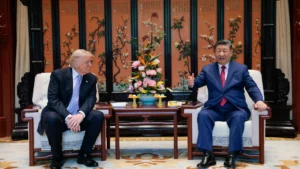
President Donald Trump touched down in Beijing this week for his first visit to China in nearly a decade, framing the trip as a historic opportunity to reset the world’s most consequential bilateral relationship. Over two days of meetings, the two leaders engaged in formal sessions, a tea ceremony at the imperial-era Zhongnanhai Garden, and a state dinner marked by flag-waving crowds and ceremonial pageantry.
President Xi Jinping greeted Trump with the full weight of Chinese diplomatic protocol, signaling that Beijing valued the high-profile engagement. According to Chinese state media, the two agreed to adopt “strategic stability” as a guiding framework for the relationship over the next three years — a phrase intended to convey mutual commitment to avoiding miscalculation and open conflict.
Trump told reporters aboard Air Force One that the summit had resolved “a lot of different problems that other people wouldn’t have been able to settle,” without elaborating on what specifically had been agreed. He also told Fox News that China had committed to purchasing American oil and placing an order for 200 Boeing commercial aircraft, which would mark Beijing’s first purchases of U.S.-made jets in nearly a decade. China did not officially confirm the Boeing agreement, and the figure fell short of roughly 500 aircraft that markets had anticipated.
On Taiwan, Xi delivered a pointed warning during their first day of meetings, telling Trump that mishandling Beijing’s territorial claims over the island could lead to “clashes and even conflicts.” Trump, speaking to reporters during his flight back to the United States via Alaska, said he had not yet decided whether to proceed with a proposed $14 billion arms sale to Taiwan, stating he would consult with Taiwan’s president, Lai Ching-te, before making a final determination. Trump added that he did not believe a military conflict over Taiwan was imminent.
The president also raised the cases of political prisoners during the talks, including Jimmy Lai, the pro-democracy activist sentenced in February to 20 years in a Hong Kong national security case. Xi reportedly acknowledged the sensitivity of the case but offered little in the way of relief, telling Trump it was “a tough one.”
Why It Matters
The Beijing summit represents the most significant direct diplomatic engagement between Washington and Beijing in years, and its outcome carries enormous weight for American businesses, consumers, and policymakers. Trade between the two nations remains deeply entangled despite tariff wars and decoupling efforts, and any stabilization of the relationship has downstream effects on supply chains, inflation, and manufacturing investment in the United States.
The Boeing aircraft discussion, if it materializes into a formal deal, would represent a meaningful win for American industry. Boeing has struggled financially in recent years, and a large Chinese order could provide a meaningful revenue boost while also serving as a symbolic demonstration that economic diplomacy can produce tangible results. However, the absence of an official Chinese confirmation leaves the announcement on uncertain footing.
The Taiwan question cuts to the heart of Asian security. The island’s democratic government functions as an independent state in practice, while Beijing insists it is sovereign Chinese territory and has never renounced the use of force to achieve unification. Trump’s ambiguity on the arms sale, coming immediately after a direct warning from Xi, creates a period of strategic uncertainty that could unsettle both Taipei and American allies in the region including Japan, South Korea, and Australia.
The agreement on Iran — including China’s stated commitment to keeping the Strait of Hormuz open — was cited by U.S. officials as a positive outcome. Analysts were more cautious, however. With a U.S.-Iran war having driven energy prices sharply higher since February, Beijing’s rhetorical support for de-escalation costs China very little when it continues to purchase Iranian oil.
Economic and Global Context
The summit unfolded against a backdrop of intense economic pressure on both countries. Since the start of the Iran conflict in late February, energy costs have surged dramatically, with gasoline prices rising and inflation creeping back up globally. A Motley Fool analysis noted that the Strait of Hormuz closure has created the largest energy supply disruption in modern history, putting central banks worldwide under pressure to balance growth and price stability.
The promised Chinese oil purchases from the United States, if confirmed, would help offset some of that energy disruption by redirecting flows through American exporters. For U.S. oil producers, a guaranteed Chinese customer would be commercially significant. For Beijing, it represents a potential tool to manage Trump diplomatically by giving Washington a win it can publicize domestically.
Markets also watched the summit for signals about tariff policy. No major trade deal or tariff reduction framework was announced during the two days of talks, meaning that the tariff regime currently governing U.S.-China commerce remains in place. Investors had hoped for more concrete deliverables, and the vague communiqué is likely to temper near-term optimism.
Looking further out, Xi’s expected state visit to the United States in September — likely timed around the United Nations General Assembly in New York — sets up a follow-on round of diplomacy. Analysts at the Chinese Academy of Social Sciences noted that September will be treated as a return state visit, which implies a higher level of formal commitment on both sides.
Implications
For American businesses operating in or dependent on Chinese markets, the summit offers cautious optimism but no certainty. Companies in sectors from agriculture to technology will be watching closely to see whether the “strategic stability” framework translates into more predictable trade conditions or remains diplomatic language without operational effect.
For American voters, the summit’s messaging — that Trump personally can solve problems others cannot — reinforces a central theme of his political brand. Whether tangible economic benefits follow will determine how the trip is judged over time. The Boeing deal, if finalized, would be a headline-friendly result. The absence of movement on tariffs may frustrate industries that have borne their costs.
Taiwan’s government faces the most immediate uncertainty. Xi’s direct warning and Trump’s unresolved position on the arms sale create a window of ambiguity that could invite miscalculation. American policymakers and defense planners will be pressing the White House for clarity on whether the longstanding policy of providing Taiwan with defensive arms will continue uninterrupted.
For U.S. allies in Asia and Europe, the summit reinforces the reality that the Trump administration conducts foreign policy through personal presidential engagement rather than through multilateral frameworks. Allies not present in the room have limited insight into what commitments, if any, were made or what flexibility the White House may have signaled behind closed doors.
Sources
“Live updates: Trump concludes warm China trip with few clear wins”
