


Story Highlights
- Trump, Zelenskyy, and Macron held a 30-minute sideline session at the G7 summit in France — the first direct Trump-Zelenskyy encounter since February 2026, with Secretary of State Marco Rubio also in attendance.
- G7 leaders committed to strengthening Ukraine’s air defenses, including additional interceptor missiles, production licenses for domestic manufacturing, and a winter support package, with the U.S. pledging backstop support.
- Trump told reporters Russia must “make a deal” to end the war and signaled that American diplomatic focus is returning to Europe now that the Iran conflict is approaching resolution.
What Happened
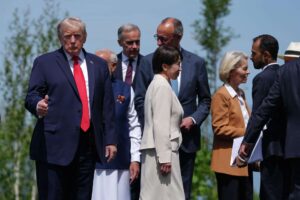
President Volodymyr Zelenskyy met with President Trump and French President Emmanuel Macron on the sidelines of the G7 summit in France on June 16. The meeting marked the first encounter between Zelenskyy and Trump in over four months and lasted around 30 minutes. U.S. Secretary of State Marco Rubio was also present, underscoring the diplomatic seriousness of the session.
The president attended the G7 meeting with leaders plus Zelenskyy on Tuesday morning, which overran by around an hour. Zelenskyy said in a post on X that “substantive meetings” were underway, with the key focus being to “strengthen air defense for Ukraine and advance diplomacy, to make Russia end its war.”
The meeting came after nearly four months of diplomatic silence on Ukraine. U.S.-mediated peace talks have effectively been frozen since February. Since then, Washington’s attention has shifted toward its war with Iran, which both Ukrainian and U.S. officials say has become the main reason talks lost momentum. The return of Ukraine to the center of the G7 agenda reflected pressure from European allies who have expressed frustration with the gap in American engagement.
Trump pledged further support to Kyiv and urged Moscow to “make a deal” to end the Ukraine war. He said he would do what he could to bring the conflict to an end and told reporters: “Now that this is finished, we’re going to be focusing on that,” referring to the Iran conflict.
Zelenskyy said he had received important commitments from the G7. “More air defence missiles along with licenses to produce them, winter support package, and cranking up pressure on Russia. Importantly, the US is ready to provide backstop across these lines of effort,” he wrote.
Why It Matters
Zelenskyy and European leaders sought to impress upon Trump that Ukraine’s fortunes have improved as Kyiv pushes for more support to strengthen its hand in eventual peace talks with Moscow. European leaders have wanted to convince Trump that previous U.S. positions on the possible terms of a deal were overly favorable towards Moscow, particularly now that Ukraine’s drone incursions into Russia have improved its fortunes.
Trump’s European allies are using the high-stakes G7 talks to push for a renewed American commitment to supporting Ukraine’s war effort and for a diplomatic end to the war. Macron said a key focus of the talks would be maintaining support for Ukraine. “Europeans are currently providing almost 100% of the aid to Ukraine,” he said. That framing carries significant political weight, as it casts continued American disengagement not as restraint but as abdication.
The air defense commitments agreed upon Tuesday carry immediate operational value. Russia has sustained a campaign of ballistic missile and drone strikes against Ukrainian cities throughout 2026. Production licenses enabling Ukraine to manufacture its own interceptor systems represent a longer-term investment in Kyiv’s ability to defend itself without relying entirely on external resupply — a principle aligned with the kind of self-reliant sovereignty that constitutional conservatives have long championed in the context of foreign entanglements.
Economic and Global Context
The G7 summit is unfolding against a backdrop of two overlapping economic disruptions. The 15-week Iran war threatened the Strait of Hormuz, the chokepoint through which roughly one-fifth of global oil supply passes. The prospect of shipping being restored through the Strait of Hormuz sent markets surging and oil prices tumbling. But industry leaders said it could take weeks for traffic to get going as doubts swirl over the deal and its long-term viability.
Russia’s war in Ukraine has compounded global commodity pressures across four years of conflict. Wheat, fertilizer, and sunflower oil markets have remained elevated, contributing to food price instability across parts of Africa, the Middle East, and South Asia. A credible diplomatic pathway for Ukraine would, over time, ease those persistent supply-side pressures, with meaningful downstream benefits for American agricultural exporters and global food security.
For European economies, American reengagement carries a direct economic dimension. Germany’s industrial base is tightly linked to Eastern European trade and manufacturing networks. Prolonged instability suppresses investment across the European Union, which collectively represents one of the world’s largest trading partners for the United States. Renewed American diplomatic commitment to a Ukraine settlement is therefore not merely a geopolitical question — it carries real economic stakes for the transatlantic economy.
Implications
The meeting came as Ukraine intensifies pressure on Russian President Vladimir Putin to hold direct talks with Zelenskyy — a face-to-face encounter that would be the first between the two leaders since the start of Russia’s full-scale invasion. Zelenskyy has long argued that only Putin has the authority to end the war. Without that direct engagement, any framework remains incomplete.
For the Trump administration, the Ukraine pivot carries credibility stakes. Having allowed talks to stall for four months, Washington must now demonstrate that its reengagement is sustained rather than episodic. European allies — skeptical after months of watching American attention focus entirely on Iran — will be closely watching whether concrete follow-through materializes in the weeks ahead.
With midterm elections approaching in November 2026, Ukraine’s unresolved status will generate political friction. Republican candidates in competitive districts face voters skeptical of open-ended foreign commitments, while Democratic challengers will press the administration on the cost and direction of its foreign policy record. How Trump navigates the Ukraine file between now and the election will be as consequential politically as it is diplomatically. The G7 session bought time — but it also raised the stakes for what must come next.
