
Story Highlights
- Trump said Jan. 6 defendants “should be compensated” on a case-by-case basis, including potentially those who pleaded guilty to assaulting officers
- The proposed $1.8 billion anti-weaponization fund has been blocked by courts and faces Republican opposition
- Trump ended the interview early after clashing with Welker over California election claims and press freedom
What Happened
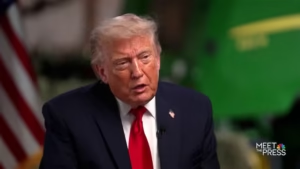
President Donald Trump sat for a prerecorded interview with Kristen Welker, moderator of NBC News’ Meet the Press, on Friday, June 5, at Custer Farms in Chippewa Falls, Wisconsin. The interview aired Sunday morning and immediately drew national attention — not only for its content, but for how it ended. Trump abruptly walked off set after a sustained back-and-forth with Welker over his election fraud claims and criticism of the press.
The interview’s most explosive moment came during a discussion of the Justice Department’s proposed $1.8 billion “anti-weaponization” fund, described by the administration as compensation for individuals the president believes were unfairly prosecuted by the Biden administration. When Welker pressed Trump on whether that fund could include individuals charged with assaulting Capitol Police officers on January 6, 2021, Trump did not foreclose the possibility. “I wouldn’t be inclined to say so, but I have to see it,” he said.
Trump expanded on his view of January 6 defendants more broadly, arguing that many were victims of a politically motivated justice system. “People have been badly hurt,” he said. “They’ve lost their jobs. They’ve lost their families. They’ve lost everything over a fake weaponization of government.” He added that many defendants who pleaded guilty did so out of fear rather than guilt, suggesting they should not be penalized based solely on that legal record.
The anti-weaponization fund itself has had a turbulent path. The Justice Department had previously told a court that the fund was “not going forward,” and it has faced opposition from members of both parties, as well as judicial scrutiny. Despite this, Trump made clear he still personally supports the concept. “I think the weaponization fund is a great idea,” he told Welker. “If Republicans don’t get it approved, I’d be disappointed.” Acting Attorney General Todd Blanche had signaled the fund was shelved, but Trump’s comments suggest the administration may seek alternative avenues for disbursement.
The interview covered a wide range of additional topics before reaching its abrupt end. When Welker pressed Trump on his unsubstantiated claims about rigged elections in California and later challenged him on the role of a free press, Trump grew visibly frustrated. He terminated the interview without the customary closing exchange, a move that drew immediate criticism from journalists and political commentators.
Why It Matters
The anti-weaponization fund debate cuts to the heart of one of the most divisive questions in American political life: whether the federal justice system was weaponized for partisan purposes, and whether any form of government remedy is appropriate. Trump’s position — that individuals prosecuted by the Biden-era DOJ deserve financial restitution — resonates deeply with a significant portion of the Republican base that views those prosecutions as politically motivated. But the suggestion that even those who assaulted law enforcement officers might qualify for compensation has alarmed legal scholars and former prosecutors across the political spectrum.
From a constitutional standpoint, the fund itself raises serious separation of powers concerns. Critics argue that executive branch disbursements to individuals with pending or completed criminal cases, particularly those tied to an attack on Congress, would represent an extraordinary and potentially unconstitutional use of executive power. The fact that courts have already moved to block the fund reflects the depth of those concerns. Any revival of the mechanism — through executive action or legislative appropriation — would almost certainly face immediate legal challenges.
The interview also highlights a growing tension between the Trump White House and the press. The president’s decision to walk off set during a live-recorded interview is rare by historical standards and signals an administration increasingly unwilling to engage with adversarial questioning. That posture has implications for press access and the public’s ability to hold elected officials accountable through traditional media institutions.
For the families and communities most affected by January 6, Trump’s comments represent a reopening of wounds. More than 1,600 people were charged in connection with the Capitol attack, and over 1,100 had been sentenced as the Biden administration concluded. The question of whether any of those individuals — particularly those convicted of violent offenses — should receive taxpayer money is certain to generate fierce debate in Congress and in the broader public arena.
Economic and Global Context
The anti-weaponization fund carries a price tag of approximately $1.8 billion, a figure that has itself drawn scrutiny from fiscal conservatives. The fund originated from a settlement related to the IRS’s alleged leak of Trump’s personal tax returns, and the administration has sought to broaden its scope significantly to cover a wide range of individuals claiming government persecution. At a time when federal budget negotiations remain contentious and deficit concerns are rising, the prospect of a multi-billion-dollar fund directed by executive discretion is viewed warily by many on both sides of the aisle.
Internationally, the spectacle of a sitting American president defending potential payments to individuals convicted of attacking the country’s legislature adds complexity to an already strained image abroad. American allies, particularly those in Europe, have followed U.S. democratic norms carefully since 2021, and episodes like Sunday’s interview are noted by foreign governments assessing the credibility and stability of U.S. institutions.
Domestically, the jobs market remains strong — the May nonfarm payrolls report showed 172,000 new jobs added — but consumer confidence has been weighed down by the ongoing Iran conflict, rising gas prices, and political turbulence. Political controversies of this magnitude can further erode economic confidence, particularly when they inject uncertainty into the administration’s relationship with Congress, the courts, and independent agencies.
Markets have shown sensitivity to political risk in the Trump second term, and any movement toward reviving the anti-weaponization fund through unconventional channels could rattle investors already navigating the impact of the Iran war on energy prices and global supply chains.
Implications
The most immediate consequence of Trump’s remarks is political. Republican leaders in the Senate and House now face pressure to take positions on a deeply unpopular policy — government payments to January 6 defendants — ahead of the 2026 midterm elections. Any vote on legislation related to the fund would force vulnerable members to choose between loyalty to the president and accountability to constituents who oppose the idea.
For the Justice Department, the interview creates an awkward dynamic. Acting Attorney General Todd Blanche had publicly stated the fund was shelved, only for the president to publicly reaffirm his support within days. That contradiction could further complicate DOJ’s interactions with the courts, where the fund remains the subject of ongoing litigation.
For January 6 victims, including Capitol Police officers and their advocates, the prospect of government compensation flowing to individuals convicted of violence is deeply offensive and demoralizing. Law enforcement organizations that backed Trump’s presidential campaigns have already begun to push back, creating a fissure within a coalition Trump cannot afford to fracture as midterms approach.
Finally, the abrupt end of the Meet the Press interview raises questions about future press access. If the administration continues to resist structured, adversarial interviews, the public record of presidential statements will increasingly be filtered through friendlier outlets. That shift has long-term consequences for democratic accountability and the public’s ability to evaluate executive decision-making in real time.
