

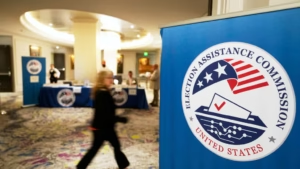
President Trump has removed the last remaining members of the U.S. Election Assistance Commission, the independent federal agency responsible for certifying voting equipment and supporting state election officials, leaving the bipartisan body entirely without sitting commissioners just months before the November midterms. The move follows a Supreme Court ruling earlier this year that dramatically expanded presidential authority to remove members of independent agencies without cause. Critics warn the decision leaves a critical piece of election infrastructure effectively paralyzed at a pivotal moment.
Story Highlights
- Trump removed Democratic commissioners Thomas Hicks and Benjamin Hovland from the four-seat Election Assistance Commission, following the earlier resignations of both Republican commissioners
- The agency cannot conduct official business until at least three new commissioners are appointed by the president and confirmed by the Senate
- The White House cited a recent Supreme Court ruling expanding presidential removal power over independent agency officials as legal justification
What Happened
The White House confirmed in mid-July that President Trump had removed the two remaining Democratic members of the Election Assistance Commission, an independent federal agency created by Congress in 2002 to support state and local election administration, certify voting systems, and maintain the national mail voter registration form. The commissioners removed, Thomas Hicks and Benjamin Hovland, were dismissed by the White House in a move that left the four-seat, statutorily bipartisan commission without a single sitting commissioner, since Republican commissioner Christy McCormick had recently resigned and fellow Republican Donald Palmer had departed earlier in the year.
In a statement explaining the dismissals, the White House said the president “reserves the right to remove individuals that may not be totally aligned with the important task of securing America’s elections and ensuring every legal vote is counted.” The administration explicitly cited the Supreme Court’s recent decision in a case involving Federal Trade Commission member Rebecca Slaughter, which the White House said gave the president clear legal precedence to act.
That underlying Supreme Court ruling, issued in a 6-3 decision, struck down a 91-year-old precedent established in the 1935 case Humphrey’s Executor v. United States, which had long shielded members of certain independent agencies from removal without cause. The ruling significantly expanded presidential authority over agencies structured with multimember, bipartisan boards, though the same court separately ruled 5-4 that Federal Reserve Board member Lisa Cook could not be removed under the same reasoning, citing the central bank’s unique constitutional structure and its critical role in monetary policy.
With the removals, the Election Assistance Commission is now legally unable to conduct official business requiring commissioner action until at least three new commissioners are nominated by the president and confirmed by the Senate, a process that could take months. Authority over day-to-day operations has effectively shifted to the commission’s executive director, who has only limited powers to keep the agency functioning under its existing rules and responsibilities policy. Election law experts have noted that it remains legally unclear whether the Supreme Court’s ruling regarding the FTC actually extends to bipartisan-by-statute agencies like the EAC, since that specific question has not yet been directly tested in court.
Why It Matters
The Election Assistance Commission plays a foundational, if often overlooked, role in the integrity of American elections. It certifies voting equipment used by states across the country, distributes federal grants for election security improvements, and maintains national standards for voting system testing. Leaving the agency without any sitting commissioner just months before a consequential midterm election raises practical concerns about the certification and support functions that many state and local election offices rely upon.
The dismissals also represent the latest and perhaps most consequential test yet of the newly expanded presidential removal power established by the Supreme Court’s ruling earlier this year. Because the statute governing the EAC specifically requires a bipartisan four-member structure with two commissioners from each major party, legal scholars argue the agency presents a genuinely novel question about whether the court’s reasoning in the FTC case extends to agencies whose structure Congress explicitly designed to prevent single-party control.
For advocates concerned about the concentration of federal authority over election administration, the timing is especially notable. The removals follow a pattern of increased executive assertiveness over election-related functions, including Justice Department letters warning state election officials of potential criminal prosecution over voter roll maintenance, suggesting a broader strategy of consolidating federal influence over what has traditionally been a decentralized system administered primarily by states and localities.
The dismissed commissioners have not indicated publicly whether they intend to challenge their removal in court, though any such litigation could become an important vehicle for resolving the unsettled legal question of whether bipartisan election-related commissions fall within or outside the scope of the president’s newly expanded removal authority.
Economic and Global Context
The Election Assistance Commission distributes federal grant funding that states rely upon to upgrade voting equipment, enhance cybersecurity protections for election infrastructure, and train local election officials, functions that have taken on increased importance following years of heightened scrutiny of election security following the 2020 and 2024 election cycles. A commission unable to conduct official business could delay or complicate the distribution of these funds during a critical pre-midterm period.
Voting equipment certification, another core EAC function, ensures that voting machines used across thousands of jurisdictions meet consistent federal technical and security standards. Without sitting commissioners to formally approve certification decisions, manufacturers and state election offices may face delays in bringing new or updated voting systems online ahead of November.
Internationally, U.S. election administration has often been held up by democracy-focused organizations as a model of institutional independence, precisely because bodies like the EAC were structurally designed by Congress to resist unilateral political control through mandated bipartisan composition. The removal of all sitting commissioners, regardless of the legal justification offered, is likely to draw scrutiny from international election observers monitoring institutional independence ahead of the midterms.
The broader legal precedent set by the underlying Supreme Court ruling on presidential removal power carries implications well beyond the EAC, potentially affecting dozens of other federal agencies structured with multimember, bipartisan boards designed by Congress to operate with some insulation from direct presidential control, a structural question with significant long-term implications for the balance of power between the executive and legislative branches.
Implications
In the coming months, expect close attention to whether Trump nominates replacement commissioners and how quickly the Senate moves to confirm them, given the agency’s inability to conduct official business without a quorum. Any delay in that process would leave the EAC in an extended state of limited operational capacity heading directly into the November midterms.
Election administrators and advocacy organizations are likely to press Congress to clarify, through legislation if necessary, whether the EAC’s specific bipartisan structure entitles it to protection from the kind of unilateral removal upheld in the FTC case, a question that may ultimately require additional Supreme Court review if litigation emerges from the dismissed commissioners.
For state and local election officials who rely on EAC certification, funding, and technical support, the practical near-term implication is a period of reduced federal capacity to assist with election preparation, potentially placing additional strain on state-level resources already stretched thin by increased federal scrutiny on multiple fronts simultaneously.
Sources
