


Story Highlights
- The executive order reclassifies roughly 8,000 “policy-influencing” federal employees into Schedule Policy/Career, making them at-will employees who can be fired for any reason
- Federal unions, including the American Federation of Government Employees and the National Treasury Employees Union, have filed multiple lawsuits challenging the order as unconstitutional
- The White House says the move enhances accountability and that removal decisions will not be made based on political affiliation
What Happened
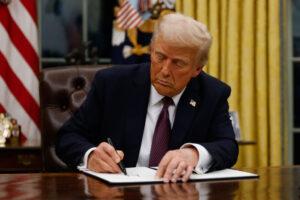
On Wednesday, June 3, President Donald Trump signed an executive order formally transferring an estimated 8,000 senior career federal employees into a new employment category known as Schedule Policy/Career. The category, which was first proposed as Schedule F during the final months of Trump’s first term and subsequently rescinded by the Biden administration, covers federal workers in positions described as having a “confidential, policy-determining, policy-making, or policy-advocating” nature. Under the previous system, these employees could only be dismissed through a process that included written notice, access to supporting materials, legal representation, and the right of appeal to an independent review board. The new designation strips those procedural protections and makes them effectively at-will employees.
The White House released a fact sheet alongside the signing describing the order as a measure to restore accountability to the federal workforce. Scott Kupor, a senior administration official who presented the policy, said that contrary to critics’ warnings about political patronage, the new category retains the traditional merit-based hiring process for competitive service positions. Kupor emphasized that removal decisions under Schedule Policy/Career would not be made based on political affiliation. The administration has consistently argued that career employees in policy-influencing roles are delegated presidential power and must therefore be accountable to the elected chief executive.
The response from federal unions was swift and emphatic. Everett Kelley, national president of the American Federation of Government Employees, described the order as a blatant attempt to corrupt the federal government by eliminating due process rights so that employees can be fired for political reasons. Doreen Greenwald, president of the National Treasury Employees Union, said the administration was stripping workers of rights that Congress had granted them rather than allowing them to perform the jobs the American people depend on. Federal employee groups have filed multiple lawsuits, with Democracy Forward, which represents several of the plaintiff unions, arguing that the executive orders and associated rules exceed presidential authority, violate federal civil service laws, and strip workers of constitutionally and statutorily guaranteed due process protections.
Agencies have one week from the signing to formally reclassify affected positions, according to guidance issued by the Office of Personnel Management. The order builds on a series of prior actions during Trump’s second term in which agencies have been directed to shrink their staffing levels, union contracts have been terminated in the name of national security, and the application process for competitive service positions has been modified with new essay questions critics have described as politically loaded.
Why It Matters
The constitutional stakes of Schedule Policy/Career are significant and extend well beyond employment law. The core legal question is whether the president can, by executive order alone, override protections that Congress deliberately built into the 1978 Civil Service Reform Act — a law that established the merit system and the independent appellate processes that career federal employees currently rely on. The unions’ lawsuits argue that the president’s action is precisely the kind of unilateral executive overreach that the law was designed to prevent.
For the American worker in federal service, the immediate practical consequence is a loss of whistleblower protection leverage. The National Treasury Employees Union noted that workers who previously felt comfortable reporting waste, fraud, and mismanagement because they were shielded from retaliation will now face job insecurity if they speak out. That chilling effect has implications for government accountability that extend to taxpayers and oversight institutions, including Congress.
Constitutionally, the order raises questions under the Fifth Amendment’s due process clause. Courts have long recognized that government employees who are dismissed can have a “property interest” in continued employment that triggers procedural protections before termination. Whether reclassification into an at-will category effectively waives that interest, or whether it can be eliminated by executive order rather than by statute, is precisely the question the courts will now be asked to answer.
Economic and Global Context
The executive order arrives as the federal government is already managing significant workforce turbulence following agency-level reductions, buyout offers, and reassignments that have characterized the Trump administration’s approach to the executive branch since January 2025. The cumulative effect on government operations has been difficult to measure comprehensively, but federal contractors, grantees, and state agencies that depend on federal expertise in regulatory and policy functions have flagged disruptions across multiple departments.
From an economic perspective, the federal workforce represents a substantial segment of employment in the Washington metro area and in communities across the country where major federal facilities and agencies are headquartered. Uncertainty about job security, driven by both the workforce reduction campaign and now Schedule Policy/Career, has had measurable consumer sentiment impacts in those communities, with local real estate and retail markets reflecting the anxiety.
Internationally, the hollowing out of career expertise in key policy-influencing positions — particularly in departments involved in trade, national security, and foreign affairs — has prompted concern among allies who rely on the continuity of American institutional knowledge in joint operations, intelligence sharing, and diplomatic negotiations.
Implications
The legal battles over Schedule Policy/Career are likely to be prolonged. Courts will need to resolve the fundamental question of whether the 1978 Civil Service Reform Act’s protections can be circumvented by executive reclassification, or whether Congress must act to modify them. That question has no obvious quick answer, and the litigation will likely proceed on an expedited timeline given the urgency of the agencies’ one-week implementation deadline.
If the courts allow the order to stand, the administration gains effective at-will authority over a significant tier of the career workforce and establishes a precedent for potentially broader future reclassifications. If the courts block implementation, the administration faces yet another judicial check on its executive reorganization agenda, adding to a growing list of policy actions that have been enjoined or reversed through litigation.
For the 8,000 employees affected, the weeks ahead will be marked by significant professional uncertainty even if courts ultimately intervene. The knowledge that their positions could be redefined — and that protections enjoyed for decades may be subject to executive reconfiguration — will inevitably shape the conduct and culture of affected agencies in ways that are difficult to fully anticipate.
Sources
