President Donald Trump used a primetime address to announce the declassification of intelligence documents he says reveal “shocking vulnerabilities” in America’s election infrastructure, tying the disclosure to his push for a sweeping elections reform bill. But a review of the documents by election officials, fact-checkers and members of his own past administration found little new evidence, reigniting a constitutional debate over executive power, election integrity and the limits of presidential authority heading into the 2026 midterms.
Story Highlights
- Trump declared he was declassifying intelligence documents showing vulnerabilities in U.S. election systems and ordered the Justice Department to prosecute those involved
- The president’s central ask was for Congress to pass the SAVE America Act, which Senate Majority Leader John Thune has said lacks sufficient Republican votes
- Independent reviews found the declassified documents largely restate previously known vulnerabilities rather than evidence of a stolen or rigged election
- Election officials, including Arizona’s Adrian Fontes, said the disclosure contained “nothing new”
What Happened
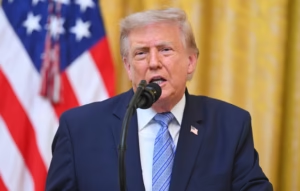
President Donald Trump delivered a 25-minute primetime address from the East Room of the White House on July 16, announcing that he had declassified a series of intelligence documents he said revealed “shocking vulnerabilities in our election infrastructure.” Trump argued that American election systems were exposed to hacking, exploitation and foreign interference at levels “never thought possible,” and directed the Department of Justice to pursue prosecutions of those he said were responsible for concealing the information from him and the public.
The president’s remarks focused heavily on claims that China had compromised election data during the 2020 election, alleging that Chinese actors had obtained roughly 220 million voter registration files. He also renewed longstanding allegations involving Venezuela and the voting technology company Smartmatic, and asserted that the intelligence community had suppressed information about foreign interference during his first term. Trump used the speech to press Congress to pass the SAVE America Act, his broad elections overhaul bill, which Senate Majority Leader John Thune has said does not currently have enough Republican support to pass.
A review of the declassified materials by independent fact-checkers and journalists found that much of the content had either been previously disclosed or reflected known, longstanding weaknesses in the U.S. election system rather than new evidence of manipulation. One declassified CIA memo, dated June 2026, restated a determination originally made in 2006 that Venezuela and Smartmatic lacked the capability to manipulate election outcomes outside Venezuela. Separately, a report from the Cybersecurity and Infrastructure Security Agency acknowledged that cyberattacks targeting vote tabulation systems could delay reporting or create public confusion, but concluded such attacks would probably not affect the integrity of certified results.
Officials from both the Biden and Trump administrations said there remains no intelligence indicating that voting machines or vote totals were altered in any election. A March 2021 Intelligence Community Assessment, declassified early in the Biden administration, found that China had taken some steps aimed at undermining Trump’s 2020 re-election prospects, but concluded those efforts occurred primarily through social media and public statements rather than through interference with election processes themselves, a conclusion Trump’s own declassified documents reiterated.
Democratic lawmakers and state election officials pushed back sharply on the speech. Arizona Secretary of State Adrian Fontes, a Democrat, said his staff reviewed the documents and found the disclosure “unimpressive,” adding “there is nothing new here.” Senator Chris Coons of Delaware characterized the address as “a temper tantrum” stemming from Congress’s refusal to advance Trump’s elections legislation. All 24 Democratic governors issued a joint statement following the speech, alleging the president intended to “intimidate and silence voters.”
Why It Matters
The speech touches directly on one of the most sensitive constitutional questions facing the country: the federal government’s role in overseeing elections that the Constitution largely reserves to the states. Trump’s push for the SAVE America Act, combined with his direct call for Justice Department prosecutions tied to election administration, raises questions among constitutional scholars about the separation of powers and the historical independence of state election systems from federal executive control.
For American voters, the dispute carries real stakes heading into the 2026 midterm elections. Public confidence in the electoral process is foundational to a functioning democratic republic, and repeated assertions of vulnerability, whether substantiated or not, can shape how citizens perceive the legitimacy of election outcomes regardless of the underlying facts. Critics argue that framing unproven claims as “shocking” evidence risks eroding trust in a system that Trump’s own Cybersecurity and Infrastructure Security Agency previously described, in 2020, as the most secure in American history.
For policymakers, the episode underscores the difficulty of advancing federal election legislation in a closely divided Congress. Thune’s acknowledgment that the SAVE America Act lacks sufficient Republican votes suggests that even within Trump’s own party, there is hesitation about the scope of proposed federal involvement in state-run elections, a dynamic that will likely shape debate through the remainder of the legislative session.
Economic and Global Context
While the speech centered on domestic election administration, it carries international dimensions given its focus on alleged Chinese and Venezuelan interference. The declassified documents referenced a 2022 finding that a Chinese actor had downloaded publicly available state voter information spanning 2013 to 2021, information experts note is not difficult to obtain since much voter data is either public or commercially available.
The renewed focus on Venezuela comes amid a broader escalation in U.S.-Venezuela relations, following the capture of former Venezuelan leader Nicolás Maduro by U.S. forces and his transfer to New York to face narcoterrorism and drug trafficking charges, to which he has pleaded not guilty. The declassified CIA memo on Smartmatic and Venezuelan capabilities is likely to factor into ongoing legal and political proceedings tied to that case.
Globally, the episode adds to scrutiny of how the Trump administration handles classified intelligence for domestic political purposes, a pattern that press freedom and transparency organizations have tracked closely across multiple disputes this year. The selective declassification of intelligence to support a policy argument, while common across administrations, has drawn particular attention given the sensitivity of election-related material.
Implications
In the near term, the SAVE America Act faces an uncertain path in the Senate, where Thune’s own assessment suggests Republican support remains insufficient for passage. Trump is likely to continue pressing the issue publicly, particularly as the 2026 midterms approach, and Democratic governors and secretaries of state are expected to continue pushing back against what they describe as an effort to delegitimize the electoral process in advance of any potential Republican losses.
For the Justice Department, Trump’s directive to prosecute individuals connected to alleged election interference will be closely watched by legal observers, particularly given the absence of new evidence of vote manipulation in the declassified materials. Any prosecutions that follow are likely to face legal challenges questioning whether they rest on substantiated findings or politically motivated claims.
For state election officials, who administer elections independently of federal direction under the Constitution’s allocation of authority, the speech reinforces an ongoing tension with the federal executive branch over jurisdiction and control. Officials like Fontes are likely to continue defending the security of existing systems publicly, setting up a prolonged battle over public perception heading into next year’s vote.
Sources
