
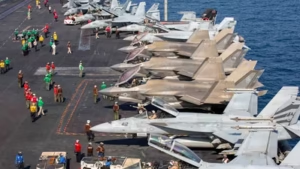
In the past week, the U.S. political and geopolitical landscape has entered a period of intense strategic pressure and acute constitutional debate as President Donald Trump’s authorization of a major military campaign against Iran — coordinated with Israeli forces — has rapidly evolved from a tactical strike into a full-blown conflict. The operation, branded “Operation Epic Fury,” marked a historic escalation with precision airstrikes that eliminated Iran’s Supreme Leader, triggered Iranian retaliation against U.S. forces, and resulted in the first American combat fatalities since Trump returned to the White House.
Domestically, United States Senate and United States House of Representatives members are now confronting the legal and political implications of continued hostilities without explicit congressional authorization for war, reigniting a decades-long battle over executive war powers and legislative prerogatives. At the same time, economic reverberations — including energy market jitters — and public opinion pressures are shaping an election-year narrative that could define Trump’s strategic legacy. The stakes are high: whether Washington can sustain broad support for a distant war while preserving constitutional balance and securing American interests on multiple fronts.
Story Snapshot
- U.S. confirms first service-member deaths in ongoing Iran operations; Trump signals campaign could last weeks.
- Bipartisan lawmakers say there’s no clear post-strike strategy; concerns over lack of Congress authorization mount.
- Congress begins formal debate on war powers under the War Powers Resolution.
- Domestic public support remains tepid; communication strategy is emerging as a political vulnerability.
Escalation and American Sacrifice
The joint U.S.–Israeli offensive against Iran’s leadership and military infrastructure, initiated late February 2026, has rapidly escalated beyond a surgical strike into a sustained military campaign with real costs. Central Command confirmed the deaths of three U.S. service members and serious injuries to several others during actions associated with the operation, marking the first combat losses for American troops under Trump’s second term. President Trump has publicly acknowledged both the strategic gains and the human cost of the campaign, warning that more casualties may follow as operations continue.
This phase of conflict — following Iran’s retaliation against U.S. bases in the region — underscores the lethal seriousness of the situation and the unpredictable dynamics of modern Middle East warfare. While Trump framed the action as necessary to neutralize an imminent threat and destroy Tehran’s capacity to project power across the region, these combat losses bring an immediate and sobering reality to the prolonged nature of the engagement. The human toll continues to shape public sentiment and political debates back home.
Constitutional Clash: War Powers and Authority
Even as tactical successes are cited by administration officials, the domestic political arena is irrevocably shaped by constitutional scrutiny and inter-branch tensions. Lawmakers from both parties in United States Senate and United States House of Representatives have voiced deep concern over the lack of formal Congress authorization for what has now become a prolonged military campaign. Critics argue that Trump’s decision to escalate without clear legislative endorsement runs counter to the Constitution’s allocation of war powers, challenging executive latitude and raising fresh questions about checks and balances.
The looming debate in Congress over the War Powers Resolution reflects an institution grappling with reclaiming its constitutional prerogatives while confronting the realities of an emergent conflict overseas. Although a Republican-led Congress may be predisposed toward sustaining the administration’s strategic aims, the absence of a nuanced post-strike plan has emboldened dissent even among traditional allies. Bipartisan voices are calling for precise benchmarks, legal justification, and oversight mechanisms before funding or further escalation decisions. This constitutional wrangle could define legislative–executive relations for years to come.
Political Terrain: Messaging and Midterm Impacts
As the conflict unfolds, significant strain is emerging on the domestic political front, where public opinion and media narratives are forming at breakneck speed. Polling data reveals tepid approval for the military operation, with segments of the electorate questioning the rationale for engagement so far from U.S. shores. Trump’s challenge has been twofold: concurrently explaining strategic necessity and reassuring voters that broader American interests — from energy prices to troop safety — are being safeguarded.
This messaging challenge is particularly salient given the proximity of the 2026 midterm elections and the ongoing struggle within the Republican coalition between traditional defense hawks and constituents skeptical of foreign entanglement. Failure to articulate a clear, achievable political and military objective could erode the coalition’s cohesion and create opportunities for opposition narratives to gain traction on national security and fiscal responsibility. How Trump leverages his communication platforms and engages with both rank-and-file Americans and key lawmakers will be a linchpin for his electoral calculus moving forward.
Strategic Foundations and Global Implications
Beyond domestic politics, the consequences of an expanded U.S. military role in the Middle East extend into global strategic realms. Allies and adversaries alike are recalibrating their geopolitical assessments. Traditional partners are cautious, urging de-escalation to avoid a wider regional conflagration that could disrupt global supply chains and accelerate energy market instability. Meanwhile, adversaries are watching Washington’s political fracturing as a potential vulnerability to exploit. This dynamic underscores the broader challenge for the Trump administration: balancing decisive military action with sustainable diplomacy and coalition management.
Equally significant is the operational precedent set by this conflict — where executive initiative, allied military coordination, and partial legislative retreat shape a modern blueprint for U.S. engagements abroad. Whether this model strengthens deterrence or undermines long-term diplomatic leverage will be a key strategic question for policymakers across the political spectrum.
Sources
- US announces its first casualties in Iran war; poll signals challenge for Trump
- US lawmakers see no Trump plan for Iran following strikes
- Congress will debate an Iran conflict that is well underway
- Trump Launched Iran Operation Abroad. Can He Sell It at Home?
