

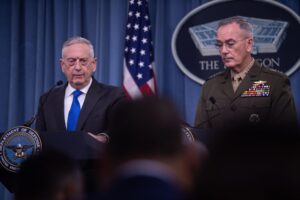
The United States has reinforced its military posture in the Middle East over the past two weeks, deploying additional naval assets and air defense systems as tensions with Iran remain elevated. Defense officials confirmed that carrier strike group movements and missile defense reinforcements are designed to deter escalation while diplomatic talks continue in Geneva. President Donald Trump has framed the deployments as a preventive measure — strengthening deterrence without committing to conflict. The strategic message is clear: negotiation remains open, but American military readiness is non-negotiable. This calibrated posture reflects a broader administration doctrine — leverage first, diplomacy second, and credible force always available. As regional actors assess Washington’s intent, the convergence of military reinforcement and diplomatic engagement is shaping a consequential moment in U.S. foreign policy.
Story Snapshot
- U.S. deployed additional naval and missile defense assets to the Middle East.
- Reinforcements coincide with ongoing U.S.–Iran nuclear negotiations in Geneva.
- Pentagon describes moves as defensive and deterrence-focused.
- Regional allies signal support for sustained U.S. presence.
- White House frames posture as strength-backed diplomacy.
Deterrence as Strategic Foundation
The Pentagon confirmed that expanded naval deployments include enhanced air defense capabilities and regional force protection adjustments. While not framed as preparation for imminent conflict, officials emphasized readiness in response to intelligence assessments regarding Iranian activity and proxy dynamics. Carrier strike groups and destroyers equipped with missile defense systems provide layered protection and signal rapid-response capability.
For the administration, deterrence serves as the strategic baseline. Rather than reducing presence during negotiations, the United States has reinforced it — a posture designed to avoid miscalculation. The principle aligns with long-standing conservative defense doctrine: stability through strength.
Military analysts note that such deployments create both reassurance and leverage. Regional partners view visible U.S. presence as a stabilizing anchor, while adversaries are reminded that escalation would encounter immediate counter-capability.
Diplomacy Under Pressure
The reinforced posture coincides with renewed nuclear talks between Washington and Tehran. U.S. negotiators are reviewing Iranian proposals concerning enrichment limits and inspection frameworks, while administration officials stress that any agreement must be verifiable and enforceable.
By maintaining military readiness during negotiations, the White House avoids signaling concession. This dual-track approach — pressure plus dialogue — aims to secure tangible concessions without incentivizing brinkmanship. Officials have stated that absent credible commitments, additional economic measures remain available.
Strategically, the administration appears determined to avoid repeating prior frameworks criticized for limited enforcement clarity. Diplomacy, in this model, operates within a framework of credible deterrence rather than substituting for it.
Alliance Confidence and Global Signaling
The deployment has drawn supportive signals from regional allies, including Gulf states and Israel, who have long advocated sustained American presence as a counterweight to Iranian influence. European governments, while emphasizing diplomatic progress, have not opposed the defensive nature of the U.S. reinforcements.
Globally, the message extends beyond the Middle East. Following recent judicial scrutiny over trade authority, reinforcing defense posture demonstrates continuity of executive strength in security matters. It underscores that constitutional checks in one domain do not diminish resolve in another.
For geopolitical observers, the interplay between trade recalibration and military reinforcement illustrates a comprehensive approach to national power — economic, diplomatic, and strategic levers functioning in tandem.
Congressional Oversight and Political Context
Members of the United States Senate have requested briefings on force posture adjustments, emphasizing the need for transparency regarding mission scope and escalation thresholds. While bipartisan support generally exists for deterrence measures, lawmakers seek clarity on long-term objectives and costs.
Domestically, the timing intersects with the upcoming State of the Union address and broader midterm positioning. For President Trump, projecting steadiness in national security reinforces executive credibility amid ongoing legislative debates over trade and election law.
Polling suggests voters consistently prioritize national security and economic stability. By emphasizing readiness and restraint simultaneously, the administration aims to appeal to constituencies that favor assertive but controlled foreign policy.
Operational and Strategic Implications
Operationally, the reinforced deployments provide redundancy in missile defense and maritime security corridors. Strategically, they reduce the likelihood of opportunistic aggression during diplomatic engagement. The layered approach seeks to minimize risk without foreclosing negotiation.
Defense planners caution that visible deterrence must be calibrated to avoid unintended escalation. So far, Pentagon statements emphasize defensive intent and coordination with allies, framing movements as prudent adjustments rather than aggressive maneuvers.
The coming weeks will test whether deterrence stabilizes the environment sufficiently for diplomatic breakthroughs — or whether it signals prolonged strategic standoff.
What Comes Next
Negotiations in Geneva are expected to continue through technical review sessions, while the Pentagon maintains heightened readiness. Should talks yield measurable commitments, the reinforced posture may gradually recalibrate. If diplomacy falters, Washington has signaled readiness to intensify economic or strategic pressure.
For American national interests, the equation remains straightforward: prevent nuclear escalation, protect regional stability, and uphold deterrent credibility. The administration’s current posture reflects an attempt to balance firmness with flexibility — projecting strength while preserving diplomatic channels.
As geopolitical tensions evolve, the convergence of military preparedness and diplomatic engagement will define the next chapter of U.S. strategy in the Middle East. Whether this calibrated approach yields de-escalation or prolonged rivalry, it underscores a governing principle: national security rests on credible capability paired with disciplined statecraft.
Sources
- Trump pushes US toward war with Iran as advisers urge focus on economy, Reuters,
- Next US-Iran nuclear talks are Thursday in Geneva as Washington awaits proposed deal from Tehran, Associated Press,
- US deploys additional military assets to Middle East amid rising tensions, PBS NewsHour,
- Pentagon confirms carrier strike group movements in region, Reuters, February 2026
