


Story Highlights
- Trump’s visit to China is the first by a U.S. president since 2017 and comes as the Iran ceasefire appears on the verge of collapse
- The White House has invited more than a dozen senior American executives including Tesla CEO Elon Musk and Apple CEO Tim Cook to accompany Trump on the trip
- Taiwan is watching the summit with deep anxiety over the possibility Trump may trade political concessions on cross-strait policy for economic commitments from Beijing
What Happened
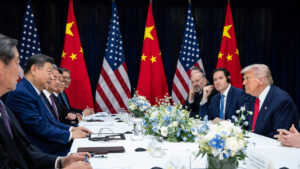
China’s Foreign Ministry confirmed Monday that President Donald Trump will pay a state visit to Beijing from May 13 to 15 at the invitation of President Xi Jinping. According to the White House, Trump will arrive in Beijing on Wednesday evening for what press secretary Anna Kelly described as a “visit of tremendous symbolic significance.” The following morning, Trump will participate in a formal welcome ceremony and hold a bilateral meeting with Xi, followed by a tour of the historic Temple of Heaven — a 15th-century landmark in central Beijing — and a state banquet on Thursday evening.
The summit will be the first face-to-face meeting between the two leaders since their encounter at the APEC forum in Busan, South Korea, last October, and Trump’s first trip to Chinese soil since his first term in 2017. The timing is anything but routine. The visit comes with the U.S.-Iran ceasefire on what Trump himself called “massive life support,” Iran’s blockade of the Strait of Hormuz continuing to suppress global energy markets, and the Trump administration having imposed new sanctions on 12 entities for helping Iran sell oil to China just one day before Trump’s departure.
The White House confirmed that more than a dozen senior American business executives have been invited to join the president in Beijing, including Elon Musk, CEO of Tesla and SpaceX; Tim Cook, CEO of Apple; and Kelly Ortberg, CEO of Boeing. Notably absent from the list is Jensen Huang, CEO of Nvidia, whose absence is widely interpreted as reflecting ongoing U.S.-China friction over semiconductor technology exports. The inclusion of major corporate leaders suggests Trump is seeking concrete economic commitments from Beijing alongside any diplomatic progress.
Treasury Secretary Scott Bessent departed for Asia ahead of Trump, with trade negotiators from both countries meeting in Seoul, South Korea, to prepare the diplomatic ground. The packed itinerary ahead of the summit reflects the breadth of issues at stake and the urgency felt on both sides to manage bilateral tensions that have reached a critical juncture.
Why It Matters
The Beijing summit carries enormous significance for American foreign policy and the global economic order. The United States and China are the world’s two largest economies, and their relationship touches virtually every major international challenge — from the Iran conflict and energy prices to semiconductor supply chains, rare earth minerals, and the future of the Taiwan Strait. A successful summit that reduces tensions could provide meaningful economic relief through lower oil prices and improved trade stability. A failed summit could accelerate already dangerous dynamics.
For Trump, the most pressing objective in Beijing is persuading Xi to use China’s substantial influence over Iran to push Tehran toward a workable ceasefire agreement. China is one of the few major powers with meaningful diplomatic ties to both the United States and Iran. The Trump administration has simultaneously been escalating pressure on Chinese entities that buy Iranian oil through the IRGC’s sanctions-busted export networks, creating a dynamic in which Beijing is being squeezed and cajoled simultaneously.
China’s broader priority at the summit is greater predictability and stability in the bilateral relationship, particularly on trade policy. Beijing is seeking relief from the tariff escalation that peaked above 140 percent during the most acute phase of last year’s trade war before both sides reached a partial accommodation. Chinese analysts see the summit primarily as a relationship management exercise — an opportunity to prevent the relationship from deteriorating further rather than a vehicle for historic breakthroughs.
Taiwan’s government is watching the summit with particular apprehension. Senior Taiwanese officials have told Bloomberg they are most afraid of being put “on the menu” of the Trump-Xi talks. Taipei’s concern is that Trump, confident in his personal relationship with Xi, might offer Taiwan-related concessions — such as softening the language on U.S. opposition to Chinese unification or agreeing to limits on arms sales to Taipei — in exchange for economic commitments or Chinese pressure on Iran.
Economic and Global Context
The backdrop to the summit is a global economy under severe stress from the Iran war’s energy disruption. Oil prices above $100 per barrel are functioning as a tax on every sector of the global economy, slowing growth in Europe, Asia, and the developing world. Japan, which imports roughly 75 percent of its oil from the Middle East, has been particularly hard hit. Bessent’s meeting with Japanese Prime Minister Takaichi in Tokyo on Monday was partly focused on coordinating a response to the economic consequences of the Hormuz blockade.
China’s own economic interests in resolving the Iran conflict are complex. On one hand, China is Iran’s largest oil customer and has benefited from discounted Iranian crude flowing through what American officials call “teapot refineries” in Shandong province. On the other hand, the energy disruption and global economic slowdown are hurting Chinese exporters and increasing domestic pressure on Beijing. Trump’s decision to sanction Chinese entities buying Iranian oil just hours before departing for Beijing is a calculated signal of American seriousness — and leverage.
The Center for Strategic and International Studies described the summit as primarily aimed at “avoiding an unnecessary escalation of tensions and managing risks” rather than building deep structural frameworks. Nomura’s Chief China Economist Ting Lu said in a note Monday that “the most pressing agenda item is the Iran-Hormuz crisis,” reflecting broad market consensus that the summit’s most consequential outcome will be whether China agrees to pressure Iran into reopening the Strait of Hormuz.
Implications
If Trump secures meaningful Chinese pressure on Iran as part of the summit, the geopolitical and economic dividends could be substantial. A credible Chinese commitment to push Tehran toward a deal could accelerate ceasefire negotiations, help reopen the Strait of Hormuz, and send oil prices lower — providing the economic relief that currently appears beyond the reach of any domestic policy measure. Gas prices falling back toward $3 per gallon before November would dramatically improve Republican midterm prospects.
For Taiwan, the stakes are existential in a more long-term sense. Any Trump concession on the cross-strait relationship — even a subtle shift in language — could undermine decades of carefully calibrated ambiguity in American Taiwan policy. The ripple effects would extend to allied nations in Asia, particularly Japan and South Korea, who are watching American reliability under Trump with sustained anxiety.
For American businesses attending the summit, the visit represents an opportunity to advance commercial relationships in the world’s second-largest consumer market. Apple’s supply chain dependence on Chinese manufacturing, Boeing’s commercial aviation ambitions in China, and Tesla’s electric vehicle competitiveness in the Chinese market all stand to benefit from reduced bilateral friction — or to suffer if the summit deteriorates into a confrontation.
The summit will also send a signal to the rest of the world about whether the United States and China can continue to manage their competition without it tipping into open conflict. In an era of U.S.-Iran hostilities, a fraying global trading system, and NATO cohesion under stress, a stable U.S.-China relationship remains one of the few anchors holding the international order together. The world’s governments, financial markets, and defense establishments will be watching carefully.
Sources
“China confirms dates for Donald Trump’s state visit to Beijing”
