


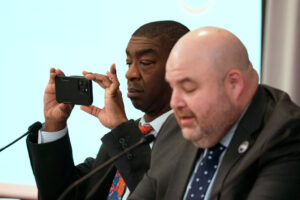
President Trump has removed the last three sitting members of the U.S. Election Assistance Commission, leaving the bipartisan agency that certifies voting equipment and distributes federal election grants without a functioning quorum just months before the midterms. The move marks the first major test of expanded presidential removal power the Supreme Court granted Trump last month, and it has drawn sharp warnings from voting rights advocates and state election officials about disruption heading into November. Critics say the ousters strike at the heart of an agency Congress deliberately designed to operate above partisan control.
Story Highlights
- Trump fired Democratic commissioners Thomas Hicks and Benjamin Hovland by email; Republican commissioner Christy McCormick was asked to resign.
- The Election Assistance Commission has distributed more than $1 billion in election security grants since 2018 and is now left without a quorum.
- The action follows the Supreme Court’s ruling in Trump v. Slaughter, which granted presidents broad power to remove leaders of independent agencies.
- The commission had resisted a Trump executive order demanding proof-of-citizenship requirements on the national voter registration form.
What Happened
The White House confirmed last week that President Trump had removed all three remaining members of the four-seat Election Assistance Commission, an independent agency created by Congress in 2002 following the disputed 2000 election. Democratic commissioners Thomas Hicks and Benjamin Hovland were notified of their termination by email from a White House personnel aide, while Republican commissioner Christy McCormick was asked to resign in a phone call, according to multiple people familiar with the dismissals. A fourth seat had already been vacant since a previous Republican commissioner departed earlier this year to join the Heritage Foundation.
The commission, created under the bipartisan Help America Vote Act signed by President George W. Bush, is structured to require two commissioners from each party and plays a largely supportive role in election administration: certifying voting equipment, distributing federal grants, and maintaining the national mail voter registration form used across nearly every state. Hovland, a Trump first-term appointee who had served since 2019, said the commission’s work sharing best practices between state election offices would be directly hindered by its inability to act. “When you’re asking more and more of people without giving them the necessary resources, mistakes happen,” he said.
The dismissals follow months of friction between the commission and the White House. In March 2025, Trump issued an executive order directing the commission to require documentary proof of citizenship on the national voter registration form, a change sought by the Trump-aligned law firm America First Legal. The commission opened the proposal for public comment, receiving hundreds of thousands of responses, but had not held a final vote before its members were removed. Courts have separately blocked most of Trump’s executive actions attempting to reshape federal voting procedures, citing the Constitution’s assignment of election administration authority to the states.
The ousters came less than two weeks after the Supreme Court’s ruling in Trump v. Slaughter, which overturned decades of precedent by allowing the president to remove leaders of independent agencies, such as the Federal Trade Commission, without cause. In a separate ruling issued the same day involving the Federal Reserve, the court carved out an exception for central bank governors, citing the Fed’s unique constitutional design. Whether that same protection extends to bipartisan election agencies like the EAC remains legally unresolved, and any legal challenge from the fired commissioners could force the justices to directly confront that question.
Why It Matters
The Election Assistance Commission occupies a small but structurally important place in the American election system. Congress deliberately built it to require bipartisan balance precisely because election administration touches the legitimacy of democratic outcomes themselves. Removing all sitting commissioners at once, leaving the agency without the quorum needed to take any formal action, represents an unprecedented disruption to that structure with the midterms just months away.
For state and local election officials, who rely on the commission for equipment certification, technical guidance and federal funding, the leadership vacuum threatens practical disruptions at a moment when election offices are already stretched thin. The Bipartisan Policy Center noted the agency previously went without commissioners for three years starting in 2011, a period during which its ability to support state election officials was significantly hampered.
Constitutionally, the episode represents the first real-world application of the Supreme Court’s expanded removal-power doctrine to an agency explicitly designed around bipartisan checks rather than unified executive control. Legal scholars have noted that if courts ultimately extend the same removal authority the justices granted for agencies like the FTC to election-specific bodies like the EAC, it would mark a significant shift in how much direct influence a sitting president can exert over the machinery of federal elections, even though the Constitution assigns primary authority over elections to the states.
For voters, the practical stakes may be less immediate than the symbolic ones. Officials broadly agree the move is unlikely to directly alter how ballots are cast or counted in November. But the episode reinforces a pattern of executive actions aimed at reshaping oversight of elections, following the administration’s Fulton County investigation and renewed 2020 fraud claims, that critics argue cumulatively erode public confidence in nonpartisan election administration.
Economic and Global Context
Since 2018, the Election Assistance Commission has distributed more than $1 billion in federal grants to states for election security infrastructure, funding that supports everything from voting machine upgrades to cybersecurity protections for local election offices. A commission unable to act due to lack of quorum could complicate the distribution or oversight of any future rounds of this funding ahead of November.
The broader legal fallout from Trump v. Slaughter carries economic implications well beyond election administration, as the same removal-power doctrine could be applied to a range of independent regulatory bodies overseeing financial markets, communications, and consumer protection, raising uncertainty for industries that rely on predictable, insulated regulatory oversight.
Internationally, U.S. election administration is closely watched by democracy-focused organizations and allied governments as a benchmark for institutional independence. Continued disruption to a body Congress designed specifically to be shielded from partisan control adds to a broader narrative, tracked by international election observers, about the durability of independent institutions within the American system.
Implications
Presidential appointments to the EAC require Senate confirmation, a process that could take months even if the White House moves quickly to nominate replacements. In the interim, the agency’s day-to-day operations will likely continue through career staff, though without commissioners able to approve major decisions or respond to emerging issues before the midterms.
For Hicks and Hovland, a legal challenge to their removal remains possible, though doing so would require directly confronting the Supreme Court’s recent removal-power rulings, an uncertain and potentially lengthy legal path. Any such case would be closely watched as a bellwether for how far the court’s new doctrine extends into election-specific institutions.
For state election officials, particularly those in politically competitive states, the coming months will likely require greater reliance on their own resources and cross-state coordination as the federal support structure the EAC has historically provided remains in limbo.
For Congress, the episode is likely to reignite debate over whether the Help America Vote Act needs strengthening to better insulate the commission from removal, though any such legislative fix would require bipartisan cooperation that has proven elusive on most election-related measures this year.
Sources
