

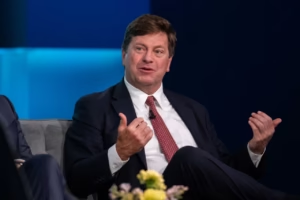
Jay Clayton, President Trump’s nominee for director of national intelligence, testified before the Senate Intelligence Committee Wednesday after Trump abruptly delayed his confirmation hearing weeks earlier. The hearing unfolded against the backdrop of a lapsed federal surveillance authority and mounting Democratic concern that the nation’s intelligence apparatus could be turned toward domestic election disputes. Clayton’s testimony, including a pointed refusal to affirm who won the 2020 election, has renewed scrutiny of how far the administration is willing to go in reshaping independent institutions.
Story Highlights
- Jay Clayton, U.S. attorney for the Southern District of New York, testified before the Senate Intelligence Committee to become director of national intelligence.
- Trump abruptly canceled Clayton’s originally scheduled June 17 hearing, delaying his confirmation for weeks.
- Section 702 of the Foreign Intelligence Surveillance Act, a warrantless surveillance authority, has lapsed amid the standoff.
- Sen. Angus King pressed Clayton to state who won the 2020 election; Clayton declined to answer.
What Happened
Jay Clayton, currently the U.S. attorney for the Southern District of New York and a former chairman of the Securities and Exchange Commission, appeared Wednesday before the Senate Intelligence Committee for his long-delayed confirmation hearing to become director of national intelligence. The hearing had originally been scheduled for June 17, but Trump directed Clayton not to appear just hours beforehand, prompting Committee Chairman Tom Cotton to call the delay “regrettable.” Trump said at the time he wanted the Senate to first confirm Clayton’s eventual successor as U.S. attorney and suggested the nomination process was moving too quickly.
Clayton’s nomination would fill a post that has sat in flux since Tulsi Gabbard resigned as director of national intelligence in May, citing her husband’s cancer diagnosis. Trump then installed Bill Pulte, a former housing official with no intelligence background who has used past administration roles to target perceived adversaries of the president, as acting director. Lawmakers in both parties have expressed discomfort with Pulte’s continued presence atop the nation’s 18 intelligence agencies, and many see Clayton, despite his lack of traditional intelligence experience, as a more conventional choice.
During the hearing, Clayton faced a tense exchange with independent Sen. Angus King of Maine, who asked him directly to state who won the 2020 presidential election. “I’ve answered that question. I’m not going to get into that,” Clayton replied, declining to affirm President Biden’s certified victory. The exchange took on additional significance given that Clayton previously told CNBC the United States is “doing an absolutely terrible job” on election integrity and singled out California’s mail-in voting laws as creating opportunities for fraud, despite election experts and state officials saying no evidence supports that claim.
The hearing also carries stakes for national security law. Section 702 of the Foreign Intelligence Surveillance Act, a warrantless surveillance authority used to monitor foreign intelligence targets, has lapsed amid the broader confirmation standoff, and Senate Republicans have said confirming Clayton “would be a good first step” toward breaking the logjam on its renewal. Democrats, led by Vice Chairman Mark Warner, have called Clayton “a capable public servant” without committing to support his nomination, while House Intelligence ranking member Jim Himes praised his independence during his SEC tenure.
Clayton’s office has also been involved in reviewing Justice Department files related to Jeffrey Epstein, and as U.S. attorney he oversaw the indictment of former Venezuelan President Nicolás Maduro on drug trafficking charges. His hearing took place the same morning that acting Attorney General Todd Blanche faced his own confirmation hearing before the Senate Judiciary Committee, underscoring a broader wave of contested personnel changes moving through the Senate simultaneously.
Why It Matters
The director of national intelligence oversees the entire U.S. intelligence community, advises the president on matters of national security, and plays a central role in classified budget decisions. Clayton’s refusal to affirm the outcome of the 2020 election, even as a matter of settled historical fact, raises questions about whether the nation’s top intelligence official would provide unvarnished, apolitical assessments to the president or defer to Trump’s long-standing and unsubstantiated fraud claims.
The lapse of Section 702 surveillance authority represents a genuine national security gap that intelligence officials have said complicates efforts to track foreign threats. Whether Clayton’s confirmation can break the legislative logjam surrounding its renewal carries direct implications for how effectively U.S. agencies can monitor threats from adversarial states during an active military conflict with Iran.
For advocates of institutional independence, the broader concern is that Trump delayed and reshaped this nomination process specifically to install a preferred acting director, Pulte, whose background raised bipartisan alarm. That pattern, of using acting appointments to bypass the ordinary confirmation process, has become a recurring feature of the administration’s approach to staffing sensitive positions.
The timing of the hearing, arriving just one day before Trump’s planned primetime address on elections, adds further weight to questions about the next intelligence director’s willingness to push back against the president’s election claims, a role Congress has traditionally expected of nonpartisan security officials.
Economic and Global Context
The lapse of Section 702 authority has tangible costs for national security operations, as it curtails the government’s ability to conduct warrantless surveillance of foreign intelligence targets communicating with individuals inside the United States. Intelligence officials have periodically warned that gaps in this authority can create blind spots during periods of heightened international tension, a concern made more acute by the active U.S. military campaign against Iran.
Clayton’s background as a corporate lawyer and former SEC chairman, rather than a career intelligence official, reflects a broader trend across the administration of appointing officials from finance, law and business backgrounds to national security posts traditionally filled by career professionals. Supporters argue this brings valuable managerial and legal expertise; critics contend it sacrifices institutional knowledge at a sensitive moment.
Globally, U.S. allies rely on consistent, credible American intelligence leadership to coordinate on shared threats, including those emanating from Iran, Russia and China. Extended uncertainty atop the intelligence community, compounded by an unqualified acting director, has drawn quiet concern from foreign intelligence partners about continuity in information-sharing arrangements.
Implications
The Senate Intelligence Committee is expected to vote on Clayton’s nomination in the coming weeks, with both parties signaling a desire to move relatively quickly given widespread discomfort with Pulte’s continued leadership. A confirmed Clayton would likely accelerate efforts to renew Section 702, a priority for national security hawks in both parties.
For Democrats, Clayton’s noncommittal answers on 2020 and his prior comments on mail-in voting will likely feature prominently in future oversight hearings, particularly if Trump’s Thursday address escalates his election fraud claims.
For the intelligence community itself, a prolonged leadership vacuum, or the installation of a director seen as unwilling to challenge the White House on politically sensitive assessments, could affect morale and the perceived independence of intelligence products delivered to Congress and the public in the months ahead.
Sources
