Story Highlights
- The DOJ served grand jury subpoenas to Wall Street Journal reporters on March 4, targeting a February 23 article on Pentagon warnings about the risks of an extended Iran campaign
- Trump personally directed Acting Attorney General Todd Blanche to pursue the subpoenas, reportedly via a sticky note bearing the word “Treason” atop a stack of printed news articles
- Multiple other news outlets have reportedly also received subpoenas; Dow Jones called the action “an attack on constitutionally protected newsgathering”
What Happened
The Wall Street Journal disclosed Monday that it received grand jury subpoenas from the Department of Justice dated March 4, seeking records belonging to the paper’s reporters in connection with a story published five days before the United States launched its military campaign against Iran. That February 23 article reported that Gen. Dan Caine, Chairman of the Joint Chiefs of Staff, and other senior Pentagon officials had warned President Donald Trump about the serious risks of undertaking an extended military operation against Iran. Trump launched the joint U.S.-Israeli offensive on February 28.
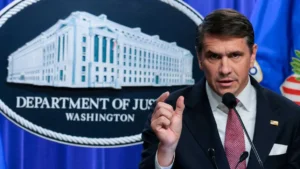
According to officials familiar with the matter who spoke to CNN, Trump personally drove the subpoena process. The president assembled a stack of printed news articles related to Iran war coverage, wrote the word “Treason” in Sharpie on a sticky note affixed to the top, and handed the package to Acting Attorney General Todd Blanche during a White House meeting. Blanche subsequently directed the DOJ to issue the subpoenas. Officials told CNN the department’s National Security Division had already begun examining potential leak sources, but the president’s direct intervention accelerated the effort considerably.
Blanche followed up publicly on Tuesday, writing on social media that the administration has made prosecuting leakers a top priority. He stated that any person — including reporters — who has information about the “illegal leaking of classified material” should not be surprised to receive a subpoena. Blanche made clear that while the stated target of the investigation is the government employees who allegedly leaked, reporters who received classified information are within the scope of the department’s interest.
Dow Jones, which publishes the Wall Street Journal, responded forcefully. The company’s chief communications officer stated that the subpoenas “represent an attack on constitutionally protected newsgathering” and vowed to “vigorously oppose this effort to stifle and intimidate essential reporting.” The Committee to Protect Journalists likewise condemned the subpoenas, calling the conflation of journalism with treason “dangerous and anti-democratic.” Multiple other news organizations are believed to have received similar subpoenas, though several have declined to comment publicly.
Why It Matters
The First Amendment to the Constitution explicitly protects freedom of the press from government interference, and the Supreme Court has repeatedly affirmed that protection over more than two centuries of American jurisprudence. When the federal government issues grand jury subpoenas to journalists seeking their source records, it tests the outer limits of that constitutional protection in the most direct possible way. The use of a criminal grand jury process — rather than a civil proceeding — carries significant coercive power and creates genuine legal jeopardy for reporters who resist.
The article at the center of this controversy described Pentagon officials warning the president about the risks of the very military campaign he had already decided to launch. Whether one supports or opposes the Iran war, the public’s ability to know that senior military leaders expressed reservations before combat operations began is precisely the kind of information that a free press exists to report. The administration’s framing of that reporting as treasonous is a direct argument that citizens do not have a right to know about internal government dissent on matters of war and peace.
The broader context matters here. Trump has, over several months, floated the prospect of criminal charges against journalists covering the Iran war and publicly discussed the desire to imprison the reporter responsible for a story about a downed American fighter jet. Each of those statements, taken alone, might be dismissed as presidential rhetoric. The issuance of actual subpoenas transforms rhetoric into legal action and places the constitutional conflict in concrete, justiciable territory.
For the American press corps and the millions of citizens who rely on independent journalism to understand what their government is doing in their name, this development is not abstract. If reporters can be compelled to reveal sources through grand jury subpoenas whenever the executive branch labels coverage of military operations a national security threat, investigative reporting on government conduct in wartime becomes functionally impossible.
Economic and Global Context
The press freedom implications extend well beyond the United States. International rankings of press freedom have already been tracking a downward trend for America under the current administration. Formal subpoenas targeting journalists at one of the country’s most respected financial newspapers will further damage those rankings and complicate American diplomatic efforts to champion press freedom in authoritarian states, including at the very moment Trump is meeting Xi Jinping in Beijing.
Domestically, the Journal’s subpoenas land in the middle of a broader national debate about the boundaries of executive power. The Trump administration has pursued an expansive theory of presidential authority across multiple policy domains — immigration, regulatory enforcement, personnel control — and the press subpoenas fit squarely within that pattern. Each new assertion of executive prerogative invites legal challenge and forces courts to draw clearer lines about what the Constitution permits.
For the defense industry and national security establishment, there are real and legitimate concerns about classified information leaks that compromise ongoing military operations. The pilot rescue operation story that Trump referenced in April involved operational security details that could, in theory, endanger service members. That concern deserves to be addressed through lawful means. The question is whether subpoenaing the reporters who published the story, rather than exclusively investigating the government employees who leaked, crosses a constitutional line.
The financial press, in particular, has an outsized role in informing markets about government decision-making. The Wall Street Journal is not merely a political newspaper — it is the most widely read financial publication in the United States. Any chilling effect on its national security and defense reporting ultimately impoverishes market participants who rely on independent information to make decisions.
Implications
The most immediate implication is legal. Dow Jones has vowed to fight the subpoenas, which sets up a court battle that will likely produce significant First Amendment precedent. Courts have historically extended qualified protection to journalists in such circumstances, but the scope of that protection in the context of national security and classified information remains contested territory. The outcome of any litigation will shape the landscape for press-government relations for years.
For Congress, the subpoenas create a potential oversight moment. Lawmakers on both sides of the aisle have, in the past, defended the principle of press freedom against executive overreach, even when they disagreed with specific reporting. Whether Republican members of Congress are willing to publicly push back against an administration they otherwise support will be an early test of institutional independence heading into the midterm election season.
For the Trump administration, the strategic calculation is transparent: identify and prosecute the government employees who shared sensitive information, while simultaneously discouraging future leaks through demonstrated willingness to pursue reporters as legal leverage. Whether that calculation succeeds depends on how courts rule and how the public ultimately weighs press freedom against national security.
For ordinary Americans who support both a strong national defense and a free press, this story presents a genuine tension with no easy resolution. The government has a legitimate interest in protecting military secrets. The press has a constitutional role in holding the government accountable for its decisions in wartime. The line between those two interests is the most important constitutional battleground of the current moment.
Sources
“Justice Dept. subpoenas Wall Street Journal, escalating investigations into media leaks”
