
Story Highlights
- The Supreme Court heard oral arguments on Trump’s birthright citizenship executive order in April 2026, with a decision expected before early July
- Every federal court to examine the executive order has found it unconstitutional, blocking its implementation nationwide
- The Trump administration argues that children of undocumented immigrants are not “subject to the jurisdiction” of the United States under the 14th Amendment’s citizenship clause
What Happened
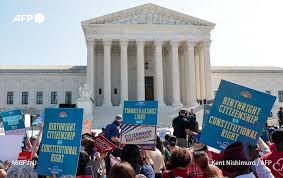
The Supreme Court heard arguments in the landmark challenge to Trump’s birthright citizenship executive order, with a decision expected by the end of June or early July. The executive order attempts to strip certain babies born in the United States of their U.S. citizenship, specifically seeking to deny citizenship to U.S.-born children of certain immigrants born after February 19, 2025.
The Trump administration asserts that the federal government will no longer consider U.S.-born children to be citizens if neither parent has citizenship or permanent immigration status. The case, formally titled Barbara v. Trump, consolidated multiple challenges to the executive order from civil rights organizations, states, and affected individuals.
All of the courts to address this case have found the executive order violates the U.S. Constitution, over a century of Supreme Court precedent, and a longstanding federal statute. Federal district courts in Maryland, Massachusetts, and Washington issued preliminary injunctions blocking implementation of the order, and appellate courts declined to disturb those rulings. The Supreme Court’s decision will ultimately determine whether the administration can implement this dramatic departure from established constitutional law.
The constitutional centerpiece of the debate involves interpreting the 14th Amendment’s citizenship clause, ratified in 1868. The Fourteenth Amendment was ratified to repudiate the infamous Dred Scott decision that denied Black people the protections of U.S. citizenship. The Trump administration’s position that children of undocumented immigrants are not “subject to the jurisdiction” of the United States contradicts 128 years of established Supreme Court precedent.
Why It Matters
The birthright citizenship case addresses fundamental constitutional principles regarding who qualifies for citizenship and what authority states and presidents possess to exclude entire categories of persons from membership in the political community. The 14th Amendment’s citizenship guarantee represents one of the Constitution’s most explicit protections of individual rights, enacted specifically to reverse the Supreme Court’s approval of slavery through the Dred Scott decision.
If the Supreme Court upholds the Trump administration’s theory, it would overturn United States v. Wong Kim Ark, the 1898 Supreme Court decision affirming that children born to immigrant parents automatically receive citizenship. The ruling would represent one of the most dramatic reversals of established constitutional law in American history, affecting millions of American-born children and fundamentally redefining membership in the political community.
The constitutional battle also raises questions about presidential authority to reinterpret federal statutes and constitutional provisions through executive action. The Trump administration has not sought to amend the 14th Amendment through the formal constitutional amendment process but instead claims that the existing amendment has been consistently misinterpreted for more than a century. This approach challenges the separation of powers framework by suggesting that the executive branch can unilaterally reinterpret the Constitution without legislative or judicial involvement.
For America’s system of constitutional governance, the case tests whether the written Constitution maintains stable meaning or whether presidents can fundamentally reinterpret constitutional provisions based on new policy priorities. The stability of constitutional meaning matters for the rule of law, as citizens and institutions depend on consistent interpretation of constitutional protections.
Economic and Global Context
Birthright citizenship shapes American immigration law and policy in ways with significant economic consequences. The citizenship status of nearly 250,000 children born annually in the United States to at least one undocumented parent depends on whether the Supreme Court upholds or strikes down the Trump executive order. Children born in the United States to documented immigrants would also potentially face exclusion from automatic citizenship if the Trump administration’s broader interpretation of “subject to the jurisdiction” prevails.
The policy implications extend beyond individual families to affect labor markets, education systems, and social safety nets. Denying citizenship to American-born children would create a permanent class of non-citizens born in the United States, a status that would affect employment eligibility, government benefits access, and educational opportunities. Economic analysis suggests that such citizenship restrictions would create substantial administrative costs for government agencies attempting to verify and enforce citizenship status determinations.
International legal norms generally support jus soli citizenship, the principle that place of birth determines citizenship. Most developed democracies provide some form of birthright citizenship, recognizing the principle that individuals born within a state’s territory belong to that political community. The Trump administration’s constitutional theory would place the United States in a minority position among developed nations regarding citizenship acquisition.
Implications
The Supreme Court’s decision will determine whether the Trump administration can implement the birthright citizenship executive order or whether the order remains blocked pending ultimate resolution of the constitutional questions. A Supreme Court decision upholding the order would have immediate effects for hospitals, government agencies, and individuals managing citizenship status determination processes. A decision striking down the order would validate the lower court rulings and establish that the executive order violates the Constitution.
The broader constitutional implication involves presidential power to reinterpret established constitutional provisions. If the Supreme Court permits the administration to unilaterally overturn a century of constitutional interpretation through executive action, it would expand presidential power to redefine fundamental constitutional rights in ways that challenge the separation of powers framework.
For civil rights organizations, immigrant advocates, and constitutional law scholars, the case represents a fundamental test of whether the written Constitution maintains stable meaning or whether presidents can dramatically reinterpret constitutional provisions without legislative or judicial involvement. The decision will shape constitutional jurisprudence regarding presidential interpretation of the Constitution and the scope of executive power.
For lawmakers considering immigration policy, the Supreme Court’s reasoning regarding presidential authority to reinterpret the Constitution will influence whether Congress must explicitly amend citizenship statutes or whether executive branch interpretation suffices to alter longstanding policy frameworks. The decision will clarify the respective roles of different branches in constitutional interpretation and the scope of presidential authority to overturn century-old precedent.
