


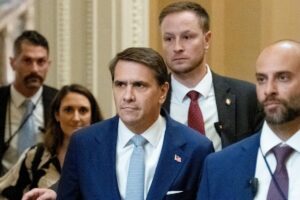
A deep crack has formed between the White House and Senate Republicans after the Trump administration’s push for a $1.8 billion “anti-weaponization” fund blindsided GOP lawmakers and forced them to abandon a vote on a major immigration enforcement bill just before the Memorial Day recess. The confrontation marks the most significant open break between congressional Republicans and the president since Trump began his second term, raising urgent questions about the party’s ability to govern with its narrow majorities. With the June 1 deadline the president set for passage now unmet, the political damage is compounding on both sides.
Story Highlights
- Senate Republicans departed for recess without passing President Trump’s immigration enforcement package after the Justice Department’s controversial anti-weaponization fund sparked a revolt within the GOP, with senators saying they were blindsided by the $1.8 billion proposal.
- The Senate had planned to vote on a bill to fund ICE and the Border Patrol through the end of Trump’s term but scrapped it after the president sought to add $1.8 billion for the DOJ fund. Acting Attorney General Todd Blanche made an unplanned trip to Capitol Hill to personally argue the case for the fund.
- The Senate’s rule keeper determined over the weekend that $1 billion in White House ballroom funding also could not be included in the bill under Senate rules, adding a second major controversy to the package.
What Happened
A growing political battle erupted within the Republican Party over President Donald Trump‘s proposed $1.776 billion anti-weaponization compensation fund, exposing deep divisions among congressional Republicans just months before critical midterm elections. The dispute intensified after Republican senators pushed back against a broader $72 billion immigration enforcement spending package that included the fund for people Trump says were unfairly targeted by what he describes as government weaponization during the Biden administration.
GOP senators emerged from a closed-door briefing with top Justice Department officials about the fund with more questions than answers, and it became clear that Republicans did not have consensus on moving forward. Senate Majority Leader John Thune told reporters after canceling the votes that administration officials needed to help address concerns from members who were troubled by both the timing and the substance of the proposal.
Acting Attorney General Todd Blanche made an unplanned trip to Capitol Hill to personally argue the case for the fund, but the effort did not resolve Republican doubts. The episode was unusually public for a party that has largely maintained discipline behind the president throughout his second term, and the spectacle of the administration’s top law enforcement official lobbying reluctant members of his own party underscored the depth of the rift.
Among the fund’s most outspoken critics was Senator Bill Cassidy of Louisiana, who recently lost his own primary race after Trump endorsed his opponent. Cassidy argued that Americans were focused on mortgages, groceries, and gas — not on funding a $1.8 billion pool for the president and his allies with no legal precedent or accountability.
With Congress leaving town for the Memorial Day recess, the House also canceled its Friday votes. Trump had said he wanted the ICE and Border Patrol funding package on his desk by June 1, but with lawmakers departing Washington, it is clear they will blow past that deadline.
Why It Matters
The anti-weaponization fund debate is not simply a procedural dispute about what belongs in a spending bill. It goes to the heart of what the Republican Party is willing to authorize with taxpayer money, and what limits — if any — members of Congress are prepared to place on an executive branch they have largely deferred to for 18 months. The fund would provide compensation to individuals claiming they were unfairly targeted by prior Justice Departments, a category that includes a broad range of Trump allies and political figures.
Trump has largely disregarded his plunging approval ratings and polls that increasingly show Democrats winning the 2026 midterms by as much as double digits. For Republican senators facing competitive races, the anti-weaponization fund represents exactly the kind of vote they cannot afford — one that allows Democrats to argue Republicans are using public money to compensate political operatives rather than deliver tangible benefits for constituents.
The episode also reveals a structural vulnerability for the administration. The more Trump uses endorsement threats to discipline Republican lawmakers, the more he creates a cohort of members — Cassidy, outgoing incumbents, those in safe seats — who have little remaining political incentive to stay in line. Senators who have already lost primaries or who represent states where Trump’s approval has eroded are the most likely to become vocal dissenters.
The immigration bill itself — intended to fund ICE and the Border Patrol through the end of the presidential term — enjoys genuine Republican support. Its failure to advance because of an unrelated funding controversy illustrates how a single contentious provision can unravel consensus on legislation where agreement exists.
Economic and Global Context
The $72 billion immigration enforcement package that stalled in the Senate has direct fiscal implications for border security operations. ICE and the Border Patrol have been operating under funding structures that the administration has argued are inadequate for the scale of enforcement priorities Trump has set. Delayed funding means delayed hiring, delayed infrastructure, and operational uncertainty for agencies expected to carry out an aggressive enforcement mandate.
The controversy quickly became one of the most politically sensitive issues facing Republicans in Congress, with some lawmakers warning that supporting the proposal could damage the party’s chances in competitive races across the country. Election-year spending fights have a long history of damaging the governing party, particularly when they involve expenditures that are difficult to explain to voters.
The anti-weaponization fund itself, if eventually passed, would represent an unprecedented use of federal appropriations — directing taxpayer dollars to compensate individuals for alleged prosecutorial misconduct by prior administrations. The legal framework for such payments is untested, and the absence of defined eligibility criteria has drawn criticism from members of both parties.
Bond markets and fiscal watchdogs have noted that additional unbudgeted spending — whether for military operations in Iran, border enforcement, or compensation funds — continues to accumulate against a backdrop of elevated federal debt and rising interest costs.
Implications
When Congress returns from recess in early June, Senate Republican leaders will need to either strip the anti-weaponization fund from the immigration bill or find a way to structure it that allays the concerns of members who threatened to vote against the entire package. The White House has indicated it would not accept cosmetic changes, creating a standoff with no easy resolution.
The safest bet in Washington in recent years has been that Republicans will eventually cave to Trump, at least in part. But even if the optics of the fund can be addressed in a way that allays GOP fears, it leaves unresolved Trump’s ballroom funding — which the Senate parliamentarian has already ruled cannot be included in the bill under Senate rules.
For voters, the spectacle of a Republican-controlled Congress unable to pass the president’s own priority legislation on his stated timeline will raise questions about governance competence, particularly among independents who supported Republican candidates on the promise of effective executive action on immigration and public safety.
For the 2026 midterms, this episode will serve as early evidence of the cracks that opposition campaigns will seek to widen. Democratic strategists will use the anti-weaponization fund — and its beneficiaries — as a campaign-trail argument that the Republican majority is using governmental power to reward political allies at taxpayer expense.
Source
Senate goes on break amid GOP plan to curtail Trump ‘anti-weaponization’ and ballroom funding
