
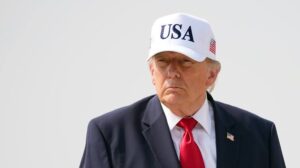
President Donald Trump announced on Monday that the United States is reinstating a full blockade against Iranian shipping through the Strait of Hormuz, declaring the U.S. will act as the waterway’s “guardian” while charging commercial vessels a fee for safe passage. The move comes after a weekend of escalating violence, including attacks on merchant ships and expanded strikes that Iranian media say have moved beyond coastal targets. The declaration marks a dramatic hardening of U.S. policy just weeks after Washington and Tehran had signed a memorandum of understanding meant to de-escalate hostilities.
Story Highlights
- Trump announced the U.S. will reinstate a blockade targeting Iranian ships and customers in the Strait of Hormuz, while keeping the waterway open to all other nations.
- The president said the U.S. will charge commercial shippers a fee equal to 20 percent of cargo value in exchange for security guarantees through the strait.
- The announcement follows a breakdown of a nearly month-old ceasefire, with Iran accusing Washington of undermining separate safe-passage talks with Oman.
What Happened
Speaking in a Truth Social post and in a phone interview with Fox News, President Trump said the Strait of Hormuz “is OPEN, and will remain OPEN, with or without Iran,” while confirming that the United States is reinstating what he termed the “Iranian Blockade,” a policy aimed exclusively at stopping Iranian vessels and their customers from using the waterway. Trump said all other countries would retain “fair and open use” of the strait, one of the world’s most critical corridors for global oil shipments.
The announcement came after a volatile weekend in which strikes intensified well beyond the coastal areas that had previously been targeted, according to reports carried by Iranian state media. U.S. allies in the region reportedly came under fire as well, and Iranian military officials warned that the risk of a broader regional conflict had increased sharply. Explosions were reported near the southern Iranian city of Bandar Abbas and Qeshm Island around midday local time, according to the semi-official Mehr News Agency.
Trump framed the renewed military action as a response to Iranian violations of an earlier agreement. “We hit them very hard last night. Every time they send a drone, we hit them very hard. But we had a deal. What nobody knows, we had a deal. It was a done deal, and then they broke it,” Trump said, adding that the U.S. has now struck dozens of targets in the latest round of operations.
Central to Trump’s announcement is the plan for Washington to formally position itself as what he called the “GUARDIAN OF THE HORMUZ STRAIT.” Under this framework, the U.S. would charge commercial shippers 20 percent of the value of their cargo as compensation for providing security through the passage, which handles roughly a fifth of global oil flows. Trump justified the fee as a matter of “fairness,” saying it would reimburse the U.S. for the cost and risk of protecting commercial traffic. “Now we’re going to guard it, and we’re going to get paid for guarding it,” he said, adding that American forces should not “be put in danger” without compensation.
Iranian officials have pushed back sharply, arguing that the American position undermines a fragile diplomatic arrangement being brokered separately with Oman to guarantee safe passage through the strait. Tehran maintains that recent strikes on American installations in the region are strictly defensive responses to U.S. and allied military action, not unprovoked aggression.
Why It Matters
The reinstated blockade represents one of the most consequential shifts in Middle East policy since Trump’s return to office, effectively ending, at least for now, the diplomatic off-ramp that had briefly cooled tensions between Washington and Tehran. For American voters, the announcement raises the specter of a prolonged military commitment in a region where prior administrations have struggled to define clear exit strategies, and it places the president’s foreign policy instincts back at the center of national debate.
The 20 percent cargo fee is a novel and legally untested approach to what has traditionally been treated as freedom-of-navigation enforcement backed by the U.S. Navy at taxpayer expense. Converting that mission into a paid service raises questions about how allied nations, energy companies, and international shipping insurers will respond, and whether the arrangement can be implemented without provoking further retaliation from Tehran or friction with trading partners who rely on the strait.
For policymakers in Congress, the shift will likely reignite long-simmering debates over the scope of presidential war powers and whether renewed strikes on Iran require explicit congressional authorization. Lawmakers on both sides of the aisle have previously raised concerns about mission creep in the Gulf, and the reinstated blockade, paired with expanded strikes, gives those concerns new urgency.
Economic and Global Context
The Strait of Hormuz remains the single most important chokepoint for global energy markets, with roughly a fifth of the world’s oil and a substantial share of liquefied natural gas passing through it daily. Any disruption, real or anticipated, tends to move oil futures quickly, and traders have been closely watching the weekend’s escalation for signs of sustained supply risk. A formal U.S. blockade against Iranian shipping, combined with a new toll on other commercial traffic, introduces fresh uncertainty into shipping insurance markets, which had only recently begun to stabilize after the earlier ceasefire.
Gulf allies, including Saudi Arabia and the United Arab Emirates, have a direct stake in how the blockade is implemented, given their own reliance on unimpeded strait access for exports. European and Asian economies, which import significant volumes of Gulf energy, are similarly exposed to price shocks stemming from prolonged instability.
The proposed 20 percent cargo fee, if implemented, would represent a substantial new cost embedded directly into global shipping and energy prices, with downstream effects likely to reach consumers at the pump and businesses reliant on seaborne trade. Whether allied nations accept this fee structure, challenge it, or seek alternative security arrangements will shape how isolated the policy remains diplomatically.
Implications
In the near term, expect continued military activity in the Gulf as the U.S. moves to operationalize its blockade and guardian role, alongside likely Iranian countermeasures against shipping or regional U.S. assets. Diplomatic channels through Oman, which had been working toward a safe-passage agreement, are now in serious jeopardy, and it remains unclear whether talks can be salvaged given Tehran’s public accusations against Washington.
For American businesses and energy markets, the announcement means heightened attention to freight costs, insurance premiums, and fuel price volatility in the weeks ahead. Shipping companies will need clarity on how the fee structure will be enforced and whether it applies uniformly or selectively.
Congress is likely to face renewed pressure to hold hearings on the legal basis for both the blockade and continued strikes, particularly given the earlier memorandum of understanding that briefly paused hostilities. Allies will be watching closely to see whether the U.S. coordinates its Gulf security posture multilaterally or proceeds unilaterally, a decision with lasting consequences for America’s alliance relationships in the region.
Sources
