


Story Highlights
- Dave Venturella, a former career ICE agent and ally of border czar Tom Homan, will serve as acting ICE director beginning June 1
- Todd Lyons, who oversaw more than 570,000 deportations and a hiring surge of 12,000 new ICE employees, announced his resignation in April
- ICE has not had a Senate-confirmed director since the Obama administration, leaving the agency under acting leadership throughout Trump’s second term
What Happened
Dave Venturella, a former career ICE agent who previously worked at a private prison group, will step in as acting director of Immigration and Customs Enforcement when Todd Lyons departs his post on May 31, the Department of Homeland Security announced Tuesday. According to a law enforcement source cited by ABC News, the selection reflects DHS Secretary Markwayne Mullin‘s preference for a low-key leader to run the agency, which carries the largest law enforcement budget in the federal government. Venturella is described as a close ally of Tom Homan, the White House border czar who has been the public face of the Trump administration’s mass deportation strategy.
Lyons announced his resignation in April, with his last day officially set for the end of this month. His exit adds to a series of senior personnel departures at DHS that have accelerated over the past year, including the departure of Deputy Director Madison Sheahan at the start of the year to run for Congress and spokesperson Tricia McLaughlin in February. Mullin himself is relatively new to the DHS secretary role, having taken over from Kristi Noem last month.
During his tenure as acting director, Lyons oversaw the most aggressive phase of the Trump administration’s immigration enforcement strategy. The agency conducted sweeps across major American cities, including Chicago, Los Angeles, and Minneapolis. It presided over a record-high number of individuals in immigration detention, carried out more than 570,000 deportations, and hired 12,000 new employees — a hiring surge without modern precedent at the agency. The administration’s stated goal of 3,000 arrests per day was never consistently achieved, a shortfall that drew criticism from hardliners within the White House even as the raw numbers represented a dramatic escalation from previous norms.
Lyons’ tenure was also marked by significant legal and operational controversy. In May 2025, he authored a secret memorandum — later leaked by a whistleblower — that authorized ICE officers to enter private residences using administrative warrants not approved by a federal judge. Fourth Amendment scholars and civil liberties organizations argued that this practice violated constitutional protections against warrantless searches of private homes, a principle dating to the founding era and reaffirmed through centuries of Supreme Court precedent. Politico reported in March 2026 that Lyons had been hospitalized at least twice for stress-related issues during the prior seven months, underscoring the personal toll of leading one of the federal government’s most politically charged agencies.
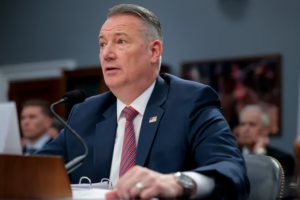
Mullin praised Lyons effusively in his departure statement, saying he “jumpstarted an agency that had not been allowed to do its job for four years.” White House Deputy Chief of Staff Stephen Miller credited Lyons as being “at the center of President Trump’s historic efforts to secure our homeland.” Homan called Lyons’ service “selfless” and said he “served with distinction.” Lyons himself, in testimony before a House Appropriations subcommittee the day he announced his resignation, said his “top priority” had been ensuring the agency “operates efficiently.”
Why It Matters
The transition at ICE’s top post carries direct implications for the constitutional questions surrounding immigration enforcement that have been litigated intensively since Trump took office for a second term. The warrantless home entry memo Lyons authored in 2025 has never been publicly rescinded, and whether Venturella continues or reverses that policy will determine whether ICE officers continue to enter private homes without judicial warrants — a practice that raises serious Fourth Amendment concerns. For Liberty Tribunal readers who care about constitutional limits on government power, the answer to that question is of immediate practical consequence for millions of American residents.
The absence of a Senate-confirmed ICE director is itself a governance issue with constitutional dimensions. The Senate’s role in confirming the leaders of major federal agencies is a structural check written into the Constitution’s Appointments Clause. When major agencies operate under a succession of acting directors indefinitely, that check is circumvented. ICE, which manages the largest law enforcement budget in the federal government and holds tens of thousands of people in detention, is an agency whose leadership should be subject to the full confirmation process — including public testimony, documentary disclosure, and a floor vote.
Beyond the constitutional questions, the leadership change matters for the hundreds of thousands of people currently in the immigration enforcement pipeline. Enforcement priorities, detention conditions, and the treatment of individuals seeking legal remedies all depend heavily on the culture and direction set by agency leadership. Civil rights organizations and immigration advocates will be watching closely to see whether Venturella maintains, moderates, or escalates the approach Lyons established.
Economic and Global Context
The scale of Trump’s deportation program has economic effects that extend well beyond immigration policy proper. Agricultural producers, construction companies, food processing plants, and hospitality businesses have all reported labor shortages and operational disruptions linked to the removal of workers who, regardless of documentation status, were integrated into the American labor market. The Federal Reserve and private economists have flagged labor supply constraints as a contributor to wage-driven inflation in certain sectors.
At the federal budget level, the costs of the mass detention and deportation program are substantial. Expanding detention capacity, hiring 12,000 new enforcement personnel, and conducting large-scale deportation operations across dozens of American cities requires sustained appropriations that must be reconciled against competing demands on the federal budget — including the Iran war, which has already cost $29 billion. The tension between immigration enforcement spending and fiscal sustainability will intensify as the 2026 appropriations process unfolds.
Internationally, the deportation program has strained diplomatic relationships with several receiving countries. Nations in Central and South America that have balked at accepting deportation flights have faced U.S. economic pressure, including threats of tariffs and aid reductions. The diplomatic management of the deportation program falls partly on DHS and partly on the State Department, making leadership continuity and interagency coordination matters of genuine foreign policy consequence.
Implications
For the Trump administration, Venturella’s appointment sends a signal of continuity. By selecting a Homan ally described as preferring a low-key operational style, DHS is prioritizing sustained enforcement activity over the kind of high-profile confrontational posture that sometimes generated negative headlines under Lyons. Whether that means quieter deportation operations or simply less visible conflict with the press and Congress remains to be seen.
For Congress, the perpetual reliance on acting leadership at ICE presents a long-overdue oversight challenge. Senators who care about institutional integrity across the political spectrum should be pressing for a nominee who can be publicly vetted and confirmed. An agency with this level of authority over millions of people’s lives, this size of enforcement budget, and this degree of constitutional sensitivity should not be run indefinitely by officials who have not faced the scrutiny of Senate confirmation.
For state and local governments, the appointment of a Homan ally signals continued pressure on sanctuary jurisdiction policies. Jurisdictions that have limited their cooperation with federal immigration enforcement can expect the new acting director to maintain an adversarial relationship and continued legal challenges to local non-cooperation policies, consistent with the approach that has defined the administration’s stance since 2025.
Sources
“Dave Venturella to serve as acting ICE director, DHS announces”
