
Story Highlights
- The DOJ sued D.C.’s Office of Disciplinary Counsel, Board on Professional Responsibility, and related authorities on May 14, 2026.
- Clark’s bar discipline stems from drafting an internal DOJ letter challenging the 2020 election results, which was never officially issued.
- Acting Attorney General Todd Blanche declared the D.C. Bar has “long acted as a blatantly partisan arm of leftist causes.”
What Happened
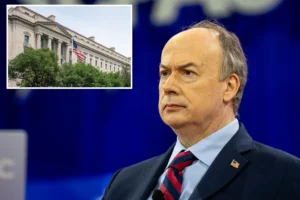
On May 14, 2026, the Department of Justice filed a federal lawsuit against Washington, D.C.’s attorney disciplinary system, targeting the Office of Disciplinary Counsel, the Board on Professional Responsibility, the D.C. Court of Appeals, and the city itself. The action was taken in defense of Jeffrey Clark, a former assistant attorney general who had been recommended for disbarment following his efforts in 2020 to persuade Justice Department superiors to issue a letter casting doubt on the integrity of the presidential election results.
Clark drafted the letter in question but was overruled by his superiors, and the document was never sent. The D.C. Bar’s Board of Professional Responsibility nonetheless recommended disbarment, finding that Clark had violated legal ethics through his conduct. The final determination rests with the D.C. Court of Appeals, which has not yet ruled. Clark remains an attorney in good standing under the D.C. bar while the proceeding continues.
The DOJ’s lawsuit argues that disciplinary authorities are punishing Clark solely because he attempted to persuade his superiors of a legal position they ultimately rejected. The department’s complaint states that D.C. disciplinary authorities cannot constitutionally punish a federal official for disagreeing with colleagues or offering a legal opinion, however controversial, within the confines of internal executive branch deliberations.
Acting Attorney General Todd Blanche issued a pointed statement alongside the filing, saying the D.C. Bar has acted as a partisan body and adding that such conduct would no longer be tolerated. The lawsuit argues that bar discipline over internal executive branch legal advice creates a chilling effect on candid legal counsel to the president and attorney general, thereby threatening the executive branch’s capacity to function.
The filing came just days after the administration acknowledged that earlier in 2026, it had proposed new regulations that would allow the attorney general to suspend state and local bar investigations into DOJ attorneys — a move that would represent an even broader assertion of federal authority over the legal profession.
Why It Matters
The lawsuit strikes at one of the central structural debates of the Trump era: the scope of professional accountability for government lawyers who advance controversial legal positions at the direction of senior officials. The independence of state bar associations in disciplining federal attorneys has long been considered a backstop against the abuse of legal office — but the Trump administration argues that independence, when exercised against executive branch deliberations, is itself unconstitutional.
The case has direct bearing on constitutional separation of powers. If bar authorities can discipline federal officials for the content of internal legal memos, critics of the lawsuit argue that accountability mechanisms remain intact. If the DOJ’s position prevails, however, it would significantly limit the ability of professional bodies to sanction government lawyers for conduct that takes place within the executive branch — even when that conduct involves challenging democratic processes.
The pattern is broader than Clark’s case alone. Rudy Giuliani was permanently disbarred in both D.C. and New York for his work in post-election litigation. John Eastman, another attorney who participated in the effort to challenge the 2020 results, was stripped of his California law license by the state Supreme Court earlier in 2026. The DOJ lawsuit cites these cases as part of what it characterizes as a coordinated effort to suppress legal advocacy on behalf of conservative causes and the executive branch.
Also referenced in the filing is the disciplinary proceeding against Ed Martin, the Justice Department’s current pardon attorney, who faces D.C. Bar scrutiny over communications he sent to Georgetown Law School’s dean questioning its DEI policies. The lawsuit argues Martin’s case demonstrates the D.C. Bar is targeting federal attorneys based on viewpoint and political affiliation rather than genuine ethical violations.
Economic and Global Context
While the DOJ lawsuit is primarily a domestic legal and constitutional matter, its downstream effects on U.S. governance and the rule of law have broader significance. The independence of professional legal institutions is widely regarded by international partners, investors, and allied governments as a marker of institutional stability. Challenges to those institutions carry reputational weight beyond American borders.
Legal experts have observed that the proposed DOJ regulations allowing the attorney general to suspend state bar investigations into department lawyers would represent a structural change without modern precedent. If enacted and upheld in court, such regulations would fundamentally alter the landscape of attorney accountability in the United States, with implications for every jurisdiction that employs federal lawyers.
The cost to taxpayers of this litigation, while modest in isolation, adds to a broader pattern of the executive branch directing public legal resources toward protective actions on behalf of political allies. The DOJ lawsuit was filed at a time when the department was also pursuing other high-profile cases tied to the administration’s legal defense posture, compounding scrutiny of how prosecutorial and legal resources are being allocated.
Implications
The immediate procedural effect of the lawsuit is unclear. The D.C. Court of Appeals still holds final authority over Clark’s law license and has not yet issued its ruling. If the federal court accepts the DOJ’s arguments, it could enjoin the disciplinary process from proceeding — but such an injunction would itself be legally unprecedented and likely challenged on grounds of federalism and judicial independence.
For the legal profession at large, the case raises questions about whether government lawyers can rely on the doctrine that internal executive deliberations are categorically immune from professional sanction. Bar associations across the country are watching the case, as its resolution could either validate or sharply curtail their jurisdiction over attorneys who work within the federal government.
For Congress, the lawsuit adds pressure to consider whether legislation clarifying the boundaries between federal attorney accountability and state bar authority is needed. Given current partisan divisions, bipartisan agreement on such legislation appears unlikely — meaning the courts will remain the primary arena for resolving the underlying constitutional questions this case presents.
