
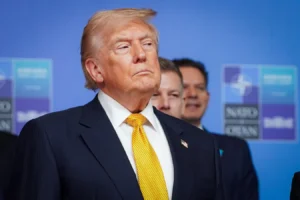
A federal judge in Florida has ruled that President Trump’s lawsuit against the Internal Revenue Service was brought in bad faith to manufacture legal cover for a settlement that funneled taxpayer money to his allies and shielded his family from audits. U.S. District Judge Kathleen Williams ordered sanctions against Trump, his sons, the Trump Organization, and the private attorneys who represented them, while also directing her findings to bar associations already reviewing Acting Attorney General Todd Blanche’s conduct. The ruling lands just as Blanche faces a contentious Senate confirmation hearing to become permanent Attorney General.
Story Highlights
- A federal judge found Trump’s $10 billion IRS lawsuit was filed in “bad faith” to create a fake legal dispute.
- The since-abandoned settlement had created a $1.776 billion “anti-weaponization fund” and shielded Trump’s family from IRS audits.
- The judge referred Trump’s attorney to the Florida Bar and flagged Todd Blanche and Stanley Woodward to disciplinary boards already reviewing their conduct.
What Happened
Judge Kathleen Williams, an appointee of President Obama, issued a 56-page opinion Monday concluding that Trump’s lawsuit against the IRS was never a genuine legal dispute. Trump filed the $10 billion suit in January, claiming the agency failed to protect his tax returns after a contractor leaked details to reporters. Williams found that because Trump, as president, effectively controls both the IRS and the Justice Department that would ordinarily defend against such a claim, there was never real adversity between the parties, a legal requirement for any court case to proceed.
Rather than mount a defense, Trump’s attorneys withdrew the lawsuit in May, just two days before a court filing deadline. The Justice Department simultaneously announced a settlement establishing a $1.776 billion “anti-weaponization fund” intended to compensate people who claimed the federal government had targeted them politically, including some January 6 defendants. A separate memo signed by Blanche also barred the IRS from investigating Trump, his family, or affiliated businesses for any past tax matters, a provision that legal experts said directly conflicted with federal law.
The arrangement provoked swift bipartisan backlash in Congress. Facing pressure from Republicans and Democrats alike, Blanche told lawmakers last month that the anti-weaponization fund was dead. However, he has refused a judge’s request to confirm that cancellation in a signed written statement, and the separate audit-immunity provision protecting Trump’s family remains formally in place.
Williams’ order sanctions Trump, his sons Donald Trump Jr. and Eric Trump, the Trump Organization, and attorneys Alejandro Brito and Daniel Z. Epstein. She referred Brito to the Florida Bar for possible disciplinary review and sent her findings to bar associations in New York and Washington, D.C., where Blanche and Associate Attorney General Stanley Woodward already face separate ethics proceedings. The judge also barred Trump’s team from citing the settlement in any future proceeding as evidence a legitimate agreement was reached.
Blanche defended the arrangement Wednesday during his own confirmation hearing before the Senate Judiciary Committee, insisting the fund no longer exists even as senators, including Republican John Cornyn, questioned why Trump has not put that in writing.
Why It Matters
The ruling represents one of the most direct judicial findings to date that a sitting president used the federal court system to manufacture legitimacy for an arrangement benefiting himself and his family. Williams was explicit that Trump sat on both sides of a lawsuit involving agencies he controls, undermining the credibility of the settlement from its inception.
For ordinary Americans, the case raises basic questions about equal treatment under the law and whether the machinery of government can be used to reward political allies at taxpayer expense. The proposed fund was designed, in part, to compensate individuals connected to the January 6 Capitol riot and other Trump allies who claimed to have been wronged by prior administrations, a use of public funds that drew criticism even from within Trump’s own party.
The case also has direct bearing on Blanche’s confirmation. Senators from both parties are now weighing whether a nominee for the nation’s top law enforcement post should be confirmed after a federal judge found he played a central role in what she described as an effort to manipulate judicial proceedings for personal and political gain.
Economic and Global Context
While the case does not carry the immediate market impact of tariff or foreign policy news, it touches directly on the integrity of the $1.776 billion in taxpayer funds that would have been distributed through the fund had it proceeded. That figure, Williams noted, appeared to reflect a “branding” exercise rather than any calculated damages assessment, raising questions about how such sums move through federal accounts without full congressional appropriation review.
The ruling also arrives amid broader scrutiny of executive power over independent agencies. Critics argue the episode illustrates how a president can direct agencies theoretically insulated from political control, a concern that extends beyond the IRS to other regulatory bodies facing similar pressure during Trump’s second term.
Internationally, the story has drawn less attention than Trump’s trade and foreign policy actions, but legal analysts note it fits a broader pattern scrutinized by international observers assessing the durability of American judicial independence and separation-of-powers norms.
Implications
Trump’s legal team could appeal Williams’ order or attempt to restructure the settlement to survive judicial review, though her ruling forecloses framing any future arrangement as a court-approved settlement. The financial exposure from sanctions remains unclear, though it is expected to be tied to reimbursing the attorneys’ fees of the retired judges who intervened to challenge the deal.
For Blanche, the ruling complicates an already difficult confirmation path. Republicans control the Judiciary Committee and the Senate floor, but a handful of GOP defections could stall his nomination, and several senators have signaled discomfort with his role in the settlement.
For Congress, the episode will likely fuel renewed calls for oversight legislation governing settlements between the executive branch and agencies it controls, an issue that has taken on new urgency given the scale of funds involved and the beneficiaries the arrangement was designed to reach.
Sources
