


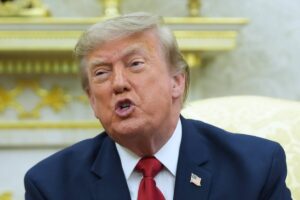
President Trump publicly reversed a Department of Homeland Security directive that had paused most ICE vehicle stops nationwide, just one day after the pause was implemented following fatal shootings of two men in Maine and Texas. The reversal exposed a rift between career officials seeking to manage officer safety concerns and a president determined to maintain aggressive enforcement numbers. The episode has reignited a national debate over ICE tactics as the administration pursues its mass deportation agenda.
Story Highlights
- ICE fatally shot two men, neither the target of the operations, during traffic stops in Biddeford, Maine, and Houston, Texas, within a week of each other.
- DHS briefly suspended most ICE vehicle stops nationwide, then Trump publicly overturned that pause via social media.
- Sen. Angus King and Maine’s governor have called for independent investigations and, in the governor’s case, congressional reform of ICE.
What Happened
The controversy began after ICE agents fatally shot Lorenzo Salgado Araujo, 52, in Houston and Johan Sebastián Durán Guerrero, 25, in Biddeford, Maine, both during attempted traffic stops roughly a week apart. Neither man was the intended target of the enforcement operations in which they were killed. Durán Guerrero, a Colombian national, left behind a wife and young daughter, while Salgado Araujo, who had lived in the U.S. for decades and was reportedly near obtaining legal work authorization, was killed on his way to work.
In response, the Department of Homeland Security issued a memo Tuesday instructing ICE’s Enforcement and Removal Operations division to suspend most vehicle stops, with limited exceptions for criminal warrants or partner-agency operations. Border czar Tom Homan characterized the move as a temporary pause tied to additional officer training rather than a permanent policy shift, and DHS also pledged to accelerate deployment of body cameras to field agents nationally.
The pause proved short-lived. On Wednesday morning, Trump wrote on Truth Social that ICE “CANNOT give up one of I.C.E.’s most important and effective Crime Fighting tools, THE TRAFFIC STOP,” arguing that ending the practice would let dangerous individuals evade capture. He added that officers should be “judicious, fair and smart” but made clear the tactic itself would continue. The White House confirmed the post was intended to override the prior day’s directive.
DHS Secretary Markwayne Mullin said he and the president were “on the same page,” and ICE field offices issued verbal clarifications telling agents that vehicle stops remained “a tool in the toolkit.” According to CNN, Trump was privately furious that prominent supporters had criticized the pause as a sign of weakening enforcement, and the reversal came amid pressure to sustain the administration’s goal of roughly 2,000 arrests per day.
The shootings have prompted protests in Maine, Houston, and Boston, alongside renewed scrutiny of ICE’s use of lethal force against vehicles, a tactic policing experts have long warned creates unnecessary danger to bystanders and officers alike.
Why It Matters
The episode illustrates a recurring tension inside the administration between operational safety concerns raised by career homeland security officials and the president’s political imperative to project strength on immigration enforcement. When Trump personally overturned his own department’s safety measure within twenty-four hours, it signaled that enforcement optics take precedence over emerging on-the-ground safety data.
For the families of Salgado Araujo and Durán Guerrero, and for communities where ICE operates aggressively, the reversal means the same enforcement tactics that led to fatal encounters will continue largely unchanged. Neither man killed had been the target of the operation in which he died, raising broader questions about how ICE identifies and confirms targets before deploying lethal force.
The controversy also reflects on congressional oversight of immigration enforcement generally. Maine’s governor has called on Congress to reform or even abolish ICE, while Sen. King has publicly challenged the administration’s framing that enforcement operations target only “the worst of the worst,” noting hundreds of arrests in Maine alone that did not fit that description.
Economic and Global Context
Immigration enforcement carries direct economic implications for industries reliant on immigrant labor, including construction, hospitality, and agriculture, sectors where enforcement actions can disrupt local labor markets even when individual arrests are limited in number. Houston’s construction and service economy, in particular, has already reported worker shortages tied to increased enforcement activity in the region.
At least ten people have been killed during immigration operations since the administration’s mass deportation campaign began, according to reporting compiled by NBC News, a toll that has drawn condemnation from immigrant advocacy groups and some international human rights observers monitoring U.S. enforcement practices.
The administration’s stated goal of roughly 2,000 ICE arrests per day requires sustained operational tempo, and vehicle stops have functioned as one of the most efficient tools for locating individuals away from homes or workplaces, explaining the pressure from within the administration to preserve the tactic despite the recent fatalities.
Implications
DHS is expected to proceed with body camera deployment even as vehicle stops resume, a move officials hope will provide clearer evidence in future encounters and address some criticism from lawmakers in both parties. Independent investigations into both shootings remain pending, and their outcomes could shape future policy regardless of Trump’s public stance.
For ICE agents in the field, the reversal removes any ambiguity about expectations, but current and former law enforcement officials have warned that reinstating the practice without addressing the underlying safety concerns raised just a day earlier risks repeating the same outcomes.
For Congress, expect renewed legislative pushes from Democrats demanding stricter use-of-force reporting requirements and independent oversight of ICE operations, though such measures face long odds in a Republican-controlled Congress focused on supporting the administration’s enforcement priorities.
Sources
“Trump overturns pause of ICE vehicle stops implemented after Maine, Texas shootings”
