

Story Highlights
- The Senate confirmed Warsh 54-45 along mostly party lines, with a last-minute Republican hold tied to a DOJ investigation nearly derailing the vote
- Powell will remain on the Fed’s governing board through 2028, setting up a potential ongoing tension with the new chair
- Warsh has signaled support for lower interest rates but faces a challenging inflation environment worsened by the Iran war and surging energy prices
What Happened
Jerome Powell’s eight-year tenure leading the Federal Reserve came to its scheduled end on Friday, concluding a run that saw him navigate the deepest economic contraction in modern U.S. history during the COVID-19 pandemic, a subsequent inflation surge that reached a four-decade high, and unrelenting pressure campaigns from two politically opposing presidents. Trump originally appointed Powell in 2017 to succeed Janet Yellen, then reappointed him in 2022 under President Biden.
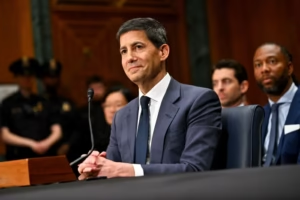
The Senate confirmed Kevin Warsh as the new Federal Reserve chair on Wednesday, just three days before Powell’s term expired, on a 54-45 vote that ran mostly along party lines. The confirmation was delayed for weeks after the Trump administration’s Justice Department launched a criminal investigation into Powell related to his congressional testimony about cost overruns on a renovation project at the Fed’s Washington headquarters. Senator Thom Tillis of North Carolina initially blocked a committee vote on Warsh’s nomination to protest what he called a politically motivated probe. Tillis dropped his opposition only after a U.S. attorney agreed to drop the investigation.
Warsh, 55, is a former member of the Fed’s Board of Governors, serving from 2006 to 2011. A Stanford and Harvard Law graduate, he has long been a prominent figure in financial policy circles and is closely aligned with Trump’s preference for lower borrowing costs. He had previously been passed over for the Fed chairmanship in 2017 when Trump chose Powell instead.
In a notable break from historical precedent, Powell will not leave the Fed entirely. His term on the Board of Governors extends through 2028, and he has stated publicly that he intends to remain as a governor for “a period of time to be determined,” at least until pending investigations into the headquarters renovation project are complete. This arrangement preserves Powell’s voice within the institution and potentially positions him as an internal check on any abrupt policy pivots under Warsh.
Why It Matters
The Federal Reserve chair is arguably the most consequential economic policymaker in the United States, with authority over the benchmark interest rate that determines borrowing costs for mortgages, auto loans, business credit, and government debt. The change in leadership at this moment is far from routine — it comes amid rising inflation tied to the Iran conflict and a broader debate about whether the Fed should lower rates to stimulate growth or hold firm to contain price pressures.
Trump has consistently and publicly pushed for aggressive interest rate cuts, a preference that aligns with Warsh’s stated inclinations. However, Warsh has also been an outspoken critic of the Fed’s bloated balance sheet and has hinted at a more hawkish approach to unwinding the trillions in assets accumulated during and after the pandemic. Those two signals — dovish on rates but hawkish on the balance sheet — could produce unpredictable policy outcomes.
The DOJ’s brief investigation into Powell was widely condemned as an attempt to intimidate an independent institution. The episode fueled bipartisan alarm about the erosion of Fed independence, a foundational feature of the American economic system. When Powell called the probe a result of “threats and ongoing pressure” from the administration in a public video statement, it marked an extraordinary moment of open conflict between the executive branch and the central bank.
Powell’s decision to stay on the board adds another layer of complexity. Having the outgoing chair remain as a fellow governor is unusual and could create friction if Warsh pursues sharp reversals of existing policy. For markets, the arrangement introduces a new variable: a split at the top of the Fed between a new chair with fresh presidential backing and a former chair with deep institutional knowledge and his own policy views.
Economic and Global Context
Warsh steps into the chairmanship during an exceptionally difficult economic period. The U.S.-Iran war, which began in late February, has triggered a supply disruption that analysts are calling the largest in modern history. Gasoline prices have risen steeply, diesel costs have climbed, and energy-driven inflation has intensified. The Motley Fool noted that the Federal Reserve’s total asset holdings sat at approximately $6.7 trillion as of early May, down from a 2022 peak but still historically elevated. Warsh’s stated desire to meaningfully reduce that figure could have significant consequences for bond markets and long-term Treasury yields.
Globally, central banks in Europe and Asia are watching the Fed leadership change with close attention. Any shift toward more aggressive rate cutting could weaken the dollar and ripple through currency and fixed-income markets worldwide. Conversely, if Warsh surprises observers by prioritizing inflation control, markets currently priced for future rate reductions could face a sharp correction.
The Fed’s interest rate decisions directly affect the U.S. housing market, where elevated mortgage rates have kept affordability strained for years. Millions of Americans waiting for rate relief will be watching Warsh’s early moves closely.
Implications
For the Trump administration, Warsh’s confirmation represents a long-sought victory in reshaping the Fed in a more politically compatible direction. Whether Warsh delivers the rate cuts Trump wants remains to be seen; the inflationary environment severely constrains how far and how fast rates can come down without reigniting price pressures.
For financial markets, the transition creates short-term uncertainty. Investors will parse Warsh’s early statements and his first Federal Open Market Committee meeting for signals about the direction and pace of policy change. Any indication of a sharp break from Powell-era gradualism could trigger volatility in equities, bonds, and currencies.
For American households, the stakes are tangible. If Warsh manages to engineer lower rates without inflaming inflation further, consumers and homebuyers could benefit meaningfully. If the new chair misjudges the balance, inflation could persist or worsen, compounding the economic strain already imposed by elevated energy prices.
Sources
“Senate confirms Kevin Warsh as next chair of the Federal Reserve”
