


Story Highlights
- Senate Republicans delayed a crucial vote Thursday on a $72 billion ICE and Border Patrol funding bill after GOP senators revolted against Trump’s controversial $1.8 billion “anti-weaponization” fund.
- Acting Attorney General Todd Blanche was berated in a closed-door meeting with Senate Republicans, who attacked the fund as a “slush fund” designed to pay Trump allies, potentially including January 6 Capitol riot defendants.
- The dramatic pause in immigration enforcement funding reveals Trump’s consequences-free presidency may be ending as Senate Republican unity fractures over presidential overreach and questionable spending priorities.
What Happened
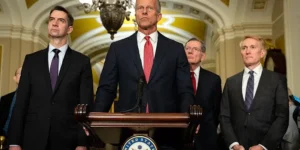
Senate Majority Leader John Thune (R-South Dakota) had carefully prepared the legislative path forward on Thursday to pass a $72 billion appropriations bill funding the Department of Homeland Security’s Immigration and Customs Enforcement and Border Patrol operations. The legislation appeared to be moving smoothly toward a floor vote that would secure funding for Trump’s signature immigration enforcement agenda through the end of his presidency. Then, unexpectedly, Republican senators pulled back from the brink, delaying the vote indefinitely and leaving Washington for their Memorial Day recess without action on the bill.
The explosive issue that derailed the vote was not the immigration funding itself but rather a separate $1.8 billion “anti-weaponization” fund announced by the Justice Department on Monday. The administration described the fund as compensation for individuals claiming they had been unfairly targeted by the Biden administration’s law enforcement apparatus. However, Senate Republicans reacted with shock and anger upon learning that the fund could potentially extend payments to people convicted of serious crimes, including violent January 6 Capitol riot participants.
Acting Attorney General Todd Blanche was dispatched to Capitol Hill Thursday morning to brief Senate Republicans and alleviate their concerns. The meeting, however, quickly became confrontational. Multiple GOP senators expressed outrage at what they viewed as a blank check for politically motivated payouts. Senator Tom Tillis (R-North Carolina) described the fund as “stupid on stilts,” while Senator Ron Johnson (R-Wisconsin) called it “a galactic blunder.” Senator Mitch McConnell, himself a senior Republican figure, characterized the initiative as asking for “a slush fund to pay people who assault cops.”
The anger was not limited to a few moderates. Across the GOP conference, senators expressed concern that the fund lacked accountability mechanisms and clear legal authority. Vice President JD Vance had previously stated that the administration would not rule out using the fund to compensate January 6 defendants, adding that the Justice Department would evaluate claims on a “case-by-case basis.” This ambiguity proved deeply troubling to lawmakers facing tough reelection battles and concerned about public perception.
Beyond the weaponization fund, another Trump priority added fuel to the legislative fire: a $1 billion allocation for security upgrades related to Trump’s planned White House ballroom. Trump had initially stated the project would be funded entirely by private donations, but the administration had requested taxpayer funds for its construction. Senate Republicans viewed both spending requests as unwarranted distractions from the core mission of securing border and immigration enforcement funding.
Why It Matters
The collapse of Senate Republican unity on a top Trump priority signals a fundamental shift in the president’s political standing within his own party. Trump has wielded near-absolute control over congressional Republicans for most of his second term, but the opposition to the anti-weaponization fund suggests this deference has reached its limits. The fund’s explicit purpose—compensating people allegedly harmed by Biden administration prosecutions—raised constitutional and political concerns that transcended partisan orthodoxy.
For Americans concerned with constitutional governance, the episode illustrates an alarming trend: the executive branch attempting to use settlement authority and vague appropriations language to circumvent traditional budgetary oversight. The fund’s lack of statutory authorization, the absence of clear spending criteria, and the potential for politically motivated compensation all raise serious questions about executive overreach and government accountability. Congress holds the power of the purse, and senators were rightfully asserting that authority.
The timing is particularly significant given Trump’s wider agenda on presidential power. Throughout his second term, Trump has tested the boundaries of executive authority through aggressive use of tariffs, immigration enforcement, and budgetary reprogramming. Senate Republicans’ resistance to the weaponization fund suggests that even friendly legislators recognize limits to such assertions of presidential power. The constitutional separation of powers depends on coequal branches maintaining their respective prerogatives.
The broader political context amplifies the importance of this moment. Trump recently endorsed primary challengers against Senators Bill Cassidy (R-Louisiana) and John Cornyn (R-Texas), both of whom have questioned various administration priorities. The president’s intervention in internal GOP politics created resentment among senators who viewed themselves as team players being punished for insufficient loyalty. This political vendetta appears to have undermined Trump’s ability to deliver votes on his own legislative priorities.
Economic and Global Context
The delayed immigration funding bill carries significant economic implications for American labor markets and fiscal policy. ICE and Border Patrol operations directly affect immigration enforcement, labor supply dynamics, and the composition of the workforce. When these agencies lack stable funding, enforcement operations become sporadic and inefficient, creating uncertainty for employers reliant on current immigration policies and workers concerned with workplace enforcement.
The broader fiscal context reveals competing priorities within the Trump administration. The $72 billion appropriations bill represents substantial federal spending committed to enforcement operations. The additional $1.8 billion for the weaponization fund, while smaller in absolute terms, represents a fundamentally different category of federal spending—not for ordinary governmental operations but for settling what amounts to a political lawsuit brought by the president himself.
This spending pattern raises macroeconomic concerns about priorities. The Treasury generates roughly $30 billion monthly from tariffs under Trump administration trade policies, yet Congressional appropriations processes remain constrained. The request for ballroom security funding and victim compensation funding alongside requests for core DHS operations reflects competing visions of how government resources should be allocated during a period of elevated federal revenue collection from tariff receipts.
Global markets and allies have closely monitored Trump’s ability to command congressional support. The immigration enforcement funding directly impacts border security posture, which carries implications for hemispheric stability and trade relationships with Mexico and Canada. Delays in securing consistent funding for these operations create uncertainty about the administration’s capacity to implement its promised immigration agenda consistently.
Implications
The most immediate consequence is a missed deadline and extended uncertainty. Trump reportedly wanted the immigration funding secured by June 1, but senators’ departure for recess means the vote will not occur until June at the earliest. This timeline slip provides additional opportunity for public pressure and interest group advocacy to influence the final bill’s form.
For Trump’s agenda, the episode demonstrates that a base of Republican senators remains willing to challenge the president on constitutional and fiscal grounds. This cadre of Republican legislators—including Lisa Murkowski (R-Alaska), Tillis, Johnson, McConnell, and others—represents institutional resistance to unchecked executive power. If Trump faces similar revolts on other priority legislation, his legislative agenda could encounter unexpected obstacles.
For voters and policymakers, the question becomes whether this moment represents a temporary pause or a genuine reassertion of congressional prerogatives over executive power. Constitutional governance depends on coequal branches maintaining their independence. If Congress ultimately capitulates and funds the weaponization initiative without substantial modification, it signals that presidential power has expanded beyond traditional constraints.
The June negotiations over this bill will determine whether Congress reclaims its authority over the purse or whether the administration successfully normalizes controversial compensation funds lacking statutory authorization. The outcome carries implications far beyond immigration enforcement, affecting the trajectory of executive power in American governance for years to come.
