
Story Highlights
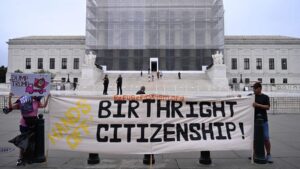
- The Supreme Court heard oral arguments on April 1 in Trump v. Barbara, with several justices expressing skepticism toward the government’s core legal theory
- The Trump administration argues the Citizenship Clause requires a child’s mother to be lawfully “domiciled” in the United States, a term that does not appear in the constitutional text
- A Reuters/Ipsos poll from April 2026 found 64 percent of Americans oppose ending birthright citizenship, compared to 32 percent who support it
What Happened
President Trump signed Executive Order 14160 on January 20, 2025, his first day back in office, directing federal agencies to stop recognizing automatic citizenship for children born in the United States unless at least one parent is a citizen or lawful permanent resident. The order immediately triggered legal challenges from states, civil rights organizations, and individual families, and multiple federal district courts issued injunctions blocking its enforcement nationwide. After the Supreme Court ruled in June 2025 that such nationwide injunctions generally exceed the authority Congress has granted to federal courts, litigation continued in a case that ultimately became Trump v. Barbara, brought on behalf of a certified class of children born after the order’s effective date.
At oral arguments on April 1, Solicitor General D. John Sauer argued that the word “reside,” which appears in the Citizenship Clause regarding state citizenship, should be read to mean “domicile” when applied to the clause’s national citizenship provision. Sauer contended that domicile requires lawful permission to live in the United States indefinitely, meaning children born to parents who are undocumented or present only temporarily would not automatically qualify for citizenship at birth. Several justices pushed back forcefully. Justice Ketanji Brown Jackson noted that the 14th Amendment was adopted specifically “to prevent future Congresses from being able to affect citizenship,” a point Sauer disputed but could not fully overcome during questioning.
The legal fight traces back to the amendment’s ratification in 1868, when it was added to the Constitution to overturn the Supreme Court’s 1857 Dred Scott decision, which had held that enslaved people could never be citizens. The Citizenship Clause provides that anyone “born or naturalized in the United States, and subject to the jurisdiction thereof” is a citizen, language the Supreme Court interpreted broadly in its 1898 decision in United States v. Wong Kim Ark, a precedent that has stood for more than 125 years and has been consistently applied regardless of parents’ immigration status. The Ninth Circuit, in a related case called Washington v. Trump, held that since Wong Kim Ark, “the Judiciary, Congress, and the Executive Branch have consistently and uniformly protected the Citizenship Clause’s explicit guarantee of birthright citizenship regardless of the immigration status of an individual’s parents.”
The Trump administration’s certiorari petition had originally sought review of both the Washington and Barbara cases, but the Supreme Court’s December 2025 order limited its review to Barbara alone. Legal scholars across the political spectrum, including some who generally support expansive executive authority, have characterized the administration’s domicile theory as a significant departure from settled constitutional doctrine, while supporters of the order argue that the clause’s “subject to the jurisdiction thereof” language has never been definitively interpreted to extend to every person physically present in the country regardless of legal status.
Why It Matters
This case represents one of the most direct challenges to an explicit constitutional guarantee in modern American history. The 14th Amendment’s text does not mention domicile, lawful presence, or parental immigration status, and the administration’s argument requires the Court to read those concepts into language that has been understood for over a century to apply based on the simple fact of birth on U.S. soil. A ruling in the government’s favor would mark a rare instance of the Supreme Court narrowing rather than expanding an individual constitutional right that has been continuously recognized since Reconstruction.
For American constitutional law more broadly, the case tests whether long-settled precedent can be unwound through executive action rather than the formal amendment process the Constitution itself prescribes. Ending birthright citizenship as a matter of law would require a constitutional amendment, ratified by three-fourths of the states, according to most legal scholars, since no statute or executive order can override the plain text of the Constitution. A ruling upholding Trump’s order would effectively allow a sitting president to redefine a constitutional right through unilateral action, a precedent with implications well beyond immigration policy.
The practical stakes for American families are immense. Council on Foreign Relations analysis indicates the order, if implemented, would potentially affect hundreds of thousands of children born annually in the United States to parents who are undocumented or here on temporary visas, including work visas, student visas, and tourist visas. These children would face uncertain legal status, complications in accessing healthcare and public benefits, and the prospect of becoming part of what advocacy groups describe as a permanent, multigenerational class of residents without full citizenship rights.
For policymakers, the ruling will also resolve a broader question about presidential power over immigration and citizenship policy that Congress has not directly addressed through legislation. Regardless of the outcome, the decision is likely to generate renewed congressional debate over codifying or restricting birthright citizenship through statute, a debate that previous legislative efforts have failed to resolve.
Economic and Global Context
The economic consequences of ending birthright citizenship extend into healthcare, education, and labor markets. Research from Georgetown University’s Center for Children and Families has highlighted that newborns currently receive automatic eligibility for health coverage tied to their citizenship status, and any disruption to that system would create immediate complications for hospitals and state Medicaid programs trying to verify eligibility for infants whose parents may lack documentation themselves.
A joint analysis by the Migration Policy Institute and Pennsylvania State University’s Population Research Institute projected that ending birthright citizenship could actually increase the population of unauthorized immigrants in the United States by an estimated 2.7 million by 2045, as children who would otherwise have gained citizenship at birth remain in legal limbo alongside their parents. This finding cuts against one of the administration’s stated policy rationales, suggesting the order could expand rather than shrink the population the administration has identified as a policy priority to reduce.
Globally, the case is being watched closely as a test of American constitutional stability at a moment when the administration has pursued an unusually assertive approach to executive power across multiple fronts, from tariff authority to agency leadership. Allied nations with their own jus soli citizenship traditions, including Canada and most of the Western Hemisphere, are observing whether the United States will become an outlier among countries that have historically extended automatic citizenship based on birthplace.
Domestically, businesses and universities that rely on foreign workers and international students have expressed concern that uncertainty over the citizenship status of children born to visa holders could complicate recruitment and retention of skilled workers, particularly in sectors like technology and academic research that depend heavily on temporary visa categories such as H-1B holders.
Implications
If the Supreme Court rules against the administration, as many legal observers anticipate given the tone of oral arguments, the executive order would be permanently blocked, and birthright citizenship would remain available to all children born on U.S. soil regardless of parental immigration status, preserving the status quo that has existed since Wong Kim Ark. Such a ruling would represent a significant check on executive authority and would likely be cited in future disputes over the limits of presidential power to reshape constitutional doctrine through unilateral action.
If the Court rules in the administration’s favor, even partially, the decision would trigger immediate implementation questions for the Department of Homeland Security, the Social Security Administration, and state vital records offices, which would need to develop new procedures for determining a newborn’s citizenship status based on parental domicile, a process with no existing infrastructure and significant potential for error and delay.
For the roughly two dozen states and voting rights and civil liberties organizations that have litigated against the order since January 2025, a victory would validate years of coordinated legal strategy, while a loss would likely prompt immediate calls for congressional action to codify birthright citizenship protections through statute, an effort that would face an uncertain path in a closely divided Congress.
For American families directly affected, particularly those with mixed immigration status, the ruling will resolve more than a year of legal uncertainty about their children’s fundamental legal status in the only country many of them have ever called home, with the decision expected within the next two weeks as the Court’s traditional end-of-term ruling period concludes.
Sources
“Supreme Court Arguments Wrap in Landmark Challenge to Trump Birthright Citizenship Executive Order”
