


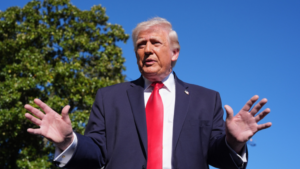
- Trump wrote to congressional leaders claiming the Iran war’s hostilities “have terminated” due to the April 7 ceasefire, bypassing the War Powers Resolution’s 60-day authorization requirement
- Democratic lawmakers, along with Republican Senators Susan Collins and Rand Paul, argue the ceasefire does not stop the constitutional clock
- Senate Majority Leader John Thune signaled the Republican-led Senate will not vote to authorize the conflict in the near term
What Happened
President Donald Trump told Congress that he doesn’t need its authorization for military operations in Iran because of the ceasefire, even though the conflict hit the 60-day mark this week. In letters to the House and Senate, Trump wrote: “On April 7, 2026, I ordered a two-week ceasefire. The ceasefire has since been extended. There has been no exchange of fire between the United States Forces and Iran since April 7, 2026. The hostilities that began on February 28, 2026, have terminated.”
The claim came on what would have been a legal deadline under the War Powers Resolution of 1973 for Trump to ask Congress to officially declare war against Iran or authorize the use of military force. Under the resolution, a president must seek authorization from Congress for military force within 60 days of the start of hostilities. Congress has not formally authorized U.S. military action against Iran at any point since the conflict began in late February.
Trump suggested the War Powers Resolution is itself unconstitutional, saying he would not seek congressional authorization because it had “never been sought before” by other presidents — a claim that is factually inaccurate. Presidents George W. Bush in 2001 and 2002 and George H.W. Bush in 1991 sought and received formal congressional authorization for military conflicts in the Middle East.
Defense Secretary Pete Hegseth, in testimony on Capitol Hill, argued that the administration’s understanding of the law is that “the 60-day clock pauses or stops in a ceasefire.” That legal interpretation was immediately challenged by lawmakers on both sides of the aisle. Republican Sen. Lisa Murkowski announced she plans to introduce a measure to formally authorize the war if she does not see a “credible plan” from the White House in the next week, stating: “I do not accept that we should engage in open-ended military action without clear direction or accountability.”
For the first time, Republican Sen. Susan Collins of Maine voted with Democrats on a procedural measure that would have required congressional approval for future military action against Iran, saying: “The Constitution gives Congress an essential role in decisions of war and peace, and the War Powers Act establishes a clear 60-day deadline for Congress to either authorize or end U.S. involvement in foreign hostilities.”
Why It Matters
The War Powers Resolution of 1973 was enacted specifically to prevent presidents from conducting extended military engagements without congressional approval — a direct legislative response to executive overreach during the Vietnam War era. Trump’s assertion that a ceasefire effectively nullifies the statute’s requirements is a legal argument without clear precedent and one that most constitutional scholars have rejected.
Democratic lawmakers on the House Armed Services, Foreign Affairs, and Intelligence Committees issued a joint statement arguing: “Hostilities have not ceased; both sides are enforcing naval blockades through military force. From Day One, this has been an unauthorized war of choice based on a demonstrably false premise of an imminent Iranian threat and as of today, 60 days in, there is still no congressional authorization for President Trump’s war.”
For American voters, the constitutional question has direct practical significance. The decision to go to war is the gravest power a government can exercise, and the founders deliberately divided that authority between the executive and legislative branches to prevent any single branch from dragging the nation into sustained armed conflict unilaterally. Trump’s position — that a ceasefire he can unilaterally pause or extend at will effectively suspends the 60-day clock indefinitely — would render the War Powers Resolution a dead letter in any future conflict.
Senate Majority Leader John Thune of South Dakota indicated the Republican-led chamber would not vote on authorizing the war anytime soon, saying “at this point I don’t see that” when asked about a congressional vote. That posture leaves the constitutional dispute unresolved and the legal standing of U.S. military operations in a gray zone that could have long-lasting implications for the balance of power between the branches.
Economic and Global Context
The ongoing military engagement has already inflicted significant economic damage at home. Gas prices have surged to $4.46 per gallon, driven largely by the Strait of Hormuz blockade that has disrupted global energy supplies. The conflict has been a central driver of Trump’s declining approval ratings, which have fallen to approximately 37 to 40 percent in multiple major polls conducted in late April and early May 2026.
Trump also told reporters in a White House appearance Friday that Iran’s leadership is “very disjointed” and that reaching a peace deal has been complicated by internal disagreements within the Iranian government. “They all want to make a deal, but they’re all messed up,” Trump said. That assessment underscores the difficulty of reaching a durable diplomatic resolution even if both sides broadly favor one.
The conflict’s economic fallout has intensified criticism of the administration’s broader strategic approach. Disapproval of Trump’s handling of foreign policy has increased eight points since April 2025, from 46 percent to 54 percent, according to Brookings analysis of polling data. The Iran conflict is now tied to voter anxieties about gas prices, inflation, and economic stability in ways that are directly shaping the midterm landscape.
Internationally, the failure to secure formal congressional authorization has weakened U.S. diplomatic credibility. Allied governments considering support for American military operations are more cautious about committing when the legal basis for those operations is disputed at home, reducing Washington’s ability to build the kind of multilateral coalitions that have historically strengthened American foreign policy.
Implications
When the Senate returns from recess the week of May 11, Senator Murkowski has committed to introducing a formal Authorization for Use of Military Force, setting up what could be the most consequential congressional debate over war powers in a generation. Republican Sen. Thom Tillis of North Carolina, who has been one of Trump’s most prominent GOP critics, said lawmakers need to begin working with the administration to get a war authorization “so the American people understand the Congress is behind what the president is trying to do.”
For liberty-minded Americans and constitutional conservatives, the situation presents a genuine tension. Supporting a strong executive is a core principle for many on the right, but the separation of powers and Congress’s exclusive constitutional authority to declare war are also foundational. The framers were explicit that no single person should hold the power to commit the nation to war.
The precedent set by this conflict — whether Trump successfully establishes that a presidential ceasefire pauses the War Powers clock indefinitely — will define how future presidents approach congressional oversight of military action for decades. A president who can self-certify that hostilities have ended, while simultaneously maintaining an active naval blockade enforced by military force, has effectively made the War Powers Resolution unenforceable.
For businesses and markets, prolonged legal and political ambiguity over the war’s status compounds the uncertainty already created by the energy price shock. Without a clear resolution — either a peace deal or formal congressional authorization — investors, energy companies, and global trade partners cannot reliably plan for the months ahead.
Sources
“Trump says he doesn’t need congressional authorization for Iran operations, citing ceasefire”
