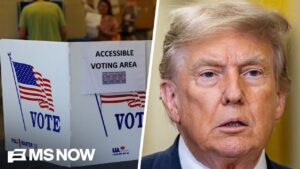
The Justice Department has sent formal warning letters to election officials in all 50 states and Washington, D.C., threatening criminal prosecution if noncitizens remain on voter rolls or cast ballots in federal elections. The unprecedented nationwide notice, signed by a top Trump administration civil rights official, has drawn sharp pushback from state election officials who call it political pressure rather than genuine law enforcement. The move marks a significant escalation in the federal government’s assertion of authority over state-run elections just months ahead of the 2026 midterms.
Story Highlights
- The DOJ’s Civil Rights Division sent letters to all 50 states and D.C. warning of potential criminal prosecution over noncitizen voting.
- Election officials were given as little as five days to respond with compliance plans.
- The Trump DOJ has secured roughly two dozen noncitizen voting arrests or convictions, with about 90 more cases under investigation.
- The push coincides with Trump’s stalled push for the SAVE America Act, which would mandate proof-of-citizenship voter registration nationwide.
What Happened
Harmeet Dhillon, the Assistant Attorney General heading the Justice Department’s Civil Rights Division, signed letters sent to election officials nationwide warning that “state election officers, including the chief election officer of the state, could be criminally prosecuted for aiding and abetting” violations of federal laws barring noncitizens from voting. The letters state that knowingly retaining noncitizens on a state’s voter registration list, sending them ballots, or counting those ballots would constitute the “procurement, casting, or tabulation” of ballots known to be false.
The letters were distributed unevenly, with several states reporting that they were sent to generic public-facing email addresses rather than directly to election officials, causing confusion about who had actually received them. States identified as recipients include Michigan, Arizona, Georgia, Kentucky, Tennessee, Oregon, and others, with some officials given as few as five days to respond with documented compliance plans.
The letters cite multiple federal statutes, including the National Voter Registration Act and the Help America Vote Act, and warn that “an intentional act aimed at diluting the votes of citizens” could also trigger liability. A Justice Department spokesperson confirmed the letters were sent to “all 50 states and the District of Columbia, asking for voluntary compliance in a timely manner” with federal obligations to ensure only citizens vote.
The campaign follows more than a year of DOJ efforts to review state voter rolls, including lawsuits against multiple states for declining to turn over full registration data. Officials told Just the News that around two dozen noncitizen voting cases have resulted in arrests, prosecutions, or convictions in recent months, with approximately 90 additional cases under investigation. States that have cooperated with federal review have identified between 20,000 and 30,000 noncitizens on their rolls, according to officials, though a much larger number is expected in states such as New York, New Jersey, Illinois, and California that have resisted DOJ requests.
Why It Matters
The dispute sits at the center of a long-running constitutional tension between federal authority and state control over election administration, a power the Constitution’s Elections Clause reserves primarily to the states, subject to congressional regulation of federal elections. Critics argue the DOJ’s letters represent an attempt to intimidate state officials into compliance with federal priorities under threat of criminal liability, without corresponding evidence of widespread wrongdoing. David Becker, a former DOJ voting rights lawyer who now leads the nonpartisan Center for Election Innovation and Research, characterized the campaign as resembling political pressure rather than the opening stages of genuine prosecution, noting that actual criminal indictments, not warning letters, would typically follow a real finding of wrongdoing.
Supporters of the initiative counter that any instance of noncitizen voting undermines the integrity of federal elections and that officials who knowingly permit such violations should face consequences. The legal reality is nuanced: research from organizations spanning the ideological spectrum, including the Brennan Center and the Cato Institute, has consistently found that noncitizen voting is exceedingly rare, and it has been a federal crime since 1996 under the Illegal Immigration Reform and Immigrant Responsibility Act, carrying penalties of up to a year in prison.
For state election officials, many of whom are nonpartisan civil servants, the letters create a genuine dilemma. Complying with sweeping data requests may conflict with state privacy laws, while noncompliance now carries an implied threat of personal criminal exposure, a combination that election administration experts warn could deter qualified people from serving in these roles altogether.
Economic and Global Context
The push is unfolding alongside the administration’s broader effort to reshape federal election law through the proposed SAVE America Act, which would require documentary proof of citizenship at voter registration and photo identification verification at the polls nationwide. The bill has stalled in the Senate amid bipartisan concerns, lacking sufficient votes to advance despite White House pressure.
The Department of Homeland Security has also entered the fray, with officials reportedly considering whether to leverage federal grant funding as a tool to compel state compliance with voter roll review requests, a strategy that would tie unrelated federal dollars to election administration decisions. Separately, a federal court recently blocked use of the Systematic Alien Verification for Entitlements, or SAVE, database tool in several states’ elections, though an emergency ruling allowed Florida, Ohio, Iowa, and Indiana to proceed under a prior settlement with DHS.
The administration’s efforts have faced repeated setbacks in court, a pattern that observers say partly explains the shift toward direct letters to officials rather than continued litigation, which has yielded limited success to date.
Implications
In the coming weeks, expect a wave of responses from state election offices, ranging from full cooperation in Republican-led states to formal legal pushback in Democratic-led states that view the letters as federal overreach. Several states are likely to challenge the DOJ’s authority to compel this level of data disclosure in court.
For voters, the practical effect in the near term is likely minimal, since existing law already criminalizes noncitizen voting and most state systems already include eligibility safeguards. The larger fight will center on whether Congress ultimately passes proof-of-citizenship legislation and whether federal courts uphold DOJ’s authority to threaten state officials directly.
Policymakers on both sides will be watching how this campaign shapes turnout and administration ahead of November, with Democrats warning it could suppress legitimate voters through confusion and delay, while Republicans frame it as a necessary safeguard for public confidence in the outcome.
Sources
