


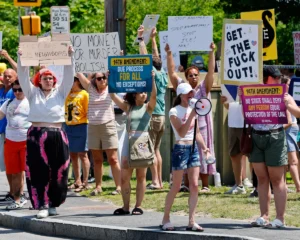
An ICE officer fatally shot a 26-year-old Colombian man in Biddeford, Maine, on Monday during an immigration enforcement operation, marking the ninth death connected to federal immigration enforcement since President Trump intensified his deportation crackdown. Both of Maine’s U.S. senators, from opposite parties, are now demanding a full and transparent investigation, while conflicting accounts have emerged over whether the man was even the intended target of the operation. The shooting has reignited national debate over the tactics and accountability of federal immigration agents operating with expanded authority under the current administration.
Story Highlights
- ICE fatally shot a 26-year-old Colombian national in Biddeford, Maine, who advocacy groups say was authorized to work in the U.S.
- Maine Senators Angus King and Susan Collins, an independent and a Republican, both called for a full, impartial investigation.
- Officials initially disputed whether the victim was the actual subject of the arrest warrant.
- It is the ninth death linked to federal immigration enforcement operations since Trump’s crackdown began, and the second lethal ICE shooting in a week.
What Happened
Federal immigration agents were conducting surveillance Monday morning on a residential street in Biddeford, a coastal town roughly 15 miles from Portland, targeting the last known address of an individual with a final order of removal, according to a statement from Immigration and Customs Enforcement. When a vehicle left the address, agents attempted a stop; ICE said the vehicle fled and that an officer, fearing for public safety, opened fire, fatally wounding the driver.
Advocacy groups, including the Maine Immigrants’ Rights Coalition and Presente!, identified the victim as a 26-year-old Colombian national who was authorized to work in the United States and held a valid Social Security number. Maine’s attorney general, Aaron Frey, launched an investigation, and the officer involved was placed on administrative leave pending its outcome, consistent with standard protocol.
Confusion quickly surrounded the basic facts of the incident. Senator Angus King said Homeland Security Secretary Markwayne Mullin initially told him the victim had been the actual target of the arrest warrant, but later corrected that account, informing King that the man shot “was not the target of the warrant.” Mullin reportedly told King the man had “weaponized” his vehicle by driving toward the officer. Officials confirmed that the ICE agents involved were not wearing body cameras, a detail King and other lawmakers cited as a significant obstacle to establishing what actually happened.
Senator Susan Collins, a Republican, said the shooting “requires a full and impartial investigation,” and confirmed that DHS’s inspector general office in Boston has taken over the case in cooperation with the FBI. Representative Chellie Pingree of Maine’s 1st District publicly raised a series of unanswered questions, including whether the man had a criminal record and why body cameras were not in use. Several hundred protesters gathered in Biddeford Monday night, facing a smaller group of counter-demonstrators supporting ICE and the administration.
Why It Matters
The Biddeford shooting is the latest in a growing pattern of lethal encounters involving federal immigration agents, and it raises pointed constitutional questions about the use of deadly force, due process, and accountability within an enforcement apparatus that has expanded rapidly under the current administration. The Fourth Amendment’s protections against unreasonable seizures apply to traffic stops and vehicle pursuits, and courts have historically scrutinized the use of lethal force against fleeing vehicles that do not pose an imminent threat to bystanders.
The fact that officials initially misidentified whether the victim was even the intended subject of the warrant underscores concerns about the accuracy and oversight of expedited enforcement operations. The absence of body cameras among the agents involved further limits independent verification of the official account, a gap that lawmakers from both parties have flagged as a systemic problem rather than an isolated lapse.
This incident follows a documented pattern: the Wall Street Journal identified more than a dozen incidents between July 2025 and January 2026 in which federal immigration officers fired at people inside vehicles, often citing the same “weaponized vehicle” justification. Previous incidents have included the deaths of U.S. citizens, raising the stakes for how these operations are conducted and reviewed.
Economic and Global Context
The shooting occurs amid a historic surge in immigration enforcement activity. In just five days at the end of June, ICE operations led to more than 10,000 arrests nationwide. In Maine specifically, ICE detained 546 people between the start of Trump’s second term and mid-March 2026, according to data from the University of California, Berkeley’s Deportation Data Project, with only 45 percent of those detained having criminal records, compared to 69 percent during a similar period before Trump’s first term.
Colombia’s embassy in Washington confirmed it is providing consular assistance to the victim’s family and working to formally confirm his identity and nationality. The incident adds to diplomatic sensitivities with Colombia and other Latin American nations whose nationals have been affected by the enforcement surge, at a moment when the administration is simultaneously pursuing aggressive foreign policy actions elsewhere in the hemisphere, including expanded sanctions on Cuba.
Implications
In the near term, the joint FBI-DHS inspector general investigation will determine whether the shooting was legally justified and whether departmental policy was followed. Given the bipartisan attention from Maine’s congressional delegation, the case is likely to receive sustained scrutiny regardless of its outcome.
For ICE and DHS leadership, the incident adds pressure to address the lack of body camera policies among enforcement agents, a gap that has repeatedly complicated public accountability in similar cases nationwide. Congressional Democrats are likely to renew calls for legislative oversight hearings, while some Republicans, including Collins, have signaled openness to a genuinely independent review despite broader support for the administration’s enforcement priorities.
For immigrant communities and civil liberties advocates, the shooting will likely fuel continued local protests and legal challenges to enforcement tactics, while state and local officials in jurisdictions skeptical of federal cooperation may face renewed pressure to limit their assistance to ICE operations.
Sources
