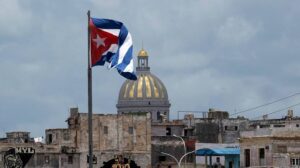
The Trump administration imposed a fresh round of sanctions on ten Cuban government entities Monday, striking at the island’s tourism industry and the paramilitary and surveillance apparatus that props up its communist government. The move, timed to the five-year anniversary of Cuba’s 2021 crackdown on popular protests, represents the latest escalation in a broader campaign to cut off the regime’s revenue sources. It comes as Secretary of State Marco Rubio pushes for sweeping political reform in Havana and Trump has floated the idea of a U.S. “takeover” of the island.
Story Highlights
- The State Department sanctioned ten Cuban entities, including the Ministry of Tourism and two civilian paramilitary organizations.
- The sanctions were issued under Executive Order 14404, signed in May, targeting entities linked to repression and strategic economic sectors.
- Targeted groups include the Territorial Troops Militia, Rapid Response Brigades, and the Association of Combatants of the Cuban Revolution.
- Entities affected have until August 12, 2026, to wind down transactions with U.S. persons and companies.
What Happened
The U.S. State Department announced Monday it was designating ten additional Cuban entities under sanctions authority, expanding an economic pressure campaign the administration describes as targeting the “interlocking pillars” of the Cuban government’s political and economic apparatus. The action was taken pursuant to Executive Order 14404, signed by President Trump in May, which authorizes sanctions on individuals and entities tied to repression in Cuba or to strategic sectors relevant to U.S. national security and foreign policy interests.
Among the entities newly sanctioned is Cuba’s Ministry of Tourism, which regulates one of the island’s largest sources of foreign currency and is considered by Washington to be one of the government’s primary revenue generators outside the military conglomerate known as GAESA. The sanctions also targeted two paramilitary organizations: the Territorial Troops Militia, known by its Spanish acronym MTT, a part-time civilian force under the command of Cuba’s Ministry of the Revolutionary Armed Forces, and the Rapid Response Brigades, described by the State Department as armed civilian para-police groups organized and trained by the Cuban government to suppress dissent.
Also designated was the Association of Combatants of the Cuban Revolution, which the State Department said conducts surveillance on dissidents at the direction of Cuba’s Ministry of the Interior. Several state-owned commercial entities were included as well, including firms involved in fuel imports, foreign trade management, insurance and financial services, and maritime shipping, reflecting an effort to disrupt the broader economic infrastructure that channels revenue to the Cuban state.
Secretary of State Marco Rubio tied the action to the five-year anniversary of Cuba’s July 11, 2021 crackdown on mass protests, stating that “the United States will continue to use every tool at our disposal to both address the national security threats posed by the Cuban Communist regime, and to drive the economic and political reforms to give Cuba a better future.” The sanctions generally prohibit U.S. citizens and companies from conducting business with the designated entities and freeze any assets those entities hold within U.S. jurisdiction. Affected parties and their international counterparts have until August 12, 2026, to unwind existing transactions.
Why It Matters
The expanded sanctions regime reflects a broader pattern in Trump’s second-term foreign policy: an aggressive use of executive sanctions authority to pressure adversarial governments without seeking new congressional authorization. While sanctions targeting repressive foreign governments enjoy broad bipartisan support in principle, the scope and pace of this campaign, layered atop existing decades-old embargo measures, raises questions about diminishing returns and the humanitarian impact on ordinary Cubans who rely on tourism-linked employment.
For Cuban-American communities, particularly concentrated in Florida, the sanctions carry significant political resonance and are likely to be welcomed as a continuation of a long-standing hardline posture toward Havana. For American businesses and travelers with ties to Cuba’s tourism sector, however, the designation of the Ministry of Tourism introduces new compliance complexity, given the sector’s role in facilitating legal travel arrangements even under existing embargo restrictions.
The action also illustrates the administration’s broader hemispheric strategy, applying sustained economic pressure on governments it views as authoritarian or hostile to U.S. interests, a posture that parallels its approach toward Venezuela and its escalating rhetoric toward other Latin American governments.
Economic and Global Context
Tourism has historically served as one of Cuba’s largest sources of hard currency, and its formal designation under U.S. sanctions authority threatens to further destabilize an economy already suffering from chronic shortages, inflation, and fuel scarcity. The additional sanctions on state-owned fuel importers, including ENETEC S.A. and COREYDAN S.A., compound existing pressure on an energy sector that has struggled with rolling blackouts across the island in recent years.
Rubio has separately called for far-reaching political and economic reforms within the Cuban government, while Trump has periodically floated more dramatic proposals, including the suggestion of a U.S. “takeover” of the island, rhetoric that, while not accompanied by any formal policy proposal, has heightened tensions between Washington and Havana.
International reaction has been muted so far, though the sanctions could complicate relationships with third-country businesses and financial institutions that maintain dealings with the newly designated entities, particularly in sectors like shipping, insurance, and trade finance where compliance risk now extends to a broader set of Cuban state actors.
Implications
In the near term, expect the Treasury Department’s Office of Foreign Assets Control to issue further compliance guidance for U.S. and international businesses navigating the expanded designations before the August 12 deadline. Financial institutions and shipping companies with any indirect Cuban exposure will need to conduct enhanced due diligence to avoid inadvertent violations.
For the Cuban government, the sanctions add further strain to an economy already navigating severe hardship, potentially accelerating emigration pressures that have already sent significant numbers of Cubans toward the United States in recent years, a dynamic that intersects with the administration’s simultaneous immigration enforcement priorities.
Congressional Republicans supportive of a hardline Cuba policy are likely to press for continued escalation, while critics, including some Democrats and humanitarian organizations, may argue the sanctions disproportionately harm ordinary Cubans rather than the regime’s leadership, a debate likely to continue as the administration weighs further measures.
Sources
