
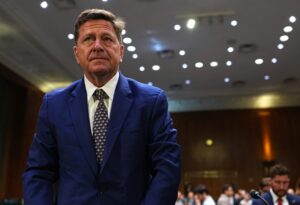
Jay Clayton, President Trump’s nominee to become Director of National Intelligence, repeatedly declined during his Senate confirmation hearing to say that Joe Biden won the 2020 presidential election, prompting sharp bipartisan questioning and accusations from Democrats that he was not being forthright. The exchange, centered on a now-familiar litmus test in Trump-era confirmation hearings, threatens to complicate Clayton’s path to leading the nation’s 18 intelligence agencies. The hearing came just a day before Trump is scheduled to deliver a primetime address focused on 2020 election claims.
Story Highlights
- Clayton, a former SEC chair and current U.S. attorney for the Southern District of New York, repeatedly avoided directly saying Biden won the 2020 election.
- Sen. Jon Ossoff called Clayton’s responses “not honest or forthright” and asked if it was “humiliating” to avoid the question.
- Republicans control the confirmation process, but several senators, including Sen. Angus King, pressed Clayton just as hard as Democrats did.
What Happened
Jay Clayton appeared Wednesday before the Senate Select Committee on Intelligence for a roughly two-hour confirmation hearing to become the next Director of National Intelligence, succeeding Tulsi Gabbard, who resigned in May, and interim director Bill Pulte. Clayton, currently the U.S. attorney for the Southern District of New York and a former chair of the Securities and Exchange Commission, had initially been scheduled to testify in June before Trump abruptly directed him not to appear, reportedly to pressure the Senate on a separate nominee for Clayton’s current post.
During questioning, Sen. Jon Ossoff of Georgia pressed Clayton directly on who won the 2020 presidential election. Clayton avoided a direct answer, instead repeating a formulation he used throughout the hearing: “I am not an election denier. Joe Biden was certified.” When Ossoff continued pressing, Clayton responded, “You know, I’m not gonna do this with you,” and later added he was “not gonna engage in the theater.” Ossoff called the responses “disqualifying” and asked Clayton whether it was “humiliating” to be unable to answer what he described as a basic factual question while seeking to lead the intelligence community.
Independent Sen. Angus King of Maine, who caucuses with Democrats, also pressed Clayton pointedly, asking, “Who won the 2020 election?” Clayton again avoided a direct answer, saying only that Biden “went through our processes” and “became president of the United States.” King responded that certification was not an answer to his question and told Clayton directly that he had not answered it.
The hearing also touched on Clayton’s decision as U.S. attorney to subpoena New York Times reporters over their coverage of a Qatari jet gifted to Trump, his views on downsizing the Office of the Director of National Intelligence, and whether he had any involvement in Trump’s planned Thursday address focused on 2020 election claims. Clayton said he had no involvement in that speech and that engaging in such matters before confirmation would be inappropriate. Sen. Susan Collins, a Republican and one of the original authors of the law creating the ODNI, said she was troubled by calls from some officials and senators to eliminate the office altogether.
Why It Matters
The hearing underscores lingering concern in Congress over whether the intelligence community will be used to validate Trump’s continued claims that the 2020 election was stolen. Democrats argue that Clayton’s evasive answers suggest he is unwilling to contradict the president even on matters of settled fact, raising doubts about his independence in a role responsible for briefing the president on sensitive national security matters, including election security threats from foreign adversaries.
Committee Vice Chair Mark Warner, a Democrat who has a longstanding professional relationship with Clayton from his time at the SEC, entered the hearing prepared to support the nomination but appeared unwilling to commit to a yes vote by its conclusion, a sign of how significant the exchange over the 2020 election proved to be even among Clayton’s allies.
For voters, the episode reflects a broader pattern in which nominees across the Trump administration have avoided direct acknowledgment of settled electoral outcomes, a dynamic that continues to shape public trust in both electoral institutions and the officials tasked with safeguarding them.
Economic and Global Context
While the hearing itself carries no direct market implications, the position Clayton seeks oversees the coordination of 18 separate intelligence agencies responsible for assessing threats ranging from foreign election interference to economic espionage, functions with direct bearing on national security policy and international relations.
The timing is notable: the hearing occurred less than a day before Trump’s planned primetime address on what the White House has billed as foreign interference in the 2020 election, a speech reportedly informed by material from the Office of the Director of National Intelligence. Lawmakers from both parties questioned Clayton about any involvement in preparing that address, reflecting concern that the intelligence apparatus itself may be enlisted to support the president’s political narrative.
Internationally, allied intelligence services closely monitor U.S. leadership transitions at the ODNI, given the office’s role in coordinating shared threat assessments; a contentious, partisan confirmation could affect perceptions of continuity and reliability in U.S. intelligence leadership.
Implications
Senate Intelligence Chairman Tom Cotton has said the committee plans to vote on Clayton’s nomination early next week. Republicans can confirm Clayton without any Democratic votes, but they cannot afford more than a few defections in committee or more than three on the Senate floor, giving outsized influence to any Republican senator who shares concerns raised by Collins or others about the office’s direction.
For Democrats, the hearing offers a clear line of political attack heading into further oversight of the administration’s intelligence and election-related activities, particularly as Trump’s Thursday address on 2020 election claims draws additional scrutiny to the ODNI’s role.
For Clayton, should he be confirmed despite the contentious hearing, he will inherit an office already reshaped by Pulte’s tenure, including the dismissal of numerous senior intelligence officials, and will face pressure from both parties to clarify his stance on election integrity matters far beyond this single hearing.
Sources
“DNI nominee Jay Clayton repeatedly refuses to answer who won the 2020 election”
