


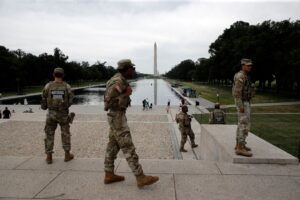
The National Guard deployment in Washington, D.C. has expanded significantly during the nation’s 250th anniversary celebrations, drawing renewed criticism from civil liberties groups and Democratic-led states whose troops were pulled into what critics describe as an open-ended federal occupation of the nation’s capital. The controversy reflects deepening tension over the use of military forces in domestic law enforcement roles under the Trump administration.
Story Highlights
- National Guard troop levels in D.C. surged from roughly 2,400 to around 5,000 during America 250 events
- Michigan sent approximately 160 troops and Minnesota just over 100 for the anniversary celebrations
- A coalition of civic and civil rights groups has asked Democratic governors to withdraw their states’ Guard members
- The D.C. attorney general’s lawsuit challenging the deployment remains active in federal court
What Happened
The National Guard presence in Washington, D.C. has swelled substantially in recent weeks, growing from a sustained baseline of approximately 2,300 to 2,600 troops to roughly 5,000 personnel as part of security arrangements for the Great American State Fair, Fourth of July fireworks, and other large-scale events marking the 250th anniversary of American independence. The surge included temporary contingents from Democratic-led states, including Michigan, which sent approximately 160 troops, and Minnesota, which sent just over 100, states whose governors had originally framed their participation as limited support for the historic celebration rather than an endorsement of the broader, ongoing Guard deployment to the city.
The deployment originated in August of the previous year, when President Donald Trump issued an executive order declaring a crime emergency in Washington and ordered more than 2,300 National Guard troops from the district and eight states to patrol the city, alongside a surge of federal law enforcement officers. For the first time in history, a president invoked Section 740 of the Home Rule Act to place the Metropolitan Police Department under direct federal Attorney General authority, though that federalization arrangement ended in September of the previous year even as thousands of Guard troops remained stationed in the capital.
D.C. Attorney General Brian Schwalb filed suit against the administration last year, arguing that the deployment illegally intrudes on local officials’ authority to direct law enforcement within the District and that the arrangement effectively operates as a federal military police force answering to the Pentagon rather than to the state National Guard leadership traditionally responsible for command decisions. A federal district judge initially found the deployment unlawful and ordered troops to leave, but an appeals court stayed that order, allowing the deployment to continue while litigation proceeds, with the appellate panel citing factors including disruption to service members’ lives and the president’s interest in protecting federal government functions and property within the capital.
This week, a coalition of think tanks, civic organizations, labor unions, and civil rights groups formally requested that Democratic governors, including Michigan’s, withdraw their states’ National Guard contingents from the ongoing D.C. mission, arguing that participation in anniversary security events was being used to normalize and extend what critics characterize as an indefinite federal military presence in the nation’s capital. A Minnesota contingent sent specifically for the anniversary celebrations is reportedly set to depart ahead of schedule, reflecting some governors’ discomfort with extended participation beyond the original scope of their troops’ orders.
Why It Matters
The ongoing D.C. deployment raises fundamental constitutional questions about the balance of power between federal and local authority, as well as the appropriate role of military forces in domestic civilian law enforcement, a principle historically constrained by the Posse Comitatus Act and longstanding norms against military involvement in routine policing functions. The District’s unique constitutional status, lacking full statehood and subject to direct congressional and presidential authority in ways other jurisdictions are not, has made it a particular focal point for these tensions.
For residents of Washington, D.C., who lack voting representation in Congress and full local self-governance, the extended Guard presence represents what advocacy groups describe as a stark illustration of the district’s limited political power to resist federal intervention in local affairs, fueling renewed calls from statehood advocates for structural changes to the district’s constitutional status.
The participation of Democratic-led states’ Guard troops, even temporarily, has created significant political complications for governors who must balance their states’ historic role supporting national celebratory events against concerns that such participation could be used to legitimize a broader deployment they oppose on constitutional grounds, illustrating the complex federalism dynamics at play when state military resources operate under federal command.
The case also carries significant precedential weight for similar disputes that have arisen in other cities where the administration has deployed or threatened to deploy National Guard troops, including previous federal court rulings finding such deployments unlawful in Los Angeles, Oregon, and Illinois, creating a body of conflicting case law that may eventually require Supreme Court resolution regarding the scope of presidential authority to federalize state Guard units for domestic law enforcement purposes.
Economic and Global Context
The extended deployment carries substantial fiscal costs, with National Guard mobilizations funded through federal appropriations that have grown considerably as the mission has continued well beyond its original stated timeframe, raising questions among fiscal watchdogs about the long-term budgetary implications of open-ended domestic military deployments absent clear congressional authorization or defined mission parameters.
State-level economic considerations have also factored into the debate, with attorneys general in several states challenging similar deployments elsewhere arguing that prolonged military presence can depress local business activity and tourism, concerns that carry particular relevance for Washington, D.C. given the city’s reliance on tourism revenue, especially during high-profile national celebratory events intended to showcase the nation’s history and institutions.
Internationally, the visible presence of military troops patrolling the streets of the nation’s capital during a major national commemorative event has drawn some attention from foreign observers and media, given the unusual optics of domestic military deployment in a democracy typically associated with civilian-led policing, particularly during celebrations meant to highlight American democratic traditions.
The legal uncertainty surrounding the deployment’s ultimate resolution also creates broader implications for interstate cooperation on Guard mobilizations going forward, as governors across the political spectrum weigh the risks and benefits of volunteering state military resources for missions that may extend well beyond their original stated scope and duration.
Implications
The ongoing federal litigation over the D.C. deployment remains unresolved, with the appeals court’s stay allowing the current arrangement to continue while the underlying legal questions about local authority and federal military power proceed through the courts, a process that could extend for months or longer depending on the pace of appellate review.
For Democratic governors whose troops participated in the anniversary events, the coming weeks will likely bring continued pressure from advocacy coalitions and constituents to withdraw remaining forces, potentially creating friction with the federal Joint Task Force overseeing the mission, which has indicated no current plans for a formal extension beyond existing orders running through the end of November.
For Congress, the deployment’s continuation raises questions about legislative oversight of domestic military operations, with some lawmakers expected to press for hearings examining the costs, legal basis, and long-term implications of sustained National Guard presence in American cities absent traditional emergency justifications.
Looking ahead, the resolution of this dispute, alongside similar ongoing cases in other jurisdictions, will likely help define the practical boundaries of presidential authority to deploy military forces domestically, with significant implications for how future administrations of either party may seek to use similar tools in response to perceived crises in American cities.
Sources
