


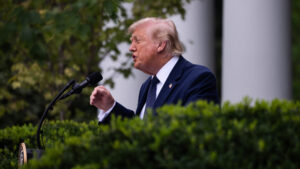
President Donald Trump is pursuing an extraordinary bid to force the Supreme Court to reconsider its recent ruling striking down his executive order restricting birthright citizenship, calling the decision “absolutely insane” just days after the justices delivered one of the term’s most consequential constitutional rulings. Legal experts note the rehearing request faces exceedingly long odds given the Supreme Court’s historical reluctance to revisit its own decisions.
Story Highlights
- The Supreme Court ruled 6-3 on June 30 that Trump’s executive order limiting birthright citizenship is unconstitutional
- Trump announced July 9 he would seek an immediate rehearing before the high court
- Chief Justice John Roberts wrote the majority opinion, joined by Justice Amy Coney Barrett and the court’s liberal justices
- The Supreme Court has not granted a rehearing in an argued case in decades
What Happened
The Supreme Court issued its ruling in Trump v. Barbara on June 30, the final day of its term, striking down President Trump’s executive order that sought to deny automatic citizenship to children born on U.S. soil to parents who were undocumented or only temporarily present in the country. Chief Justice John Roberts, writing for the majority in a 6-3 decision, held that children born in the United States to parents unlawfully or temporarily present remain “subject to the jurisdiction” of the United States and are therefore citizens at birth under the Fourteenth Amendment’s Citizenship Clause. Roberts was joined by Justices Elena Kagan, Sonia Sotomayor, Amy Coney Barrett, and Ketanji Brown Jackson in the core holding.
The executive order at issue, signed by Trump in 2025, would have required at least one parent to hold citizenship or permanent legal status for a child born in the United States to automatically receive citizenship. The case drew intense national attention, with Trump making the unusual decision to personally attend oral arguments at the Supreme Court on April 1, becoming one of the few sitting presidents in modern history to do so. During arguments, the administration’s Solicitor General argued that the Citizenship Clause’s requirement that individuals be “subject to the jurisdiction” of the United States should be understood through the lens of “domicile,” meaning lawful, permanent residence, rather than the broader historical interpretation applied in the landmark 1898 case United States v. Wong Kim Ark.
The Court rejected that argument, with Roberts writing that the Fourteenth Amendment’s framers extended citizenship’s promise to “every free-born person in this land.” Justice Brett Kavanaugh concurred in the judgment but on different grounds, arguing that Trump’s order violated an existing federal statute, 8 U.S.C. §1401(a), rather than the Constitution itself, and suggesting Congress could enact new legislation establishing exceptions to birthright citizenship if it chose to do so. Justices Clarence Thomas and Neil Gorsuch dissented sharply, with Thomas authoring a 91-page dissent arguing that the Citizenship Clause was intended as a race-conscious remedy specifically for formerly enslaved individuals and their descendants, not a universal grant of citizenship to all persons born on U.S. soil regardless of their parents’ status.
Following the ruling, Trump reacted furiously on Truth Social, calling the decision “insane” and announcing on July 9 that his legal team would immediately petition the Supreme Court for a rehearing, an exceptionally rare procedural request that the Court has not granted in an argued case in several decades. Trump also called on congressional Republicans to pass legislation restricting birthright citizenship, acknowledging the difficulty of that path given consistent public opinion polling showing strong support for the existing constitutional practice.
Why It Matters
The ruling represents one of the most significant constitutional decisions of Trump’s second term, reaffirming a settled understanding of the Fourteenth Amendment that has governed American citizenship law for more than 125 years since the Wong Kim Ark decision. The case’s resolution carries direct consequences for hundreds of thousands of families, with researchers estimating that as many as 255,000 infants annually would have been affected by the now-invalidated executive order, potentially adding millions to the undocumented population over subsequent decades had the order been upheld.
The decision also serves as a notable check on unilateral executive action to reshape constitutional rights through executive order rather than legislation or constitutional amendment, reinforcing that fundamental changes to citizenship law require either congressional action, consistent with existing statutory frameworks, or a formal constitutional amendment process, not executive directive alone.
Trump’s subsequent push for a rehearing, despite the Supreme Court’s well-established reluctance to reconsider argued cases, signals a broader pattern within the administration of contesting adverse judicial rulings through unconventional or long-shot legal avenues, a strategy that legal scholars note is unlikely to succeed but that nonetheless keeps the issue in the political and legal spotlight ahead of potential future legislative efforts.
For immigrant rights advocates and civil liberties organizations, the ruling represents a significant victory affirming what they describe as a fundamental constitutional promise. American Civil Liberties Union attorney Cecillia Wang, who argued the case, characterized the decision as reaffirming that individuals born in the United States are citizens, regardless of the immigration status of their parents.
Economic and Global Context
The ruling carries substantial implications for federal, state, and local government administration, given that birthright citizenship affects eligibility for a wide range of government programs, benefits, and services extended to citizens from birth, including access to certain healthcare programs, educational resources, and eventual voting rights upon reaching adulthood.
Internationally, the United States joins more than 30 other countries that maintain unconditional birthright citizenship policies, a fact that undercuts Trump’s characterization during the litigation that the United States was uniquely permissive in extending automatic citizenship, a claim that legal and policy analysts have noted does not accurately reflect global practice.
The decision also carries implications for broader immigration policy debates, as it forecloses one avenue the administration had pursued to restrict pathways to citizenship without congressional action, potentially redirecting administration efforts toward other executive tools, including expanded enforcement operations and visa restrictions that remain within the president’s more clearly established authority.
Economically, immigration researchers note that birthright citizenship has historically supported long-term integration and economic mobility for children of immigrants, with citizenship status from birth removing barriers to higher education financing, certain employment opportunities, and civic participation that noncitizens often face, effects that would have been substantially altered had the executive order been upheld.
Implications
The Supreme Court’s response to Trump’s rehearing request will likely come within the coming weeks or months, though legal observers widely expect the petition to be denied given the Court’s strong historical presumption against revisiting argued decisions, absent extraordinary circumstances such as newly discovered evidence or a fundamental procedural defect in the original proceedings.
For congressional Republicans, Trump’s call to pursue legislative restrictions on birthright citizenship presents significant political and legal obstacles, as any such legislation would likely require navigating constitutional questions the Court has now addressed directly, potentially triggering renewed litigation regardless of the legislative path chosen.
For families directly affected by the now-invalidated executive order, the ruling provides immediate legal clarity and stability, ensuring that children born in the United States retain their constitutional citizenship status regardless of their parents’ immigration circumstances, a protection that will remain in effect while any rehearing petition is considered and, in the likely event of denial, permanently thereafter absent future constitutional amendment.
Looking ahead, the case is expected to remain a significant point of political contention heading into future election cycles, with immigration policy continuing to serve as a central battleground issue and this ruling now standing as a definitive marker of the constitutional limits on executive authority in that domain.
Sources
