


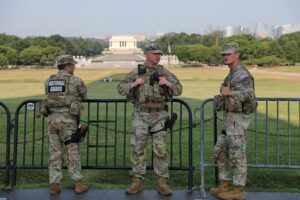
Nearly a year after President Trump first federalized the Washington, D.C. National Guard under a declared crime emergency, roughly 2,500 troops remain stationed in the nation’s capital with no firm end date in sight, as court filings indicate the deployment is likely to persist at least through the summer’s America 250 celebrations. The prolonged military presence, upheld for now by a federal appeals court despite a lower court ruling that it violates local law, has become the most enduring test case in a broader nationwide battle over the constitutional limits of using the armed forces for domestic policing. D.C.’s attorney general continues to press the case that the operation represents an unlawful and indefinite militarization of civilian law enforcement.
Story Highlights
- Approximately 2,500 National Guard troops remain deployed in Washington, D.C., with internal documents showing officials planning for a “long-term persistent presence”
- A federal appeals court has allowed the deployment to continue pending appeal after a district judge ruled it violated D.C. law and the Constitution
- Guard members have been deputized as federal law enforcement despite the Marshals Service waiving standard law enforcement training requirements for many of them
What Happened
President Trump first deployed the National Guard to Washington, D.C. in August 2025 after issuing an executive order declaring a crime emergency in the nation’s capital, a move that also placed the Metropolitan Police Department under federal control for a period. Within weeks, more than 2,300 Guard troops from the D.C. Guard and eight Republican-led states, including West Virginia, South Carolina, and Mississippi, were patrolling city streets under the command of the Army secretary, joined by hundreds of additional federal agents.
The deployment escalated further after a targeted attack near the White House in late November left one West Virginia Guard member dead and another wounded, prompting Defense Secretary Pete Hegseth to order 500 additional troops into the city. D.C. Attorney General Brian Schwalb had already sued to challenge the original deployment, arguing that it violated Title 49 of the D.C. Code by activating troops for non-military, crime-deterrence missions without the mayor’s consent, and that the federal government lacked authority under Title 32 to solicit out-of-state Guard troops for the mission. U.S. District Judge Jia Cobb, a Biden appointee, agreed, ruling in November that the deployment was unconstitutional and illegally intruded on local officials’ authority over law enforcement in the district, though she stayed her own order for 21 days to allow an appeal.
The D.C. Circuit Court of Appeals subsequently froze Cobb’s ruling in December, allowing the deployment to continue while the underlying legal questions are litigated. Writing for a unanimous three-judge panel that included two Trump appointees, Judge Patricia Millett found that the Trump administration would likely succeed on its argument that the president possesses unique authority to mobilize the Guard specifically within the federal district, distinguishing D.C. from the state-level deployments the administration has pursued elsewhere. The panel cited the disruption that removing more than 2,000 troops would cause as a factor weighing against Schwalb’s request.
Court filings obtained through the ongoing litigation reveal that Guard leadership has been planning for an extended, potentially indefinite presence rather than a temporary crime-response mission. Brigadier General Leland Blanchard II, the mission’s interim commander, wrote in internal communications that troops should “plan and prepare for a long-term persistent presence” in the district, explicitly citing the America 250 semiquincentennial celebrations in July 2026 as a factor shaping the mission’s duration. Documents also revealed that the U.S. Marshals Service waived standard law enforcement training and experience requirements for Guard members deputized to conduct policing functions on D.C. streets, a detail Schwalb’s office has cited as evidence of inadequate oversight for personnel exercising law enforcement powers over civilians.
The D.C. case now sits alongside a broader constellation of legal battles over Guard deployments to other Democratic-led cities, including a Supreme Court decision that blocked a similar deployment to Chicago after finding the administration failed to identify a lawful statutory basis for it, a ruling that led to the withdrawal of Guard troops from Illinois, Oregon, and California following months of federalization.
Why It Matters
The prolonged D.C. deployment sits at the heart of one of the most consequential constitutional debates of the current era: the proper boundary between military and civilian authority on American soil. The Posse Comitatus Act, a Reconstruction-era statute, generally prohibits the use of federal military forces for domestic law enforcement absent specific constitutional or statutory exception, a principle rooted in the founding generation’s deep suspicion of standing armies being used against the civilian population they were meant to defend rather than police.
The D.C. Circuit’s reasoning, that the president holds unique authority over the district precisely because it is a federal enclave rather than a sovereign state, raises its own separate constitutional concern: it suggests residents of the nation’s capital, who already lack full voting representation in Congress, may also possess weaker legal standing to challenge federal military deployment in their own streets than residents of any of the fifty states. That asymmetry has drawn criticism from D.C. statehood advocates and civil liberties organizations who argue it compounds an existing democratic deficit facing the district’s roughly 700,000 residents.
The waiver of standard law enforcement training and experience requirements for Guard members exercising arrest and policing powers over civilians raises additional accountability questions. Unlike sworn police officers, deputized Guard members operate under a different chain of command and disciplinary structure, complicating the ordinary mechanisms, including civilian oversight boards and use-of-force review processes, that typically govern police conduct in American cities.
For the broader nationwide pattern of Guard deployments, the D.C. case functions as something of an outlier precedent. While the Supreme Court’s Illinois ruling constrained the administration’s ability to federalize Guard troops in states over gubernatorial objection, the D.C. Circuit’s distinct reasoning for the capital suggests the administration may have found a more durable legal pathway specifically within federal territory, a distinction that could shape how future administrations of either party approach domestic military deployment in Washington going forward.
Economic and Global Context
The financial cost of sustaining a multi-state, cross-jurisdictional military deployment for nearly a year has not been fully disclosed by the Pentagon, though comparable historical deployments suggest costs running into the hundreds of millions of dollars annually when accounting for troop pay, equipment, lodging, and interstate coordination logistics. Guard members activated under Title 32 authority receive federal pay and benefits while remaining under their home state governor’s ultimate command structure, a hybrid arrangement that has itself become a point of legal contention in the litigation.
The deployment’s extension into the America 250 celebration period adds a symbolic dimension to the ongoing legal fight, with the nation’s 250th anniversary festivities in July 2026 drawing both domestic and international attention to the capital at precisely the moment the military’s domestic policing role remains legally unresolved. Foreign observers and allied democracies have periodically noted the optics of an extended military presence in the capital of a nation that has historically positioned itself as a global advocate for civilian control of the military and constraints on domestic use of force.
Comparable international precedents offer limited direct parallel, since most Western democracies maintain far stricter statutory and constitutional prohibitions on using national military forces for routine domestic policing than the somewhat more permissive framework governing National Guard units, which occupy a unique hybrid state-federal status under the U.S. Constitution’s militia clauses.
Domestically, the D.C. deployment’s cost and duration will likely factor into upcoming congressional appropriations debates, particularly as lawmakers from both parties weigh the operation against competing budget priorities and as some Republican governors who volunteered their states’ Guard units for the mission face their own state-level budget and personnel pressures from extended out-of-state deployments.
Implications
In the near term, the D.C. Circuit’s underlying appeal on the merits remains pending, meaning the current stay allowing deployment to continue is not a final resolution of whether Trump’s original August 2025 order was lawful, leaving the door open for Schwalb’s office to eventually prevail on the core constitutional question even as troops remain on the ground in the interim.
For the eight states that volunteered Guard personnel for the mission, continued rotation of troops in and out of Washington will likely strain state-level Guard readiness and create political pressure on governors, particularly as the deployment stretches well beyond its originally announced timeline and as some state officials have indicated they were not consulted about extensions.
For D.C. residents and local officials, the sustained federal military and law enforcement presence will likely remain a defining feature of daily life in the capital through at least the America 250 period, with ongoing disputes over policing tactics, oversight, and civilian trust continuing to play out both in the courts and in local political debates.
For the broader legal landscape governing presidential military authority, the ultimate outcome of the D.C. Circuit’s merits review, expected sometime after the current appeal concludes, will likely serve as an important precedent shaping how future presidents, of either party, may or may not use the National Guard within the federal district going forward.
Sources
