


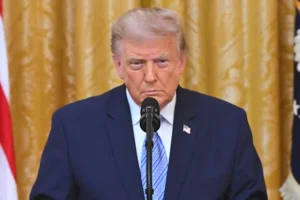
President Trump used a nationally televised primetime address Thursday night to announce the declassification of intelligence he says shows China illegally obtained roughly 220 million American voter files beginning in 2020. The address reignited years of controversy over the legitimacy of the 2020 election and comes just months before pivotal midterm elections in which Republicans face significant political headwinds.
Story Highlights
- Trump announced the declassification of intelligence alleging China acquired 220 million U.S. voter files starting in the 2020 election cycle
- The president claimed intelligence agencies withheld the information from him, Congress, and the public
- Homeland Security Secretary Markwayne Mullin is set to brief the public on alleged voting system vulnerabilities
- Democrats and China’s embassy in Washington have pushed back forcefully on the claims
What Happened
During a 25-minute address from the East Room of the White House, Donald Trump announced what he called “the immediate declassification and release of critical intelligence, revealing shocking vulnerabilities in our election infrastructure.” The president said newly released documents, compiled by the White House Government Transparency Task Force with support from the President’s Intelligence Advisory Board, show that Chinese intelligence services obtained voter registration data from 18 states beginning in 2020. He said the total haul amounted to 220 million voter files containing names, addresses, phone numbers, and political party affiliations.
Trump alleged that U.S. intelligence agencies discovered the breach in 2020 but “actively worked to suppress and downplay” the information, keeping it from him during his first term as well as from Congress and the American public. He characterized the episode as “the largest compromise of election data in history” and announced that Homeland Security Secretary Markwayne Mullin would hold a follow-up briefing on cyber vulnerabilities in state voting systems. The president also referenced a Chinese “data exploitation unit” he said had been assigned specifically to analyze the stolen files, and pointed to a Department of Homeland Security review claiming 278,000 non-citizens are registered to vote in federal elections.
The documents themselves, according to independent reviews, largely reaffirm previous public findings by the intelligence community that China analyzed voter data for opinion-research purposes but did not alter votes, hack voting machines, or change election outcomes. An August 2020 National Intelligence Council assessment cited in the newly released materials found that Beijing considered but ultimately did not deploy interference efforts, judging that neither Trump nor his opponent’s victory was worth the risk of getting caught meddling.
A spokesperson for the Chinese Embassy in Washington, Liu Chang, rejected the allegations, stating that China has never interfered in American elections and that the outcome of U.S. elections is determined solely by American voters. Democrats on Capitol Hill accused the president of using the declassification to sow doubt ahead of the 2026 midterms. Virginia Senator Mark Warner called the claims “totally bogus,” noting that intelligence agencies unanimously concluded China did not alter a single vote in 2020. Representative Joseph Morelle of New York said the timing amounted to a pretext for disputing the legitimacy of the upcoming midterm results.
Why It Matters
The declassification lands at a politically sensitive moment. Trump’s Republican Party faces difficult midterm terrain amid voter frustration over the cost of living, an escalating military conflict with Iran, and continued controversy surrounding immigration enforcement. By elevating a years-old grievance about 2020, the president is signaling that election integrity will remain a central theme of his political messaging heading into November, regardless of competing priorities that polling suggests voters care about more urgently.
For supporters of the administration, the disclosures represent vindication of long-standing concerns that federal agencies withheld material information from the public and from Trump himself during his first term, and they argue that renewed scrutiny of voter-roll security is a reasonable response to any documented foreign data collection, regardless of whether votes were altered. The administration’s push for tighter voter ID and citizenship-verification requirements is likely to gain fresh momentum from this disclosure, feeding into broader legislative efforts on Capitol Hill.
Critics counter that repeatedly relitigating 2020, an election that career intelligence officials and Trump’s own first-term agencies concluded was not manipulated, without new evidence of altered results, risks further eroding public trust in the electoral system itself. Election administrators have warned that sustained rhetoric questioning election legitimacy, even when tied to genuine data-security concerns, can suppress turnout and fuel harassment of local election workers regardless of the messenger’s intent.
Economic and Global Context
The disclosure carries diplomatic implications for U.S.-China relations, which have already been strained by an extended tariff dispute and disagreements over Taiwan and technology exports. Beijing’s rejection of the allegations is consistent with its standard posture on interference claims, but the timing, arriving amid broader trade friction, adds another point of tension to an already complicated bilateral relationship heading into the back half of 2026.
Domestically, the announcement is likely to accelerate state-level legislative pushes for stricter voter list maintenance and cybersecurity funding for election infrastructure. Several states named in the declassified documents already provide voter registration data commercially or by public records request, a detail that has led some cybersecurity analysts to question how much of the “breach” reflects unauthorized hacking versus legal, if concerning, data aggregation. Federal funding for election security grants, a recurring line item in appropriations fights, may become a new flashpoint in budget negotiations this fall.
Globally, the episode reinforces a broader pattern of major democracies scrutinizing foreign data-collection efforts tied to elections, from European inquiries into disinformation networks to congressional debates over TikTok and other Chinese-linked platforms. Analysts note that voter file exposure, whether through hacking or commercial aggregation, is a recurring vulnerability across democracies given how much registration data is legally public or semi-public in the United States.
Implications
In the immediate term, expect Secretary Mullin’s briefing to generate its own news cycle, likely featuring additional specifics on which states and systems were affected and what remediation steps DHS recommends. State election officials, particularly in the 18 states named, will face pressure to respond publicly, either confirming, contextualizing, or disputing the scope of exposure described by the White House.
On Capitol Hill, Democrats are likely to request classified briefings or hearings to independently assess whether the declassified material supports the president’s broader claims about the 2020 outcome, while Republican allies may use the disclosure to push renewed election-law legislation ahead of the midterms. The Save America Act and similar voting-overhaul proposals that stalled in the House earlier this year could see renewed attention as a legislative vehicle.
For voters, the practical effect may be more skepticism, in some quarters, about the reliability of voter rolls, and in others, renewed accusations of politicization, regardless of the underlying facts. How local election administrators communicate about their own systems’ security in the coming weeks will likely shape whether this episode becomes a genuine security-reform moment or another chapter in the broader partisan fight over 2020.
Sources
