


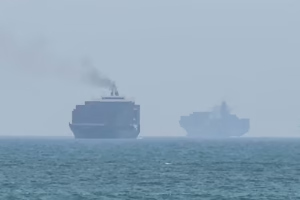
American forces have completed a sixth consecutive night of strikes against Iranian targets as President Trump’s reinstated naval blockade on the Strait of Hormuz enters its third week, deepening a conflict that reignited after a June ceasefire collapsed. The renewed fighting has disrupted global shipping through one of the world’s most critical oil chokepoints and pushed energy prices higher for American consumers.
Story Highlights
- U.S. Central Command has conducted six consecutive nights of strikes on Iranian targets tied to attacks on Gulf shipping
- Trump reinstated a naval blockade on Iran, intercepting vessels attempting to enter or exit Iranian ports
- Brent crude has climbed above $83 a barrel amid the disruption, with U.S. gas prices ticking upward
- A June ceasefire and memorandum of understanding between the U.S. and Iran collapsed after roughly three weeks
What Happened
President Trump ordered a renewed U.S. naval blockade on Iran earlier this week after a ceasefire brokered in mid-June unraveled amid disputes over control of the Strait of Hormuz, a narrow waterway through which a substantial share of the world’s seaborne oil trade passes. U.S. Central Command said American forces struck “dozens of targets at multiple locations with precision munitions” over the weekend and into Monday, aiming to degrade Iran’s capacity to continue attacking commercial vessels transiting the strait. By midweek, the military had completed a sixth consecutive night of strikes, according to live Pentagon updates.
The blockade, which Trump described in a Truth Social post as “the IRANIAN BLOCKADE,” is designed to intercept ships attempting to enter or leave Iranian ports rather than restrict traffic broadly through the strait. U.S. Central Command said the reimposed measures intercepted two vessels within the first 17 hours of enforcement, and CENTCOM has since reported intercepting dozens more, with several ships redirected away from Iranian terminals. Trump initially floated a 20 percent toll on all cargo passing through Hormuz to offset American security costs but walked the proposal back within a day after pushback from allied governments who rely on the waterway for energy imports.
The current escalation follows a ceasefire and memorandum of understanding signed by the U.S. and Iran on June 17, which briefly paused hostilities after an initial wave of “major combat operations” that Trump launched on February 28. That earlier campaign, conducted jointly with Israel, targeted Iranian military, government, and infrastructure sites. The truce lasted less than three weeks before disagreements over Hormuz traffic management triggered renewed strikes, and Trump has since declared the ceasefire “over,” although diplomatic channels reportedly remain open.
Iran has continued limited retaliatory strikes, including a claimed attack on a U.S. base in Syria and shrapnel that reportedly injured a child in Qatar. The European Union Aviation Safety Agency has issued an advisory, extended through at least July 29, warning airlines to avoid the airspace of Bahrain, Kuwait, Qatar, the United Arab Emirates, and parts of the Gulf of Oman, citing “recurrent and significant violations” of the collapsed ceasefire.
Why It Matters
The renewed conflict underscores the fragility of diplomatic arrangements in the Gulf and raises the prospect of a prolonged, open-ended military engagement with no clear resolution in sight. Analysts who track the region note that this is not the first time Washington has attempted to use military and economic pressure to force concessions from Tehran over Hormuz access, and previous rounds have not produced lasting change in Iranian behavior.
For American service members and their families, the sustained pace of strikes, now into a sixth consecutive night, represents an extended operational tempo with material and personnel costs. Defense analysts have raised concerns about depleted munitions stockpiles after months of intermittent conflict, a factor that could constrain the administration’s options if the campaign continues without a decisive breakthrough.
For the broader region, the instability threatens to draw in other Gulf states and shipping nations whose vessels transit Hormuz regardless of their involvement in the underlying U.S.-Iran dispute. Trump’s own decision to walk back the proposed 20 percent transit toll after allied objections illustrates how difficult it is to impose costs on Iran without also burdening partner nations and global commerce more broadly.
Economic and Global Context
The market impact has been immediate and measurable. Brent crude futures climbed above $83 a barrel following the announcement of the renewed blockade, and the average U.S. price for regular gasoline has risen to roughly $3.87 a gallon, an increase of about 8 cents over the prior week, according to AAA data, though prices remain about 21 cents below where they stood a month earlier. Shipping analytics firm Kpler reported that crossings through the Strait of Hormuz fell by more than half compared to the previous week as commercial operators reroute or delay voyages.
The U.S. Department of Defense has estimated that Iran lost roughly $4.8 billion in oil revenue during the initial blockade period, while Trump has claimed the cost to Iran runs as high as $500 million per day. Independent trackers, however, note that Iran has continued exporting substantial volumes of crude, with roughly 80 million barrels shipped after the June memorandum of understanding, largely to buyers in China and India, suggesting the blockade’s effectiveness has been only partial.
Globally, the disruption adds to an already volatile energy picture shaped by ongoing tariff disputes and shifting trade alignments. Countries dependent on Gulf oil and gas, including several U.S. allies in Europe and Asia, face renewed exposure to price shocks and supply uncertainty, complicating diplomatic coordination even among nations broadly sympathetic to U.S. objectives in the standoff with Tehran.
Implications
In the near term, the trajectory of the conflict will depend heavily on whether renewed diplomatic contacts, which reportedly continue despite the collapsed ceasefire, can produce a more durable arrangement than the June memorandum. Both sides have shown a pattern of returning to the negotiating table after periods of intensified strikes, suggesting further rounds of talks remain possible even amid continued fighting.
For policymakers in Washington, sustained conflict raises budgetary and strategic questions about long-term military commitments in the Gulf, particularly as Congress weighs defense appropriations and oversight of the administration’s use of force authority. Lawmakers from both parties have signaled interest in further briefings on the scope and objectives of the ongoing campaign.
For American consumers and businesses, continued volatility in oil markets will likely keep energy costs elevated heading into the fall, adding to existing affordability concerns that have already shaped political debate ahead of the midterms. Global shipping and logistics firms, meanwhile, are adjusting routes and insurance calculations in real time, a dynamic likely to persist as long as the blockade and retaliatory strikes continue.
Sources
“U.S. concludes 6th consecutive night of Iran strikes as battle continues over Strait of Hormuz”
