
Story Highlights
- DOJ filed a refusal Friday to issue a signed declaration confirming the fund will not proceed
- A federal judge had given the administration seven days to verify the fund’s cancellation under oath
- DOJ argues compelled testimony from senior officials raises separation of powers concerns
What Happened
The Justice Department on Friday formally refused a federal judge’s request that acting Attorney General Todd Blanche sign a sworn declaration confirming the administration will permanently abandon its plan to create a 1.776 billion dollar “anti-weaponization fund.” The refusal came one week after the judge overseeing a lawsuit challenging the fund gave the government seven days to provide written verification from senior officials that the fund would not move forward “in any manner, or under any name.”
The fund originated as part of a settlement between the Justice Department and President Trump, who had filed a 10 billion dollar lawsuit against the Internal Revenue Service over the leak of his tax returns, along with separate civil claims tied to the Russia investigation and the search of his Mar-a-Lago estate. Rather than a direct payout, the settlement called for creating a fund intended to compensate people who claimed the federal government had been “weaponized” against them, a concept that became a rallying cry among Trump supporters during the Biden administration.
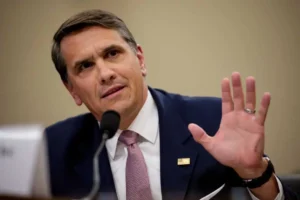
Blanche told a House Appropriations subcommittee earlier this month that the department was “not moving forward with the fund, period,” after a federal judge in Virginia issued a temporary freeze on the fund in response to a lawsuit brought by a former January 6 prosecutor. Despite that public assurance, Blanche has repeatedly declined to put the commitment in writing, telling lawmakers he was not “committing to putting anything in writing” to formally rescind, amend, or reissue the underlying agreement.
In its Friday filing, the Justice Department argued that compelling sworn declarations from senior executive branch officials, including Blanche, a top deputy named Stan Woodward, and Treasury Secretary Scott Bessent, “implicates serious separation of powers concerns.” A group of retired federal judges involved in the litigation pushed back, arguing the administration’s refusal to formalize its position “only underscores the need to investigate whether the parties have perpetrated a fraud on this Court and corrupted the integrity of the judicial process.”
Why It Matters
The standoff raises a fundamental question about the limits of judicial power over the executive branch. Courts routinely rely on representations made by government attorneys and officials, including informal statements to Congress or the press, as evidence of policy positions. When the executive branch declines to formalize those same representations under oath, it creates uncertainty about whether such statements can be trusted as binding commitments, a problem with implications well beyond this single case.
For ordinary Americans concerned about government accountability, the dispute illustrates a recurring pattern in this administration’s approach to oversight, in which officials make public statements that appear to resolve a controversy without taking the additional legal steps that would make those statements enforceable. Critics argue this approach allows the government to defuse political pressure in the short term while preserving the option to reverse course later without legal consequence.
The underlying fund itself remains controversial on its own terms. Critics, including some Republican lawmakers, characterized it as a slush fund that could direct taxpayer money to political allies, including individuals connected to the events of January 6, 2021. The Senate previously rejected an amendment that would have permanently barred the fund’s creation, leaving its legal status more ambiguous than Blanche’s public statements suggest.
Economic and Global Context
While the fund itself is relatively modest in scale compared to the federal budget, at 1.776 billion dollars, the dispute carries outsized significance for how the public and financial markets assess the predictability of executive branch commitments. Investors, government contractors, and foreign governments alike rely on a baseline expectation that public statements from senior U.S. officials reflect durable policy, and disputes over whether such statements are legally binding can introduce uncertainty into broader assessments of U.S. governance.
The fund was structured to draw from the Judgment Fund, the mechanism the federal government uses to pay legal settlements, rather than from a direct congressional appropriation. That structural choice has drawn scrutiny from budget watchdogs concerned about executive branch officials using settlement mechanisms to direct federal money toward politically aligned purposes without the typical congressional appropriations process.
The case is also unfolding alongside broader litigation testing the limits of executive authority, including disputes over agency firings and the scope of presidential control over independent agencies. Legal observers have noted that the current Supreme Court has shown some willingness to expand presidential authority in related cases, a dynamic that may shape how lower courts handle disputes like this one in the months ahead.
Implications
For the plaintiffs in the case, including the retired judges and former January 6 prosecutor who brought the underlying lawsuit, the next step will likely involve pressing the court to either compel the requested declarations or impose other consequences for the government’s refusal to formalize its position. The presiding judge’s earlier warning not to “play possum” suggests further judicial action is possible if the administration continues to resist.
For Congress, the episode adds to ongoing friction between lawmakers and the Justice Department over the fund’s legal status. Democratic members have pressed Blanche for clarity on whether related tax return protections for Trump and his family remain in effect even as the broader fund is shelved, suggesting the controversy may not be fully resolved even if the fund itself never launches.
For the broader public, the case offers a window into how disputes over the boundaries between the executive and judicial branches are likely to play out repeatedly over the remainder of Trump’s term, particularly in cases where verbal assurances substitute for formal legal commitments.
Sources
DOJ refuses to issue signed declaration verifying ‘Anti-Weaponization Fund’ is dead
