
Story Highlights
U.S. District Judge Denise Casper permanently barred most of Trump’s first elections executive order, which sought to require documentary proof of citizenship for voter registration.
The ruling converts a year-old preliminary injunction into a permanent ban, rejecting the administration’s argument that the lawsuit was premature.
Judge Casper found the order violated separation of powers, stating the Constitution grants the president no specific authority over elections.
What Happened
U.S. District Judge Denise Casper, sitting in Boston, ruled Wednesday that the Trump administration cannot implement most of President Donald Trump‘s first executive order on elections, an order signed just months into his second term that sought to require documentary proof of citizenship when Americans register to vote. The ruling converts a preliminary injunction Casper issued roughly a year earlier into a permanent prohibition, definitively closing the door on the administration’s effort to revive the policy through litigation. Casper rejected the administration’s argument that the legal challenge, brought by Democratic state attorneys general, was premature because the rules had not yet taken effect, finding instead that the constitutional defects in the order were clear and required no further factual development.
At the heart of Casper’s ruling was a separation-of-powers analysis. “The Constitution does not grant the President any specific powers over elections,” she wrote, concluding that authority over the mechanics of voter registration and election administration belongs to the states and to Congress, not to the executive branch acting unilaterally. The decision represents one of the most direct judicial rebukes yet of the administration’s broader attempt to reshape federal election rules through executive action rather than legislation.
The ruling did not occur in isolation. A separate federal judge in Washington, D.C., overseeing a related challenge brought by civil rights organizations and Democratic-aligned groups, had already blocked the government from including the proof-of-citizenship requirement on the federal voter registration form. That same judge subsequently barred the Defense Department from requiring documentary proof of citizenship for military personnel registering to vote or requesting ballots from overseas. The cumulative effect of these rulings has been to systematically dismantle the legal infrastructure the administration sought to build around its citizenship verification push.
Notably, Trump has acknowledged the difficulty of implementing a citizenship verification mandate purely through executive order, which is part of why he has simultaneously pushed Congress to pass the SAVE America Act, legislation that would codify similar requirements into federal law. That bill, however, remains stalled in the Senate, where Republicans lack the 60 votes needed to overcome a Democratic filibuster, leaving the administration’s citizenship-verification agenda without a clear path forward through either the courts or Congress for now.
Why It Matters
This ruling strikes at a foundational constitutional question: who controls American elections? The Constitution’s Elections Clause assigns authority over the times, places, and manner of holding elections to state legislatures, subject to congressional oversight, a structure the framers designed specifically to prevent any single branch of the federal government, let alone the presidency alone, from controlling how Americans vote. Judge Casper’s ruling reaffirms that structure in unambiguous terms, finding that the president simply does not possess the unilateral authority Trump’s order attempted to exercise.
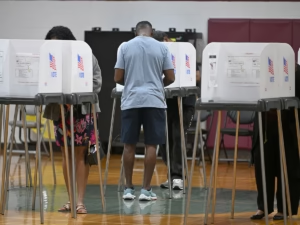
For American voters, the practical effect is that registration procedures will continue to be governed by existing state and federal law rather than the citizenship-verification regime the administration sought to impose. This matters enormously for eligible voters who may lack ready access to documents like passports or birth certificates, populations that civil rights groups have long warned would be disproportionately burdened by strict documentary proof requirements regardless of the underlying policy’s stated goals.
The decision also has implications that extend well beyond this single executive order. It establishes a judicial precedent that future presidents, of either party, will likely face when attempting to use executive authority to reshape election administration unilaterally. Combined with the separate ruling blocking portions of Trump’s mail-voting order, the courts are signaling a consistent and firm position: structural changes to how Americans vote must come through the constitutionally designated channels of state legislatures and Congress, not executive fiat.
Economic and Global Context
While election administration disputes are primarily a domestic constitutional matter rather than an economic one, the broader pattern of litigation surrounding Trump’s election orders reflects significant administrative and legal costs borne by both the federal government and the states defending against, or implementing, these policies. State election officials across the country have had to allocate resources to litigation, compliance planning, and contingency procedures as the legal status of various federal directives has shifted repeatedly over the past year.
The ruling also arrives amid a broader international context in which America’s electoral institutions face scrutiny both at home and abroad. Foreign observers and international democracy watchdog organizations have closely tracked the administration’s efforts to centralize federal control over voter rolls and registration procedures, with some expressing concern about precedents that could weaken the decentralized, state-based election administration system that has historically been a hallmark of American democracy.
Domestically, the ruling lands amid an already turbulent legislative environment, with Trump separately withholding his signature from a bipartisan housing bill until the SAVE America Act passes, and with House Speaker Mike Johnson signaling that budget reconciliation may be the only viable path to codify citizenship-verification requirements legislatively. This entanglement of election policy with other major legislative priorities suggests the fight over voter ID and citizenship verification will remain a dominant feature of the legislative and legal landscape through the November midterms.
Implications
In the near term, the Trump administration is widely expected to appeal Casper’s ruling, continuing a pattern of litigation that has now stretched across more than a year without the administration securing a durable legal victory on its core election executive orders. Given the unanimous tenor of rulings against the administration on this specific issue, an eventual path to the Supreme Court seems plausible, though the timeline for any such appeal reaching the justices remains uncertain.
For state election officials, the ruling provides clarity and stability heading into the 2026 midterm elections, allowing registration procedures to proceed under existing law without the disruption that a sudden federal citizenship-verification mandate would have caused. Election administrators in both Democratic- and Republican-led states have previously expressed concerns about the practical burdens of implementing new documentary requirements on short notice.
For congressional Republicans, the ruling intensifies pressure to find a legislative path for the SAVE America Act, since the courts have made clear that executive action alone cannot achieve the administration’s citizenship-verification goals. Whether that pressure translates into a viable reconciliation strategy, as Speaker Johnson has suggested, will be a key storyline to watch as the midterms approach and both parties sharpen their messaging on election integrity and voting access.
Sources
“Federal judge bars Trump’s proof-of-citizenship requirement for voting”
