

Story Highlights
- Indirect, lower-level technical talks resumed in Doha on Wednesday through Qatari and Pakistani mediators, with no direct U.S.-Iran contact
- The talks follow a weekend of escalating strikes that threatened to collapse the ceasefire reached under a memorandum of understanding
- Vice President JD Vance said the U.S. has achieved its “core mission” of preventing Iran from obtaining a nuclear weapon
What Happened
President Donald Trump told reporters at Joint Base Andrews on Wednesday that the “denuclearization of Iran is moving along well,” describing the day’s discussions in Doha as productive even as he acknowledged recent hostilities. “We hit them very hard… but we’re getting along very well,” Trump said before departing for North Dakota aboard a newly acquired, Qatar-gifted Air Force One aircraft. The comments came as U.S. and Iranian officials held indirect, lower-level technical talks in the Qatari capital, with Qatari and Pakistani officials relaying messages between the two delegations rather than facilitating direct contact.
Special Envoy Steve Witkoff and presidential son-in-law Jared Kushner traveled to Doha but were not expected to participate in Wednesday’s technical negotiations themselves. The two met separately with Qatar’s prime minister, Sheikh Mohammed bin Abdulrahman bin Jassim Al Thani, on Tuesday to lay groundwork for the discussions. Qatar’s Foreign Ministry spokesman, Majed al-Ansari, confirmed that no direct meeting between American and Iranian officials was planned, emphasizing that the sides remain in an indirect negotiating posture nearly a year into renewed hostilities.
The current round of talks follows a chaotic weekend in which Iran’s Islamic Revolutionary Guard Corps launched missiles toward U.S. military installations in Bahrain and Kuwait, escalating tensions that had been simmering over control of the Strait of Hormuz, a critical global oil transit chokepoint. The clashes were triggered by efforts to reopen the strait to shipping without Iranian oversight, prompting warnings and military action from Tehran, which has asserted a right to control passage through the waterway. A vessel reportedly ran aground in the strait’s shallow waters on Wednesday after straying outside Iran’s designated navigation corridor, underscoring the ongoing security risk to commercial shipping in the region.
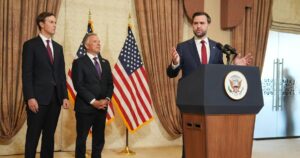
Vice President JD Vance told Fox News on Tuesday that the United States has “accomplished the core mission” of preventing Iran from acquiring a nuclear weapon, even as a comprehensive peace agreement remains unfinished. Vance asserted that the U.S. holds “all the cards” in the negotiations. Iranian President Masoud Pezeshkian, meanwhile, has praised the interim agreement, noting that it includes the release of 6 billion dollars in frozen Iranian assets held by Qatar, though Qatari officials confirmed this week that the funds have not yet been transferred and will be released only as negotiations progress.
The talks build on a memorandum of understanding reached at a Lake Lucerne summit, the first direct meeting between the two nations after a period of open conflict earlier this year that included Israeli strikes on Iranian military leadership and nuclear scientists, followed by American strikes on Iranian nuclear facilities. Oman has also delivered a separate proposal to the U.S. and allied nations regarding the long-term security status of the Strait of Hormuz, as commercial shipping traffic continues despite an elevated threat designation.
Why It Matters
The stakes of these negotiations extend well beyond diplomatic optics. Congress has a direct constitutional interest in how any prolonged military engagement with Iran unfolds, given Article I’s vesting of war-declaration authority in the legislative branch. Trump’s repeated threats of military escalation, including earlier warnings to attack Iranian infrastructure without formal congressional authorization, have reignited long-standing debates over the scope of executive war powers and the relevance of the War Powers Resolution in an era of rapid, unilateral military action.
For American families, the practical stakes are measured in energy costs. The Strait of Hormuz carries a substantial share of the world’s seaborne oil, and any disruption to transit, whether through Iranian military action or accidents like Wednesday’s grounded vessel, carries the potential to spike gasoline and energy prices domestically. Continued instability threatens to undo progress the administration has claimed on lowering costs for American consumers.
The involvement of Kushner, a private citizen and presidential family member, in high-level diplomatic negotiations also raises recurring questions about the concentration of foreign policy authority within a small, family-connected circle rather than traditional State Department channels. Kushner’s private equity firm has received substantial investment from Gulf state sovereign wealth funds, including Qatar, the same government now serving as chief mediator, a dynamic that continues to draw scrutiny from ethics watchdogs concerned about blurred lines between personal financial interests and official diplomacy.
Economic and Global Context
Global markets remain sensitive to any signal of renewed hostilities in the Persian Gulf region. Analysts at the Asia Group, a Washington-based strategic advisory firm, have noted that disruptions to Strait of Hormuz traffic disproportionately affect Asian economies, which rely heavily on Middle Eastern crude imports, with China emerging as a notable beneficiary of pricing dislocations caused by the conflict’s on-again, off-again nature.
NATO allies are separately watching Washington’s regional posture closely, particularly as the alliance works to implement a defense spending pledge, agreed at a summit in The Hague, to raise member contributions to 5 percent of GDP by 2035. U.S. Ambassador to NATO Matthew Whitaker has publicly pressed European allies to accelerate compliance, noting that nations including Poland, Germany, and the Baltic states are meeting commitments while others lag behind, a dynamic intertwined with broader questions about collective burden-sharing amid Middle East instability.
Commercial aviation has also felt the ripple effects. Lufthansa and Italy’s ITA Airways resumed flight operations to Tel Aviv’s Ben Gurion Airport this week after suspending them due to the broader regional conflict, signaling cautious optimism that the worst of the acute crisis may be subsiding even as underlying tensions persist.
Implications
For the Trump administration, sustaining the appearance of diplomatic momentum while avoiding a full military reescalation will require careful management of both Iranian provocations and domestic political pressure from hawkish allies who favor a harder line. Any breakdown in talks risks reigniting direct military confrontation, with consequences for American service members stationed at regional bases already targeted in recent strikes.
For Congress, the continued reliance on informal, envoy-driven diplomacy rather than treaty-based agreements subject to Senate ratification raises questions about long-term enforceability and oversight. Lawmakers from both parties may face renewed pressure to assert war powers prerogatives if hostilities escalate further without formal congressional authorization.
For allied nations and global shipping interests, stability in the Strait of Hormuz remains the single most consequential near-term outcome to watch, with any further military incident carrying the potential to disrupt global energy markets regardless of how the broader diplomatic track proceeds.
Sources
