
Story Highlights
- Trump flew for the first time aboard the Qatari-gifted Boeing 747-8, retrofitted at a cost exceeding $1 billion, en route to North Dakota this week.
- Legal experts and lawmakers from both parties argue the roughly $400 million gift may violate the Constitution’s Foreign Emoluments Clause, which bars officials from accepting foreign gifts without congressional consent.
- The plane is set to transfer to Trump’s personal presidential library foundation after his term, a detail critics say converts a government gift into a personal benefit.
What Happened
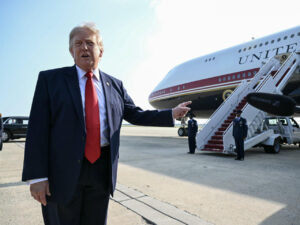
President Donald Trump took his inaugural flight Wednesday aboard the new Air Force One, a luxury Boeing 747-8 donated by the government of Qatar and valued at approximately $400 million before an overhaul that aviation experts estimate cost more than $1 billion. The flight carried Trump to Medora, North Dakota, for the opening of the Theodore Roosevelt Presidential Library, marking the aircraft’s first official use in its new role as the president’s primary mode of air transport.
The jet, repainted in a red, white, dark blue and gold color scheme distinct from the traditional light blue livery of past Air Force One aircraft, was offered by Qatar’s royal family in 2025 as what the administration characterized as a donation to the Department of Defense rather than a personal gift to Trump. Trump has defended the arrangement, calling the aircraft “maybe the greatest commercial plane ever built” and arguing it would have been “stupid” to decline a free replacement while Boeing’s contracted VC-25A successor jets remain delayed until at least 2028.
The arrangement has drawn sustained constitutional criticism since it was first proposed. The Constitution’s Foreign Emoluments Clause, found in Article I, Section 9, explicitly bars any federal officeholder from accepting “any present, Emolument, Office, or Title, of any kind whatever, from any King, Prince, or foreign State” without the consent of Congress. Legal experts, including Columbia law professor Richard Briffault, have called the arrangement a “pretty textbook case” of a potential emoluments violation, while former White House ethics counsel Richard Painter warned it could establish a precedent inviting other nations to attempt similar arrangements with future officeholders.
Congressional Democrats have introduced resolutions in both chambers explicitly demanding that Trump obtain congressional consent before accepting the aircraft, arguing the framers included the clause specifically to prevent foreign governments from cultivating improper influence over American leaders. Senator Patty Murray of Washington called the arrangement “brazen corruption” and “a clearer violation of our Constitution’s Emoluments Clause,” while House Speaker Mike Johnson, a Republican, offered a more measured response, saying the intent of the clause was to prevent “personal gifts for personal use” while declining to take a definitive position on the arrangement’s legality.
Complicating the legal picture further is the administration’s disclosed plan for the plane to ultimately transfer to Trump’s personal presidential library foundation after he leaves office, a detail that critics argue converts what the administration frames as a government asset into an eventual personal benefit for the president himself.
Why It Matters
The dispute strikes at one of the Constitution’s oldest anti-corruption safeguards, a provision the framers included specifically to insulate American leaders from the influence of foreign monarchs and governments. Whether or not the arrangement is ultimately found unconstitutional in court, the scale of the gift, potentially the largest single gift a foreign government has ever given the United States, tests the practical limits of a clause that has rarely been enforced through litigation.
Legal scholars note that prior emoluments lawsuits against Trump during his first term were dismissed largely on procedural grounds, such as standing, rather than being resolved on the constitutional merits, meaning the underlying question of what the clause actually prohibits remains largely untested by the courts. That leaves open the possibility that this arrangement, given its scale and the eventual personal transfer to Trump’s library foundation, could become the case that finally forces judicial clarity on the clause’s scope.
For Americans concerned about the presidency’s insulation from foreign influence, the arrangement raises the practical question of what obligations, explicit or implicit, come attached to a gift of this magnitude from a foreign government actively engaged in extensive diplomatic and business relationships with the United States, including Trump family business interests in the Gulf region.
The involvement of Congress, or the lack thereof, in approving the gift also tests the practical enforceability of a constitutional provision that requires legislative consent but provides no clear mechanism for compelling compliance short of impeachment, an avenue widely seen as politically unavailable given Republican control of both chambers.
Economic and Global Context
The retrofit costs alone, estimated by aviation experts to exceed $1 billion, represent a substantial expenditure funded through the U.S. Air Force rather than the Qatari government or Trump personally, a detail lawmakers have specifically flagged as adding taxpayer exposure to an already controversial arrangement. The existing VC-25A fleet, in service since the early 1990s, has faced escalating maintenance costs, providing the operational rationale the administration has cited for accepting the Qatari jet as a “bridge” solution.
Internationally, the gift arrives amid extensive and simultaneous business and diplomatic engagement between the Trump family and Gulf state governments, including hotel and development projects disclosed in Trump’s own financial filings showing multimillion-dollar revenue from Qatar-linked ventures. Ethics watchdogs argue this overlapping web of business and governmental relationships makes it especially difficult to disentangle diplomatic gestures from potential efforts to curry favor with the administration on trade, defense, or regulatory matters.
Qatar’s government has publicly characterized the gift as a good-faith diplomatic gesture reflecting the close U.S.-Qatar relationship, a characterization the administration has echoed in defending the arrangement’s legality and diplomatic intent.
Globally, the arrangement is likely to be studied by other nations as a case study in how foreign governments might seek to build influence with U.S. leadership through high-value gifts, particularly if the emoluments question is never definitively resolved by American courts.
Implications
Future litigation remains possible, though legal experts caution that any lawsuit challenging the arrangement would likely face the same standing and procedural obstacles that doomed prior emoluments cases against Trump during his first term. A successor administration could theoretically also seek to reclaim the aircraft as government property rather than allow its transfer to Trump’s presidential library, setting up potential future legal conflict over the plane’s ultimate disposition.
For congressional Republicans, the arrangement presents an uncomfortable balancing act between defending the administration and acknowledging the plain constitutional language requiring congressional consent for such gifts, a tension reflected in Speaker Johnson’s carefully hedged public comments on the matter.
For voters and constitutional scholars, the episode serves as a live test of how effectively the emoluments clause functions as a check on presidential conduct in practice, given the absence so far of any definitive judicial ruling on its application to a gift of this scale and complexity.
Looking ahead, watchdog groups including Citizens for Responsibility and Ethics in Washington are expected to continue pressing for congressional action or judicial review, though near-term prospects for either remain limited given the current political and legal landscape.
Sources
Trump’s First Flight on New Air Force One With $400M Overhaul of Qatar Gift
