


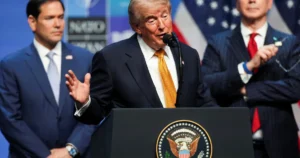
President Donald Trump declared Wednesday that the fragile ceasefire with Iran is finished, clearing the way for a second consecutive day of American airstrikes across the country. The announcement came at the close of the NATO summit in Ankara, Turkey, where Trump also confirmed the U.S. Navy is reimposing a blockade and said further negotiations with Tehran would be “a waste of time.”
Story Highlights
- U.S. Central Command carried out a second round of strikes on Iran, targeting air defenses, radar sites, missile and drone storage, and small boats used to threaten shipping in the Strait of Hormuz
- Iran responded by striking U.S. bases in Kuwait and Bahrain, with Jordan intercepting eight Iranian missiles aimed at U.S. positions
- Trump said the ceasefire is “over” and warned the U.S. may strike Iran nightly if attacks on commercial shipping continue
What Happened
Speaking to reporters aboard Air Force One and later at a press conference wrapping up the NATO summit, President Donald Trump said he no longer considers the ceasefire with Iran to be in effect. “Every time they hit us, we’re gonna hit them twenty,” Trump told reporters, describing the latest round of American strikes as overwhelming retaliation for Iranian attacks on oil tankers transiting the Strait of Hormuz, a waterway that carries roughly one-fifth of the world’s oil supply.
U.S. Central Command said American forces struck approximately 90 military targets across Iran, including air defense systems, radar installations, missile and drone storage sites, and small boats capable of harassing commercial vessels. The strikes marked the deepest American penetration into Iranian territory since the initial wave of joint U.S.-Israeli operations in February, with American aircraft reportedly hitting transportation infrastructure, including a bridge and a rail line in Iran’s northern Golestan province, for the first time.
Iran did not stand down. The Islamic Revolutionary Guard Corps launched drone and missile strikes against U.S. military installations in Kuwait and Bahrain, and Jordanian air defenses intercepted eight additional Iranian missiles headed toward American positions in the region. Iranian state media reported explosions in the southern coastal cities of Chabahar and Konarak, with damage to a port facility, a maritime traffic control tower, and a power station, cutting electricity to large portions of Chabahar.
The renewed hostilities come months after Trump announced “major combat operations” against Iran in late February, when joint U.S.-Israeli strikes killed Iran’s Supreme Leader and targeted military, government, and infrastructure sites. Delegations from both countries had entered negotiations in June aimed at a war-ending agreement built around a signed memorandum of understanding, but limited strikes continued even as talks proceeded, and the arrangement has now collapsed entirely.
Trump, when asked whether he still wanted a peace agreement with Tehran, expressed open skepticism. “Let’s just finish the job,” he told reporters in Ankara, adding that he was uncertain whether further negotiations served any purpose. Out of an abundance of caution, Trump’s security detail arranged for him to depart Turkey aboard the older Air Force One rather than his newer Qatari-donated aircraft, a change the White House attributed to scheduling rather than security concerns tied to the escalating conflict.
Why It Matters
The collapse of the ceasefire raises serious questions about the scope and duration of American military engagement in the Middle East, questions that go directly to the constitutional balance of war powers between the executive branch and Congress. Trump has directed sustained strikes against a foreign nation without a formal declaration of war, relying instead on his authority as commander in chief and existing statutory frameworks. Lawmakers on both sides of the aisle are likely to renew debate over the extent of presidential authority to conduct open-ended military campaigns absent explicit congressional authorization.
For American troops and their families, the resumption of hostilities means continued exposure to danger at bases throughout the Gulf region, several of which have already come under direct Iranian fire. The strikes on Kuwait, Bahrain, and the interception over Jordan demonstrate that the conflict is no longer confined to Iranian territory but now directly threatens American personnel and regional partners across multiple countries.
The stakes extend well beyond the battlefield. The Strait of Hormuz remains one of the most strategically vital chokepoints in global commerce, and continued attacks on tankers transiting the waterway threaten to disrupt energy supplies that directly affect American consumers through gasoline and heating prices. Trump’s decision to reimpose a naval blockade signals a more assertive American posture aimed at protecting shipping lanes, but it also raises the risk of further escalation with an adversary that has shown a willingness to strike back immediately.
Politically, the collapse of ceasefire talks tests Trump’s promise to end foreign entanglements while also protecting American interests abroad. Supporters argue that decisive, overwhelming retaliation is the only language Tehran understands and that half-measures invited the original ceasefire violations. Critics, including some in Congress, are expected to question whether the administration has a clear endpoint or exit strategy for the broader conflict.
Economic and Global Context
Energy markets are watching the Strait of Hormuz closely. Roughly a fifth of global oil supply passes through the waterway daily, and any sustained disruption to tanker traffic carries the potential to push crude prices sharply higher, with downstream effects on gasoline prices at American pumps and broader inflation. Should Iran make good on threats from the Islamic Revolutionary Guard Corps to expand retaliation to additional U.S. bases in the region, insurers covering commercial shipping routes through the strait may raise premiums substantially, adding further cost pressure to global trade.
The renewed conflict also complicates Trump’s broader Middle East diplomacy. Just one day earlier, at the same NATO summit, Trump moved to normalize relations with Syria by initiating the process to remove it from the State Department’s list of state sponsors of terrorism. An intensifying Iran conflict could undercut regional stability gains the administration has been working to secure elsewhere, particularly given Iran’s historical ties to proxy groups including Hezbollah, which remains active in Lebanon and Syria.
Allied nations are also affected. Gulf states hosting American forces, including Kuwait, Bahrain, and Qatar, face direct exposure to Iranian retaliation, while European allies dependent on Middle Eastern energy supplies are watching for signs that the conflict could spread further and disrupt broader shipping routes beyond the strait itself.
Implications
In the near term, expect continued strikes from both sides, with Trump signaling that nightly American action against Iran is likely if attacks on shipping persist. The Islamic Revolutionary Guard Corps has already warned that further U.S. strikes will trigger expanded retaliation against additional American bases in the region, raising the possibility of a broader regional war involving multiple countries hosting U.S. forces.
Congress may face renewed pressure to assert its role in authorizing or limiting further military action, particularly if American casualties mount or if the conflict shows no sign of resolution. Some lawmakers are likely to push for briefings on the administration’s endgame, while others will back the president’s aggressive posture as necessary deterrence.
For American businesses and consumers, the practical implications center on energy prices and shipping costs, both of which are sensitive to instability in the Strait of Hormuz. Sustained conflict could also affect broader financial markets as investors weigh geopolitical risk against other economic indicators heading into the second half of 2026.
Sources
“Trump declares Iran ceasefire ‘over’ as U.S. launches new retaliatory strikes”
