President Trump used a primetime address from the White House to declassify a trove of intelligence documents he says expose serious vulnerabilities in America’s election infrastructure and foreign interference by China, reigniting a six-year debate over the legitimacy of the 2020 election just months before the midterms. Intelligence officials from both his own administration and President Biden’s have said there is no evidence any vote total was altered, setting up a sharp dispute over what the newly released material actually shows. The speech doubled as a renewed push for the stalled SAVE America Act, legislation that would impose federal citizenship verification requirements on voter registration nationwide.
Story Highlights
- Trump declassified four tranches of intelligence documents during a July 16 East Room address, claiming they reveal election vulnerabilities and Chinese interference
- Officials cited a 2021 declassified intelligence assessment finding no indication any foreign actor altered voting infrastructure in 2020
- Trump renewed his call for Congress to pass the SAVE America Act, which would require proof of citizenship to register and photo ID to vote in federal elections
What Happened
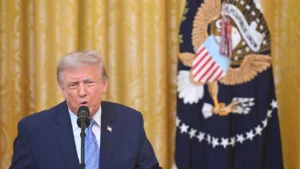
President Donald Trump delivered a 25-minute primetime address from the East Room of the White House on Thursday, July 16, framing it as a major national security disclosure about the integrity of American elections. “America is back and doing really well, but we still have a major challenge that must be urgently addressed because no country can be great without fair and honest elections,” Trump told viewers, before announcing the immediate declassification of what he called critical intelligence revealing shocking vulnerabilities in the nation’s election infrastructure.
The White House subsequently released four tranches of documents overseen by a Government Transparency Taskforce, which officials said showed evidence of Chinese hacking targeting 220 million voter files containing names, addresses, and phone numbers, along with a Department of Homeland Security finding that 278,000 noncitizens were registered to vote in federal elections. Conservative commentators and Republican officials, including Louisiana Governor Jeff Landry and Republican National Committee Chairman Joe Gruters, quickly amplified the findings as vindication of long-standing claims about the 2020 election.
However, independent reporting on the documents’ actual contents complicated that narrative. A declassified Intelligence Community Assessment from March 2021, previously released two months into the Biden administration, had already acknowledged that China took some steps to influence Trump’s 2020 reelection chances, but specified those efforts occurred “primarily through social media and official public statements and media,” not through interference with vote counting, registration, or tabulation systems. Even John Solomon, a conservative journalist who worked with the White House on releasing the newly declassified material, acknowledged after the speech that the intelligence community found “zero evidence that a foreign power flipped a vote” in 2020, 2022, or 2024.
Democratic lawmakers dismissed the speech as a distraction from the upcoming midterms rather than a genuine security disclosure. Senate Minority Leader Chuck Schumer told reporters on Capitol Hill that the address had more to do with Trump’s anxiety about Republican prospects in November than with the 2020 election itself, saying Trump was “scared to death that he will lose in 2026.” Senator Chris Coons went further, calling the speech “a temper tantrum” over Congress’s failure to pass the SAVE America Act and pointedly noting that the only documented attempt to alter a 2020 vote count came from Trump himself, referencing his post-election phone call urging Georgia’s secretary of state to find additional votes.
The speech served as the opening act for a broader administration push. The following day, Homeland Security Secretary Markwayne Mullin outlined specific new compliance requirements for states, including mandatory participation in a federal citizenship verification database, tying the initiative directly to the intelligence claims Trump unveiled in his address.
Why It Matters
The episode raises fundamental constitutional questions about the separation of powers between federal and state governments in administering elections. The Constitution assigns primary responsibility for running elections to the states, a deliberate design choice by the framers meant to prevent any single branch of the federal government from controlling the electoral process. Trump’s declassification of intelligence material, paired with a renewed legislative push and coordinated federal agency action, represents one of the most direct executive branch efforts in recent memory to reshape how states conduct elections from Washington.
For American voters, the disconnect between the administration’s public claims and the underlying intelligence findings matters enormously for public trust. When officials characterize documented social media influence campaigns as evidence of “vulnerabilities” capable of altering election outcomes, without distinguishing between those two very different categories of threat, it risks further eroding confidence in results regardless of their accuracy. Research on election misinformation has consistently shown that repeated high-level claims of fraud, even when later found unsubstantiated, measurably reduce public trust in the electoral process among significant segments of the population.
The timing is also significant from a constitutional accountability standpoint. Trump is term-limited and not on the 2026 ballot, but his party controls both chambers of Congress and faces a genuinely competitive midterm cycle. Using the machinery of the executive branch, including classified intelligence typically reserved for national security purposes, to advance a legislative agenda ahead of an election in which the president’s own party has direct stakes invites scrutiny over whether intelligence disclosure processes are being used for their intended purpose or repurposed for political messaging.
For Congress, the SAVE America Act remains the central legislative vehicle at stake, and it faces genuine hurdles. The bill requires documentary proof of citizenship to register to vote and government-issued photo identification at the polls, provisions that critics argue would disproportionately burden lower-income voters, elderly citizens, and married women who have changed their names, groups less likely to have immediate access to birth certificates or passports.
Economic and Global Context
Implementing the voter verification and identification requirements at the heart of the SAVE America Act carries substantial costs that would fall primarily on state and local election administrators. Independent estimates of the broader federal election security overhaul, which includes citizenship verification systems and equipment upgrades, have placed the nationwide implementation cost in the billions of dollars, a burden states would need to absorb largely without dedicated federal funding beyond the conditional grants tied to compliance.
The claim that Chinese actors hacked 220 million voter files also carries international implications, arriving amid broader tensions between Washington and Beijing across trade, technology, and security domains. If substantiated through independent verification, such a breach would represent a significant escalation in foreign efforts to compile detailed personal data on American voters, though the administration has not yet released technical evidence supporting the scale of the claimed intrusion for independent review by cybersecurity researchers outside the government.
The broader context of declining public trust in democratic institutions is not unique to the United States. Election security disputes rooted in unverified foreign interference claims have surfaced in multiple democracies in recent years, and international election observers have noted that such disputes, whether ultimately substantiated or not, tend to be exploited by authoritarian governments seeking to argue that democratic systems are inherently unstable or illegitimate.
Domestically, the political fallout is already shaping the 2026 campaign environment, with Republican strategists framing the speech as validation ahead of competitive Senate and House races, while Democratic campaign committees are using the unsubstantiated fraud claims as a fundraising and mobilization tool of their own heading into the fall.
Implications
In the coming weeks, expect intensified partisan conflict over the SAVE America Act as Senate Republicans attempt to build the votes needed to overcome a filibuster, a threshold the bill has not yet come close to reaching given unified Democratic opposition and skepticism from some moderate Republicans concerned about ballot access effects.
For state election officials, the practical consequence will likely be increased federal pressure to adopt citizenship verification measures independent of whether the SAVE America Act ultimately passes, since the Department of Homeland Security has already begun tying funding compliance to similar requirements through executive action rather than waiting for legislation.
For voters, particularly those in states targeted by the administration’s specific claims about noncitizen registration, expect continued uncertainty and potential confusion as list maintenance and verification processes intensify ahead of the midterms, developments that election protection organizations are already mobilizing to monitor closely.
For the broader constitutional order, the episode will likely be remembered as a significant marker in the ongoing struggle over federal versus state authority in election administration, with litigation over the specific declassified claims and any resulting policy changes expected to work through the federal courts well into 2027.
Sources
