
Story Highlights
- Numerous artists have canceled performances at the renamed “Donald J. Trump and John F. Kennedy Memorial Center for the Performing Arts” since December 2025
- Grammy-winning soprano Renée Fleming, composer Stephen Schwartz, jazz group The Cookers, and the Hamilton production are among the high-profile withdrawals
- Trump-appointed Kennedy Center head Richard Grenell has accused left-wing activists of pressuring artists into boycotting a national cultural institution
What Happened
The conflict at the Kennedy Center traces to February 2025, when President Donald Trump was named chairman of the board and subsequently moved to overhaul the institution’s leadership, removing Democratic-aligned board members and replacing senior staff. The first major performance cancellation came in March 2025, when the producers of the Broadway musical Hamilton announced the show would not proceed with its planned 2026 engagement at the Center. Producer Jeffrey Seller cited the administration’s purge of board members as incompatible with the Kennedy Center’s mission.
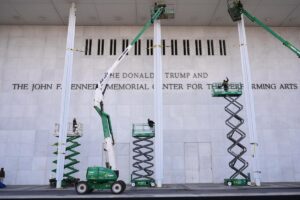
The situation escalated dramatically in December 2025, when the Kennedy Center’s board voted to rename the institution the “Donald J. Trump and John F. Kennedy Memorial Center for the Performing Arts.” The renaming announcement triggered an accelerating wave of cancellations. Jazz musician Chuck Redd canceled a Christmas Eve event. Jazz supergroup The Cookers withdrew from a planned New Year’s Eve concert, saying they wanted to perform in a room able to “celebrate the full presence of the music.” Dance company Doug Varone and Dancers canceled their April 2026 engagement, with choreographer Doug Varone saying the renaming had “pushed me off a cliff.”
Early 2026 brought further high-profile withdrawals. Grammy-winning soprano Renée Fleming, who had previously resigned her role as artistic advisor at large, was announced in late January as withdrawing from scheduled May 2026 concerts with the National Symphony Orchestra. The Kennedy Center cited a “scheduling conflict.” Composer and lyricist Stephen Schwartz, known for Wicked, Pippin, and Godspell, withdrew from a planned May 2026 fundraiser gala for the Washington National Opera, stating that making an appearance at the Center had become an “ideological statement” incompatible with his understanding of the institution’s founding purpose.
Richard Grenell, the Trump ally appointed by the president to head the Kennedy Center after the prior leadership was removed, has pushed back forcefully on each withdrawal. Grenell wrote in a letter to Redd that “your action surrenders to the sad bullying tactics employed by certain elements on the left.” He has repeatedly characterized cancellations as the result of external activist pressure rather than genuine artistic conviction. Grenell also disputed media reports about Schwartz’s cancellation, claiming Schwartz was never under contract — a claim that NBC News, Variety, and other outlets rebutted by publishing screenshots showing Schwartz had been promoted on the Kennedy Center’s official website.
Why It Matters
The Kennedy Center controversy sits at the intersection of executive power, federally funded culture, and the First Amendment. The Center was established by an Act of Congress in 1964 as the national memorial to President John F. Kennedy and was explicitly intended to serve as a nonpartisan institution for American arts and culture. Democrats have argued that Trump’s renaming has no legal force because the Center’s name was established by Congress, not the executive branch. Kennedy’s own family denounced the renaming as an attempt to undermine the slain president’s legacy.
For Americans who value limited government and individual liberty, the episode raises questions about the appropriate role of the federal government in managing cultural institutions. One argument, consistent with conservative principles, holds that the federal government should not be operating a premier performing arts venue in the first place — and that Trump’s takeover simply exposes the inherent politicization risk of government-managed culture. Under that view, the artists boycotting are as entitled to their choices as Trump is to his appointments.
A competing concern, also compatible with constitutional principles, is that using executive authority to reshape a congressionally established institution and attach a sitting president’s name to it sets a troubling precedent. The Kennedy Center’s mandate as a nonpartisan space for all Americans was not incidental — it was designed to keep federal arts patronage from becoming an instrument of political identity or incumbency.
The practical impact on the institution is measurable. Major productions, touring companies, and world-class soloists represent both the artistic and financial foundation of the Center’s programming. Cancellations affect ticket revenue, donor confidence, and the Center’s ability to attract top talent for future seasons.
Economic and Global Context
The Kennedy Center receives federal appropriations as well as private donations, ticket revenue, and endowment income. Major programming withdrawals threaten both earned and donated revenue streams. If the departures continue, the Center may face pressure to replace high-demand programming with performances that attract smaller audiences, potentially requiring increased federal subsidy to maintain operations — an ironic outcome for an administration that has otherwise emphasized government cost reduction.
Internationally, the Kennedy Center has served as a diplomatic soft-power institution, hosting visiting artists and productions from allied and partner nations. Its reputation as a world-class, nonpartisan venue has been part of what made it attractive to foreign governments and artists. Continued controversy over its political identity could affect those relationships, with international performers and companies weighing the reputational implications of association with a renamed, politically realigned institution.
The cancellations also reflect the growing economic power of artists as independent agents in the digital era. Unlike earlier decades when institutional bookings represented irreplaceable opportunities, many of today’s performers have direct-to-audience platforms, alternative touring venues, and reputational leverage that makes institutional partnerships less financially coercive than in the past.
Implications
The trajectory of the Kennedy Center conflict will depend significantly on what happens with its programming quality and attendance figures. If Grenell succeeds in attracting compelling alternative programming and maintaining strong ticket sales, the administration can credibly argue that the cancellations were politically performative rather than materially damaging. If attendance and revenue decline, the political and financial pressure to revisit the renaming and governance changes will intensify.
For the arts community broadly, the Center’s situation is being watched as a test case for what happens when federal patronage becomes explicitly tied to a specific president’s identity and political agenda. The precedent could affect how future administrations approach other federally funded cultural and educational institutions.
For voters who care about constitutional boundaries and the appropriate exercise of executive power, the Kennedy Center episode is worth monitoring regardless of one’s views on the underlying artistic controversies. Congress established the institution; whether a president can unilaterally rename and reorient it — without legislative action — is a question with implications well beyond the performing arts.
Sources
“Artists cancel performances at Trump-Kennedy Center, citing ‘takeover’ by Trump administration”
