
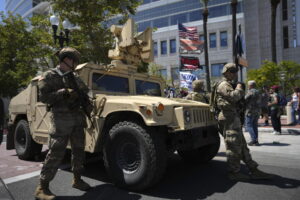
A federal appeals court battle over President Trump’s use of National Guard troops in American cities remains unresolved, with the administration continuing to press the Ninth Circuit to preserve its authority to deploy federalized troops despite a lower court ruling that the deployments violated a 148-year-old law barring military involvement in civilian policing. The dispute, now intertwined with a related Supreme Court case over Illinois, raises fundamental questions about the constitutional boundaries between military and civilian authority on American soil.
Story Highlights
- U.S. District Judge Charles Breyer ruled that Trump’s deployment of National Guard troops in Los Angeles violated the Posse Comitatus Act
- The ruling marked the first time in history a court has issued an injunction to stop a Posse Comitatus Act violation
- The Ninth Circuit stayed the ruling pending appeal, and the fight has expanded to a related Supreme Court case involving Illinois
- California Attorney General Rob Bonta says the administration wants to keep the Guard “federalized and deployed wherever, forever”
What Happened
U.S. District Judge Charles Breyer, a Bill Clinton appointee sitting in the Northern District of California, ruled following a three-day trial that President Trump’s deployment of National Guard troops in Los Angeles violated the Posse Comitatus Act of 1878, a law that generally bars the use of military personnel for civilian law enforcement unless expressly authorized by Congress or the Constitution. Breyer’s order directed the administration to stop using federalized California National Guard troops for arrests, searches, traffic and crowd control, and interrogations, activities that a lengthy factual record showed the troops had performed in coordination with immigration enforcement operations in the Los Angeles area.
The ruling was historic, marking the first time any federal court has issued an injunction specifically to stop a violation of the Posse Comitatus Act since its passage nearly 150 years ago. Breyer found that Trump, Defense Secretary Pete Hegseth and the Department of Defense had “willfully” violated the law as part of what he described as “a top-down, systemic effort” to use military troops to enforce federal drug and immigration laws across hundreds of miles over several months. The Trump administration argued that the deployment fell within an exception because the president had federalized the Guard under a statute permitting activation to suppress rebellion or protect federal functions, but Breyer rejected that argument, ruling that the exception was not “expressly” authorized as the law requires.
The administration immediately appealed to the Ninth Circuit, which stayed Breyer’s order pending review. California Attorney General Rob Bonta and Governor Gavin Newsom have continued pressing the appeals court to lift the stay, presenting evidence that circumstances have significantly changed since the initial deployment, including a substantial reduction in troop numbers in Los Angeles as forces were redirected to Portland and Chicago. Of the roughly 4,100 Guard members and Marines originally sent to Los Angeles, only around 85 remain in the city as of the most recent filings, a fact California’s legal team argues undermines the government’s original justification for the deployment.
The legal fight has since expanded well beyond California. The Trump administration federalized the Illinois National Guard over the objections of Democratic Governor JB Pritzker, prompting Illinois Attorney General Kwame Raoul to file suit, a case that has now reached the Supreme Court as Trump v. Illinois. Bonta and Oregon Attorney General Dan Rayfield filed an amicus brief in that case arguing that the federal statute cited by the administration, 10 U.S.C. Section 12406, does not support what they describe as an unprecedented and open-ended assertion of presidential authority to deploy troops domestically.
Why It Matters
The Posse Comitatus litigation represents one of the most consequential constitutional disputes of the Trump presidency, testing the boundary Congress drew nearly 150 years ago between military power and civilian law enforcement. That boundary exists precisely to prevent the kind of executive overreach the Founders feared when they included the Calling Forth Clause in the Constitution, which vests Congress, not the president alone, with authority over how and when the military may be used domestically.
For American communities, the outcome of this litigation will determine whether presidents can indefinitely station federalized troops in American cities under broad, self-certified justifications, or whether meaningful judicial checks remain on that power. Breyer’s finding that the administration essentially manufactured a “brand-new exception” to the Posse Comitatus Act that would nullify the law’s core protection strikes directly at concerns raised by legal scholars across the political spectrum about the militarization of domestic law enforcement.
The stakes extend to the integrity of the 2026 midterm elections as well. Legal experts and watchdog groups, including voices within the president’s own former administration, have raised concerns that the legal precedent being established, if it favors the government, could open the door to National Guard deployments near polling places under future emergency justifications, a scenario civil liberties advocates warn would represent a fundamental threat to free and fair elections.
Economic and Global Context
The financial cost of the sustained deployments has been substantial, with thousands of National Guard troops and Marines mobilized across multiple cities for months at a time, generating significant federal expenditures for personnel, equipment and logistics that would otherwise support state-level Guard functions such as disaster response and wildfire management. Governor Newsom has specifically noted that California’s Guard members would otherwise be deployed for wildfire management, fentanyl interdiction, and food distribution efforts, functions that have been disrupted by federalization.
Internationally, the domestic use of military forces for policing functions has drawn scrutiny from human rights organizations and foreign governments that monitor the health of American democratic institutions. The Posse Comitatus Act has long been cited internationally as a model for civil-military separation, and legal experts note that a ruling favoring broad executive authority to deploy troops domestically could complicate the United States’ standing when advocating for civilian control of the military in other nations.
The litigation also carries administrative costs for the states involved, which have devoted significant attorney general office resources to multi-front legal battles across California, Oregon, Illinois and other jurisdictions, all while managing the practical realities of federalized troops operating within their borders without state consent.
Implications
The Ninth Circuit’s eventual ruling on California’s case, combined with the Supreme Court’s pending decision in Trump v. Illinois, will likely establish the controlling precedent for how far presidents can extend National Guard federalization authority going forward. Given the divergent rulings among circuit courts so far, a definitive Supreme Court ruling on the underlying statutory and constitutional questions appears increasingly likely.
For state governors and attorneys general, particularly in Democratic-led states that have faced deployments, the outcome will determine whether they retain meaningful legal recourse against federal overreach into what has traditionally been state-controlled Guard command authority. For federal law enforcement officials, a ruling favoring the administration could formalize military support for immigration and drug enforcement operations as a routine practice rather than an emergency exception.
For voters and civil liberties advocates, the resolution of this litigation carries particular urgency ahead of the November midterms, given documented concerns from legal experts and former administration officials about the potential for military presence to be used as a tool of intimidation near polling locations in contested jurisdictions.
Sources
“Court Finds Trump’s Use of Soldiers in Los Angeles Is Illegal”
