A newly released Department of Homeland Security inspector general report has detailed sweeping security failures that allowed a gunman to open fire on President Trump during a 2024 campaign rally in Butler, Pennsylvania. The 64-page review found the Secret Service missed more than 100 radio transmissions warning of a suspicious individual, failed to secure a critical rooftop, and never detected the shooter’s reconnaissance drone before shots were fired. The findings renew urgent questions about institutional accountability for one of the most consequential security breakdowns in modern presidential protection history.
Story Highlights
- The DHS Office of Inspector General found the Secret Service missed more than 102 radio transmissions warning of Thomas Crooks before he opened fire.
- Investigators found the agency never detected Crooks’ nine-minute drone reconnaissance flight near the stage due to undertrained operators and malfunctioning equipment.
- The Secret Service failed to block a known line-of-sight vulnerability from the American Glass Research building, despite identifying it as a risk in advance planning.
- The report issued seven recommendations, all of which the Secret Service has agreed to implement.
What Happened
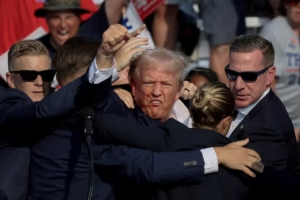
The Department of Homeland Security’s Office of Inspector General released a comprehensive 64-page report on June 30 detailing a cascade of security failures that preceded the July 13, 2024, assassination attempt against President Donald Trump at a campaign rally in Butler, Pennsylvania. The review, one of several the OIG initiated following the shooting, concluded that the Secret Service missed multiple distinct opportunities to detect and prevent the attack before gunman Thomas Crooks opened fire from the roof of a nearby building, grazing Trump’s ear, killing rally attendee Corey Comperatore, and wounding two others.
Among the most significant findings was that Secret Service personnel failed to receive 102 radio transmissions that local law enforcement officers in a separate communications room had received warning of a suspicious individual on the roof of the American Glass Research complex. Investigators attributed this breakdown to a fundamental lack of interoperability between Secret Service and local law enforcement communications systems, compounded by an excessive number of separate command posts operating during the event. Because the Secret Service’s own communications room received only a handful of phone calls and text messages relaying the threat, agents on the ground never recognized the urgency of the situation and did not warn Trump’s protective detail to delay his remarks or remove him from the stage.
The report also detailed a critical drone-detection failure. Crooks flew a reconnaissance drone over the rally site earlier the same day, operating undetected for nearly nine minutes at a distance of 471 yards from the stage and an altitude of 102 feet. Investigators found the drone went unnoticed because the equipment operator was undertrained and the agency’s counter-drone technology malfunctioned at a critical moment, leaving a significant surveillance gap that could have provided early warning of the threat.
Perhaps most consequential was the agency’s failure to address a known line-of-sight vulnerability. During advance security walkthroughs, Secret Service personnel identified the roof of the American Glass Research building as a potential vantage point with a clear view of the stage, a concern serious enough to prompt discussion of using trucks already on-site to physically block the sightline. However, Trump’s campaign staff reportedly rejected that specific placement because it would have interfered with press photography angles, and an alternative location that was proposed was never verified as having actually been implemented. As a result, Crooks had an unobstructed view of Trump’s podium from a distance of just 155 yards, close enough to fire eight shots before being fatally shot by a Secret Service countersniper.
The Secret Service formally concurred with all seven recommendations included in the OIG report, which call for mandatory threat communication protocols, enhanced counter-drone training, and a formal documented process for identifying and physically blocking line-of-sight vulnerabilities at future events. Former Secret Service agent Paul Eckloff told reporters that while the report’s findings were accurate, it did not fully address what he considered the most fundamental failure: the decision to hold the event at a site with what he called an “egregious” line-of-sight vulnerability in the first place.
Why It Matters
This report represents one of the most damning official accountings yet of the institutional breakdown that nearly cost a sitting former president and eventual sitting president his life, and it raises fundamental questions about the reliability of the agency charged with protecting the nation’s highest officials. For a constitutional republic that depends on the peaceful transfer and continuity of power, a near-miss of this magnitude, stemming not from sophisticated tradecraft by the attacker but from basic communication and equipment failures, represents a serious institutional failure with implications far beyond a single individual’s safety.
The findings also matter because they illuminate how bureaucratic silos and interagency communication failures can undermine even well-resourced government functions. The fact that critical warnings existed in real time, were received by local law enforcement, and simply never reached the federal agents responsible for the president’s immediate safety speaks to a structural vulnerability that could just as easily manifest in other high-stakes government operations, from disaster response to counterterrorism.
For advocates of government accountability and transparency, the report’s unusually candid and detailed findings, released despite the political sensitivity of documenting failures connected to the sitting president’s own security, demonstrate the continued functioning of independent oversight mechanisms within the federal government. That an inspector general’s office was permitted to conduct a rigorous, critical review of an agency’s failures related directly to presidential protection, and that the agency accepted all recommendations without public resistance, reflects a functioning check within the executive branch, even as broader debates continue about institutional accountability elsewhere in government.
Economic and Global Context
The financial and reputational stakes tied to Secret Service reform are considerable. Congress has already begun scrutinizing the agency’s budget and operational structure following the Butler incident and a subsequent second attempt on Trump’s life, with lawmakers on both sides of the aisle expressing concern about whether the agency’s current funding levels, staffing, and technology investments are adequate to meet modern protective challenges, including the proliferation of low-cost consumer drones capable of enabling exactly the kind of aerial reconnaissance Crooks conducted undetected.
Litigation stemming from the Butler shooting also carries direct financial exposure for the federal government. Two men wounded during the rally have filed suit against the federal government alleging what their attorneys describe as preventable failures by the Secret Service, and the OIG’s detailed findings are likely to feature prominently in that litigation, potentially exposing taxpayers to significant liability depending on how courts assess the agency’s culpability.
Beyond the immediate domestic implications, the incident and its aftermath have drawn international attention to the state of American political security more broadly. Allied nations that regularly coordinate protective details with U.S. Secret Service personnel during presidential travel abroad have reportedly sought additional assurances about the agency’s operational reforms, particularly regarding drone detection capabilities that are increasingly relevant given the global proliferation of commercially available unmanned aerial systems.
Implications
For Congress, the report is likely to fuel continued oversight hearings and potential legislative action aimed at mandating specific technology upgrades, staffing levels, or interagency communication standards for the Secret Service, building on already-heightened scrutiny following the 2024 attack and a subsequent security incident later that year.
For the Secret Service itself, the coming months will be a critical test of whether the agency can translate the OIG’s seven recommendations into meaningful operational change, particularly around counter-drone capability and unified command post communications, before facing the next high-profile security test at a major public event.
For the American public, the report serves as a sobering reminder of how close the nation came to a far more catastrophic outcome due to entirely preventable, correctable institutional failures rather than the sophistication of the attacker himself, reinforcing the case for sustained public and congressional vigilance over the agencies entrusted with protecting the nation’s leaders.
Sources
