


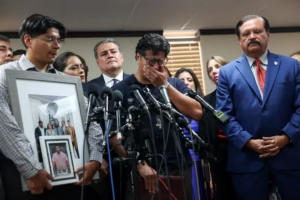
The fatal shooting of a Mexican national by an ICE officer during a Houston traffic stop has triggered multiple investigations, hundreds of protesters in the streets, and a diplomatic rift with Mexico, after the Harris County Medical Examiner ruled the death a homicide. The case has renewed scrutiny of federal immigration enforcement tactics as arrests have surged nationally in recent weeks.
Story Highlights
- Harris County’s Medical Examiner ruled Lorenzo Salgado Araujo’s death a homicide following the ICE shooting
- Witnesses dispute ICE’s account that Salgado Araujo rammed a vehicle and tried to run over an officer
- Mexican President Claudia Sheinbaum announced plans to file criminal complaints against U.S. officials
- DHS confirmed the involved ICE officers were not wearing body-worn cameras during the encounter
What Happened
Lorenzo Salgado Araujo, a 52-year-old Mexican national who had lived in the United States for 35 years and operated a construction business in the Houston area, was fatally shot by a U.S. Immigration and Customs Enforcement officer on July 7 during what the agency described as a targeted enforcement operation. According to ICE, Salgado Araujo rammed an ICE vehicle, refused verbal commands, and attempted to run over an agent with his van, prompting the officer to fire in what the agency called self-defense.
That account has been directly disputed by witnesses. Three men who were detained during the same incident told attorney Hugo Balderas-Ibarra that ICE’s version of events is false, stating that at no point did Salgado Araujo use his van to ram agents or place their lives in danger. Surveillance video obtained by local media shows Salgado Araujo leaving his home before 6 a.m. and his van being pursued by unmarked SUVs shortly before the shooting. A Department of Homeland Security official later acknowledged that Salgado Araujo was not the original target of the operation, which had focused on a different individual believed to be traveling in a similar white van.
The Harris County Medical Examiner’s office subsequently ruled Salgado Araujo’s death a homicide. DHS confirmed that the ICE officers involved were not wearing body-worn cameras during the encounter, attributing the gap to delayed equipment funding caused by prior government shutdowns. Houston city officials, including Mayor John Whitmire, have said they lack jurisdiction to investigate since the shooting involved federal rather than local officers, leaving the matter to the FBI, DHS’s Office of Inspector General, and the Harris County District Attorney’s Office.
Hundreds of protesters marched through Houston’s Magnolia Park neighborhood in the days following the shooting, organized by civil rights groups including FIEL Houston. Salgado Araujo’s family has called for an independent investigation, reforms ending what they described as ambush-style ICE tactics involving unmarked vehicles, and financial support for his widow.
Why It Matters
The shooting marks the first fatal encounter involving federal immigration agents since two American citizens were killed during ICE operations in Minneapolis earlier this year, an incident that had already prompted the administration to scale back the kind of high-profile enforcement surges that characterized operations under former Homeland Security Secretary Kristi Noem. The Houston case raises renewed questions about accountability standards for federal immigration agents operating outside the direct oversight of local law enforcement.
The absence of body-worn cameras during the encounter has become a central point of contention, particularly given the competing accounts of what transpired. Without independent video evidence, investigators are relying heavily on witness testimony and forensic evidence to reconcile the disputed narratives, a gap that civil liberties advocates argue underscores the need for consistent federal accountability standards during enforcement operations.
The diplomatic fallout adds a further dimension, with Mexican officials pursuing both criminal complaints and civil litigation against private companies operating U.S. detention facilities, reflecting broader tension between the two nations as immigration enforcement activity has intensified. Mexican President Claudia Sheinbaum characterized the shooting as part of a larger pattern of mistreatment of Mexican citizens under current enforcement practices.
Economic and Global Context
The shooting occurs amid a broader surge in ICE enforcement activity, with the agency arresting roughly 10,000 people over a five-day period at the end of June, translating to approximately 2,000 arrests daily, a sharp increase compared to earlier in the year when daily arrests averaged closer to 1,200. ICE detention facility populations have similarly climbed, reaching approximately 39,000 in June after hovering around 30,000 monthly since February.
The diplomatic dimension carries implications for U.S.-Mexico relations more broadly, particularly as both governments continue to navigate cross-border economic ties, including trade and labor migration issues, that have periodically been strained by enforcement controversies of this nature.
Salgado Araujo’s family has noted he was in the process of regularizing his immigration status at the time of his death, having begun the application process, a detail that has fueled criticism from immigration advocates who argue enforcement priorities are not always aligned with the administration’s stated focus on removing individuals with serious criminal histories.
Implications
The multiple ongoing investigations, spanning the FBI, DHS’s Inspector General, and Harris County prosecutors, will determine whether any criminal charges are pursued against the officer involved, with District Attorney Sean Teare pledging a thorough review regardless of outcome. The medical examiner’s homicide ruling does not itself establish criminal liability but will likely factor significantly into that determination.
For ICE and DHS leadership, the case adds pressure to accelerate body-worn camera deployment across field offices, an equipment gap the agency has attributed to funding delays but which critics argue reflects broader accountability shortcomings amid the enforcement surge.
For Mexican-American communities and immigration advocates nationally, the case is likely to become a rallying point in ongoing debates over enforcement tactics, particularly regarding the use of unmarked vehicles and operations that increasingly affect individuals who were not the original targets of federal actions.
Sources
