
Story Highlights
- Judge Nichols declined to issue a preliminary injunction blocking Trump’s March 31 executive order, which directs the creation of a national voter eligibility list and gives the U.S. Postal Service unprecedented authority over mail ballot delivery
- Challengers — including the NAACP, the League of United Latin American Citizens, Democratic Party committees, and nearly two dozen states — argued the order was unconstitutional because states and Congress, not the president, hold authority over election rules
- A separate federal case in Boston remains pending, and Nichols explicitly warned that plaintiffs may renew their challenge once agencies begin implementing the order
What Happened
U.S. District Judge Carl Nichols issued his ruling late Wednesday, May 28, denying a request for a preliminary injunction from a coalition of civil rights organizations and Democratic Party entities seeking to halt President Donald Trump‘s executive order on mail-in voting. The order, signed on March 31, directs the Department of Homeland Security to use Social Security Administration data to compile state-by-state lists of citizens eligible to vote in federal elections and gives the U.S. Postal Service sweeping new authority to restrict what election-related mail it will deliver.
Nichols found that while the lawsuit raises legitimate constitutional questions, the plaintiffs could not at this stage demonstrate that they or their members had already suffered concrete harm from the order. In his written ruling, the judge acknowledged that the administration had yet to take meaningful implementation steps. As of the date of the ruling, the Postal Service had not issued a formal public notice beginning the rulemaking process — a deadline that falls at the end of May — and Acting Attorney General Todd Blanche had told a Senate committee only that his department was working with other agencies to ensure the order’s goals were carried out.
Crucially, Nichols signaled that his deference was procedural and temporary rather than a judgment on the merits. “The Court recognizes that the Postal Service may ultimately issue a final rule that directly affects plaintiffs or their members,” he wrote, adding that plaintiffs “may, of course, renew their motions if and when those future actions occur.” That language made clear the door to legal challenge remains wide open once implementation begins in earnest.
The challengers — which include the NAACP, the League of United Latin American Citizens, multiple state attorneys general, and congressional Democratic leaders — had argued that the executive order violated the constitutional separation of powers by asserting presidential authority over election administration, a domain the Constitution assigns to states and Congress. A federal judge in Washington state had previously reached a similar conclusion when blocking earlier Trump election-related orders as applied to Washington and Oregon.
The Trump administration defended the order as a lawful exercise of executive power aimed at ensuring election integrity. Trump has long criticized mail-in voting as a source of fraud, a claim not supported by federal election security officials, and has stated publicly that his goal is to pass the SAVE Act — Safeguard American Voter Eligibility — before November, saying: “We’ll never lose a race.”
Why It Matters
The executive order represents one of the most aggressive attempts by any president to assert direct federal control over election administration in modern American history. The constitutional framework governing elections divides authority deliberately: Article I gives Congress the power to regulate the time, place, and manner of federal elections, while states have historically managed voter registration and ballot logistics. The Trump order challenges both dimensions of that framework simultaneously.
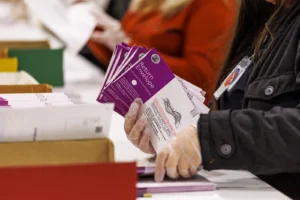
For voters — particularly elderly Americans, military personnel overseas, and those with disabilities who rely on mail ballots — the practical consequences of full implementation could be significant. A Postal Service rule restricting mail ballot delivery could effectively disenfranchise millions who have organized their civic participation around absentee voting. The NAACP and LULAC argued in court that their members face precisely this risk.
For constitutional scholars, the case presents questions that the Supreme Court may ultimately need to resolve. The president’s power to direct executive agencies is broad, but it has limits — particularly when those agencies are asked to override state election laws or override congressional statutes governing election administration. The tension between executive authority and federalism in this case is direct and unresolved.
The timing — with midterm primaries already underway in some states — makes the stakes acute. A court battle that drags into the fall could create operational chaos for election administrators who are trying to plan ballot production, postal logistics, and voter outreach under a cloud of legal uncertainty.
Economic and Global Context
Election integrity infrastructure has tangible costs. The directive to compile a national voter eligibility list using Social Security data would require substantial interagency coordination and IT investment. Security experts have also raised concerns about centralizing sensitive voter data in a federal database, noting that such systems become high-value targets for foreign adversaries seeking to disrupt American elections.
International observers note that the United States’ decentralized election system has historically been viewed as a structural defense against both systemic fraud and large-scale manipulation. Centralizing ballot logistics through the executive branch would represent a departure from that model that some democratic allies have flagged with concern.
From a market perspective, political uncertainty ahead of the midterms creates volatility. Elections that result in divided government can reshape the regulatory and fiscal environment, and any perception that election integrity is contested depresses public confidence in outcomes — a dynamic that has downstream effects on political stability metrics that institutional investors monitor.
Implications
The Postal Service’s rulemaking deadline falls at the end of May, meaning the next legal battle over implementation is imminent. Once USPS publishes a proposed rule, plaintiffs will have grounds to file renewed injunction requests — and Nichols’ own language invites them to do so. The Boston case, which involves a separate set of plaintiffs and a different judge, could produce a conflicting ruling at any time.
For states, the order creates administrative complexity during an already demanding midterm cycle. Secretaries of state who run election operations — including Republicans in states like Georgia and Arizona who have defended decentralized election management — face uncertainty about whether to comply with a federal order whose constitutionality remains unresolved in the courts.
For voters, the outcome of this legal fight will directly shape ballot access before November. The case is likely to reach a federal appellate court, and potentially the Supreme Court, before the election. The high court’s composition and recent rulings on election law will be central factors in how the case is ultimately resolved.
